Jaipur’s Sankranti happens on its roofs. Get onto one, keep the string safe, and the city does the rest.
On Makar Sankranti, Jaipur moves upstairs. From mid-morning the old city’s roofs fill with families, music and stacks of kites, and the sky over the walled city turns into a slow, crowded dogfight of paper and string. You can watch it, but it is much better to join in.
Below: where to watch, where to buy kites, what it costs, the string rules, and how to keep people and birds safe. The 2027 programme was not announced when we checked on 17 November 2026, so we note what happened in January 2026 and flag what to re-check.
Makar Sankranti in Jaipur 2027 at a glance
| What | Details |
|---|---|
| Date | Thursday 14 January 2027 on Rajasthan Tourism’s festival calendar; Drik Panchang lists the Sankranti observance on Friday 15 January. Kites fly on both days. |
| Official event | Rajasthan Tourism’s Kite Festival. In 2026: Jal Mahal ki Pal, Amer Road, 11 am to 2 pm, free entry; lantern release and fireworks against Hawa Mahal from 6:30 pm. |
| Best for flying | Any rooftop in the walled city |
| Kite markets | Handipura, Haldiyon ka Rasta, Tripolia, Kishanpole, Chandpole |
| String rules | Plain cotton thread only; synthetic and glass-coated manjha are banned in Rajasthan |
| No-fly hours (2026) | 6–8 am and 5–7 pm, to protect birds |
| Same week | Jaipur Literature Festival, 14–18 January 2027 |
The 14 versus 15 January question comes up every year. In 2027 the sun enters Makara (Capricorn) at 9:14 pm on 14 January, after sunset, so religious observances move to the 15th. Rajasthan Tourism’s 2024–2030 fairs and festivals list still puts the Kite Festival on 14 January, as it does every year. In practice Jaipur flies on both days, so if you can, plan for two.
Where to watch, from easiest to most local
1. A hotel or haveli rooftop
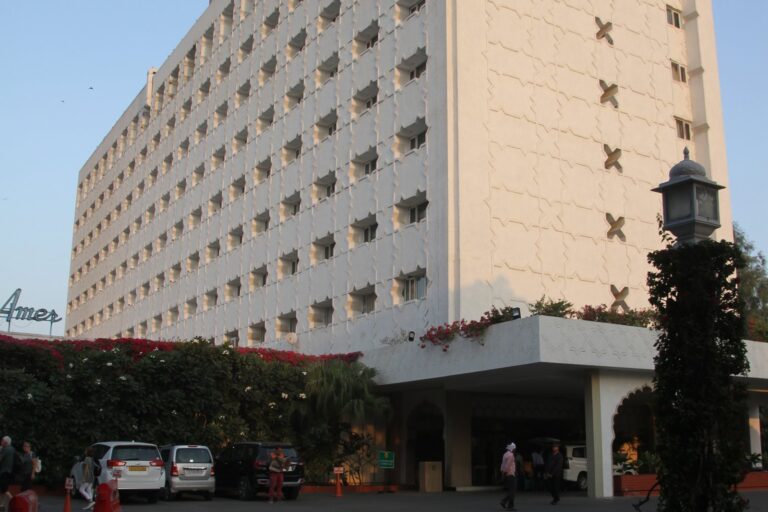
The most comfortable option is a terrace with seating, food and kites provided. Several Jaipur hotels sell Sankranti packages: in January 2026, ETV Bharat reported a hotel on Amer Road charging ₹2,999 per person for 14 and 15 January, covering kite flying, snacks, a lunch buffet and desserts, with fireworks visible from the terrace in the evening. Heritage hotels inside or near the walled city usually have the best views over the old-city roofs.
Before you pay, ask whether kites and cotton string are included, how high the parapet is if you have children, and whether lunch is served. Rooms in Sankranti and literature festival week go early, so book ahead.
2. The official Kite Festival at Jal Mahal
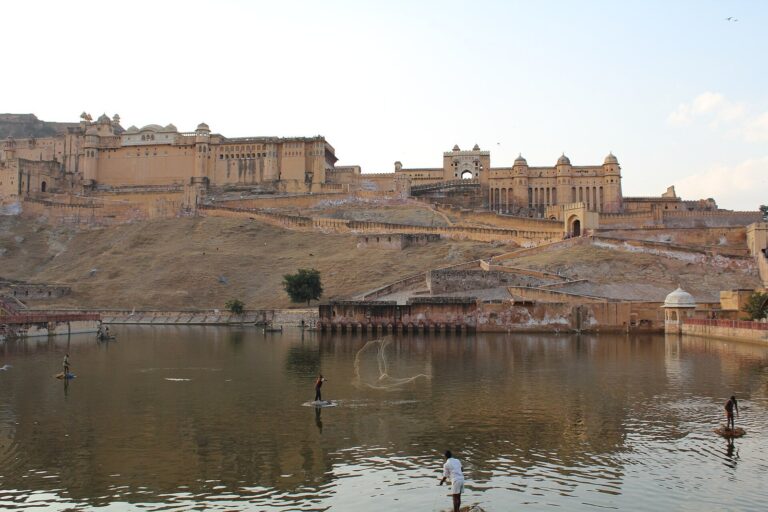
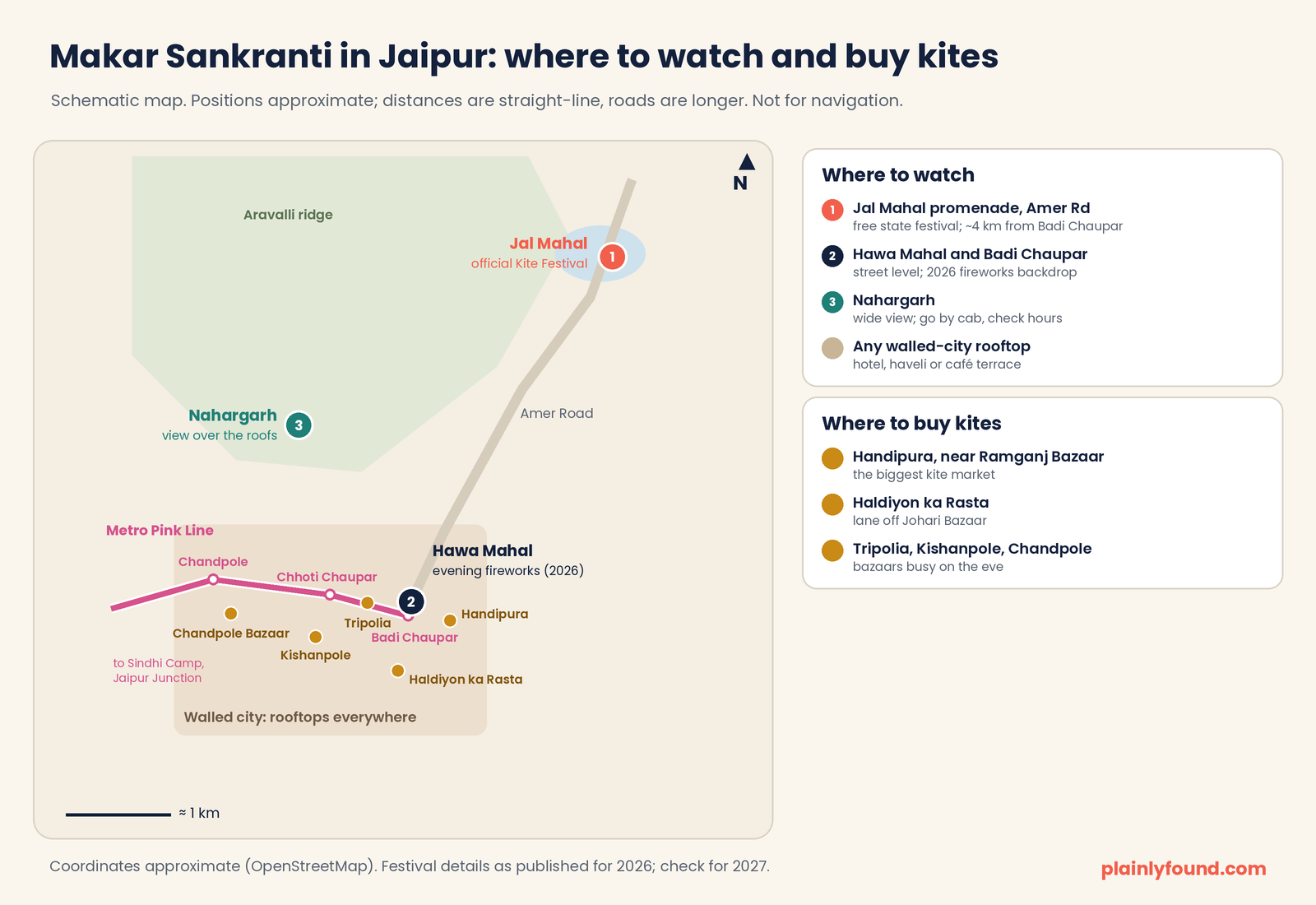
Rajasthan Tourism has run its Kite Festival for more than two decades. In 2026 it was held on the Jal Mahal promenade on Amer Road, about 4 km north of Badi Chaupar. The department announced folk performances, a kite exhibition, live kite-making, fancy-kite demonstrations, free traditional food, free camel-cart rides and free kites for foreign tourists. Entry was free.
The government’s Utsav portal listed the 2026 event as 10 am to 12 pm, while the tourism department quoted 11 am to 2 pm, so arrive by 11 am. It is an easy introduction, but the real flying happens on the roofs. Check Rajasthan Tourism’s social channels or the Utsav portal in early January for the 2027 programme.
3. Street level in the walled city
Walk the bazaars around Badi Chaupar, Hawa Mahal, Johari Bazaar and Chandpole and you are under the busiest part of the sky. Look up, but watch your feet: cut kites drift down into the lanes and children chase them, sometimes with long bamboo poles. Rooftop cafés across from Hawa Mahal fill early on the day, so go mid-morning if you want a table. For a route through these lanes on a quieter day, see our old city walking route.
4. Nahargarh, for the wide view
From the Nahargarh ridge you can see kites over the whole old city at once. Fort hours are usually listed as about 10 am to 5:30 pm; go by cab up the hill road and check the current timing and ticket price before you set out. Our 2-day Jaipur winter plan has more on Nahargarh at sunset.
How to join in
Buy kites a day or two early
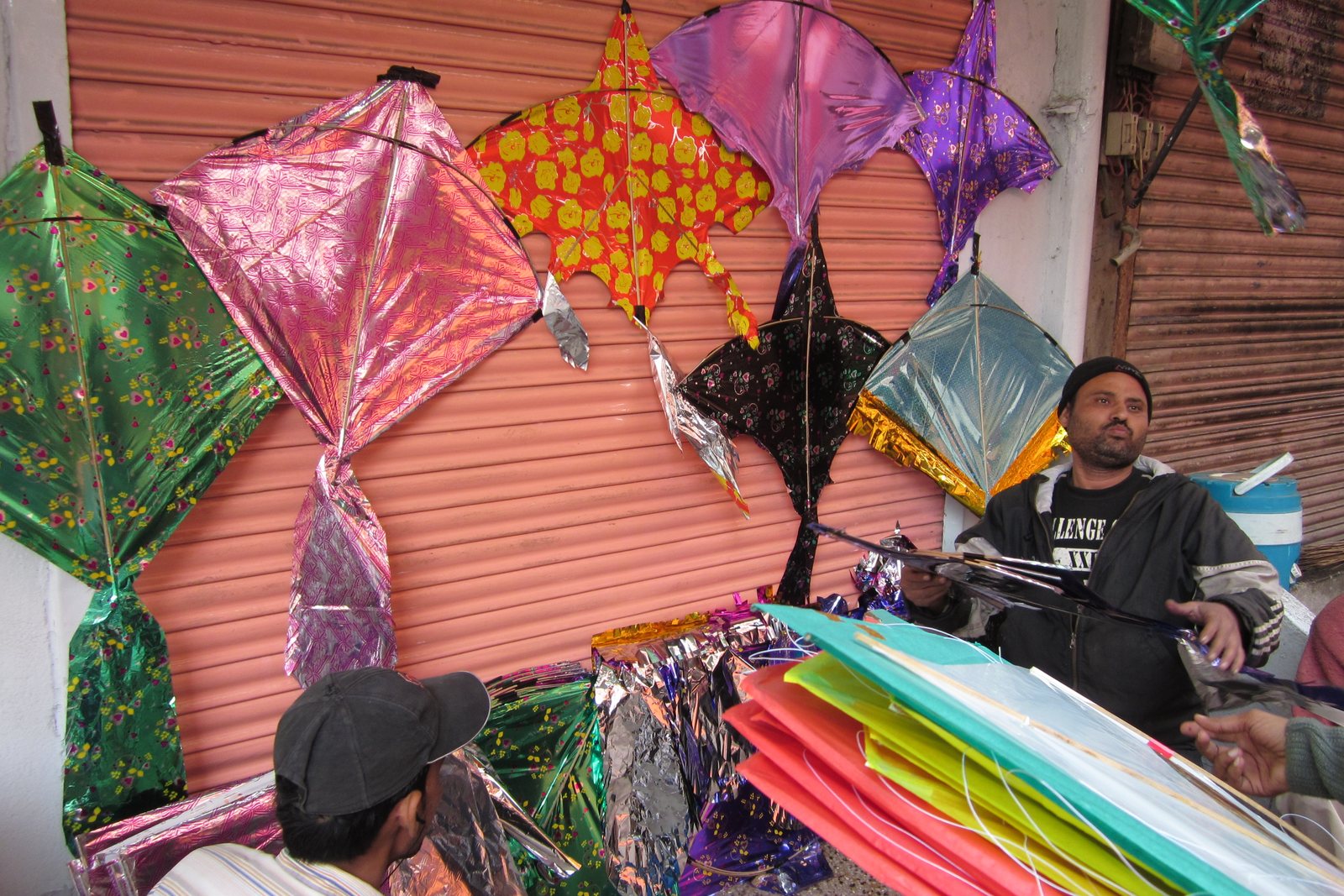
Handipura, near Ramganj Bazaar a short walk from Badi Chaupar, is Jaipur’s biggest kite market, with workshops and wholesalers lining the lanes. Haldiyon ka Rasta off Johari Bazaar, and Tripolia, Kishanpole and Chandpole bazaars also sell kites and string. On the eve of Sankranti in 2026 the Times of India found these lanes virtually blocked with shoppers, so go a day or two earlier and in daylight if you can. Many shops open early and stay open late in the festival week.
What it costs
Prices reported in January 2026, when traders said kites cost 20–30% more than the year before:
| Item | Typical price |
|---|---|
| Small paper or plastic kite | From about ₹5 each; plastic kites ₹5–20 |
| Paper kite | About ₹8–30; special kites up to ₹100 |
| Bundle of 20 small kites | About ₹120 in Handipura (was ₹80) |
| Cotton string, spool | Roughly ₹150–400 |
| Charkhi (reel) | Roughly ₹200 to ₹1,500 |
| Bamboo pole for catching kites | ₹100–300 |
Kite prices are from the Times of India and Khabre Din Raat; string and reel prices are an approximate guide from Jaipur Unveiled. A bundle of kites, a spool or two of cotton string and a simple reel cost a family a few hundred rupees.
Use plain cotton thread only
A Rajasthan government notification of April 2026, issued under the Environment (Protection) Act, bans the manufacture, sale, storage and use of kite string made of nylon, plastic or other synthetic material (‘Chinese manjha’), and of cotton string coated with glass, metal or anything sharp or abrasive. Only plain cotton thread is exempt. In January 2026 the state also ordered district collectors and police to enforce the ban strictly (DIPR Rajasthan press release). Some sellers still keep coated string under the counter; ask for plain cotton (sada dhaga) and walk away from anything sold as extra sharp.
Your first flight
- Ask the seller to tie the bridle (the kanni) for you; most will, and they can show you how to launch.
- Launch with a helper. One person holds the kite a few metres away and lets go as you pull in string with the wind at your back.
- Tape your index finger or wear thin gloves; even cotton string can burn skin when a kite pulls hard.
- Keep within the legal hours. In 2026 kite flying was barred from 6 to 8 am and 5 to 7 pm, so reel in by 5 pm.
A simple plan for the day
- 8–10 am: breakfast, then head into the walled city by metro or auto. Pick up last kites if needed.
- 10:30 am–2 pm: the Jal Mahal festival, or straight onto a rooftop.
- Lunch: on the roof, with hot dal pakodi and something sweet.
- 2–5 pm: peak flying. Stay on one rooftop; the sky gets busier through the afternoon.
- 5–7 pm: string down for the birds. Watch the sunset over the roofs.
- Evening: lanterns and fireworks across the city; in 2026 the official programme ended with fireworks at Hawa Mahal.
What to eat
Sankranti food in Jaipur is built around sesame and jaggery: til ke laddoo and gajak are everywhere in the old-city sweet shops in January. Pheeni, a nest of fine fried threads of dough, is eaten soaked in sweetened hot milk, and plates of hot dal pakodi go up to the roofs all afternoon. For where to eat the rest of the year, see our Jaipur street food guide.
Staying safe: you, children and birds
Sankranti has a real injury count. On 14 January 2026 more than 100 people across Jaipur needed hospital treatment for falls and string cuts, according to the Times of India; SMS Hospital’s trauma centre alone saw 32, including at least 12 children who had fallen from rooftops or been hurt chasing kites.
- On a two-wheeler, wrap a scarf or muffler round your neck, slow down, and consider a thread guard rod on the handlebar; many Jaipur riders fit them before the festival.
- On the roof, do not fly near a low parapet, never walk backwards while flying, and keep children away from edges and from chasing cut kites.
- For birds, respect the 6–8 am and 5–7 pm break, and pull down any string you find tangled in trees, wires or railings and bin it.
- If you find an injured bird, wrap it gently in a clean cloth, do not give it water, and call a rescue line. In 2026 these included the Raksha bird helpline (9828500065), Hope & Beyond’s Nindar Bird House in Vaishali Nagar (8239939929) and Rajasthan Jan Manch Trust’s bird hospital in Malviya Nagar (7230055800), and the animal husbandry department ran treatment camps across the city until 17 January. Check that these numbers are still active closer to the date.
- Watch for local orders. In January 2026 police banned kite flying within 5 km of Mahal Road in Jagatpura during Army Day fly-past rehearsals, including on the afternoon of Sankranti.
Getting there on the day
Leave the car behind; old-city lanes jam in Sankranti week. The Metro Pink Line runs from Mansarovar through Sindhi Camp to Chandpole, Chhoti Chaupar and Badi Chaupar, which put you inside the walled city. For Jal Mahal, take an auto or app cab up Amer Road from Badi Chaupar, and agree the fare or check the in-app price first.
Planning the rest of your trip
The Jaipur Literature Festival opens on 14 January 2027 at Hotel Clarks Amer in south Jaipur, a long way from the walled city, so pick Sankranti or a festival day rather than trying both in one afternoon. January mornings and evenings are cold, so pack layers; our Jaipur in winter plan covers what to bring and what else to see. For block prints and blue pottery while you are in the bazaars, see the Jaipur shopping guide.
FAQ
When is Makar Sankranti in Jaipur in 2027?
Rajasthan Tourism’s festival calendar lists its Kite Festival on Thursday 14 January 2027. Drik Panchang puts the Sankranti observance on Friday 15 January, because the sun enters Makara at 9:14 pm on the 14th. Expect kites over Jaipur on both days.
Where is the official kite festival in Jaipur held?
In 2026 Rajasthan Tourism held it on the Jal Mahal promenade (Jal Mahal ki Pal) on Amer Road, from 11 am to 2 pm, with free entry, followed in the evening by a lantern release and fireworks against Hawa Mahal. The 2027 venue and timings had not been announced by 17 November 2026.
Is manjha banned in Jaipur?
Yes. A Rajasthan government notification of April 2026 bans the manufacture, sale, storage and use of nylon, plastic and other synthetic kite string (‘Chinese manjha’) and of cotton string coated with glass, metal or other sharp material. Plain cotton thread is allowed.
What time can you fly kites in Jaipur on Sankranti?
In January 2026 the state asked districts to bar all kite flying from 6 to 8 am and 5 to 7 pm, when birds are most active. Plan to fly between about 8 am and 5 pm, and check for any fresh local order in early January.
Where can I buy kites in Jaipur?
Handipura, near Ramganj Bazaar and Badi Chaupar, is the biggest kite market. Haldiyon ka Rasta off Johari Bazaar, Tripolia, Kishanpole and Chandpole bazaars also sell kites. Small kites started at about ₹5 each in January 2026.
Bottom line
Plan for 14 and 15 January 2027. Buy kites and plain cotton string in Handipura a day or two early, book a rooftop or find a friend with one, and fly between 8 am and 5 pm. Catch the free Jal Mahal festival if it suits your day, keep children away from parapets, and wrap your neck if you ride.
Sources: Rajasthan Tourism 2024–2030 fairs and festivals list; Drik Panchang (Makar Sankranti 2027); Rajasthan Gazette notification of 20 April 2026 on kite string (via India Code); DIPR Rajasthan press release, 8 January 2026; Patrika, Dainik Navajyoti and the Utsav portal on the 2026 Kite Festival; Times of India (kite markets and injuries, January 2026); Khabre Din Raat and Jaipur Unveiled (prices); ETV Bharat (hotel packages); Patrika and Zee News (bird helplines and camps). Checked 17 November 2026. Map positions from OpenStreetMap. Featured photo: a kite seller in Jaipur on Makar Sankranti, 14 January 2012, by pradeep kumar chatte… (Panoramio), via Wikimedia Commons, licensed CC BY 3.0; cropped.