
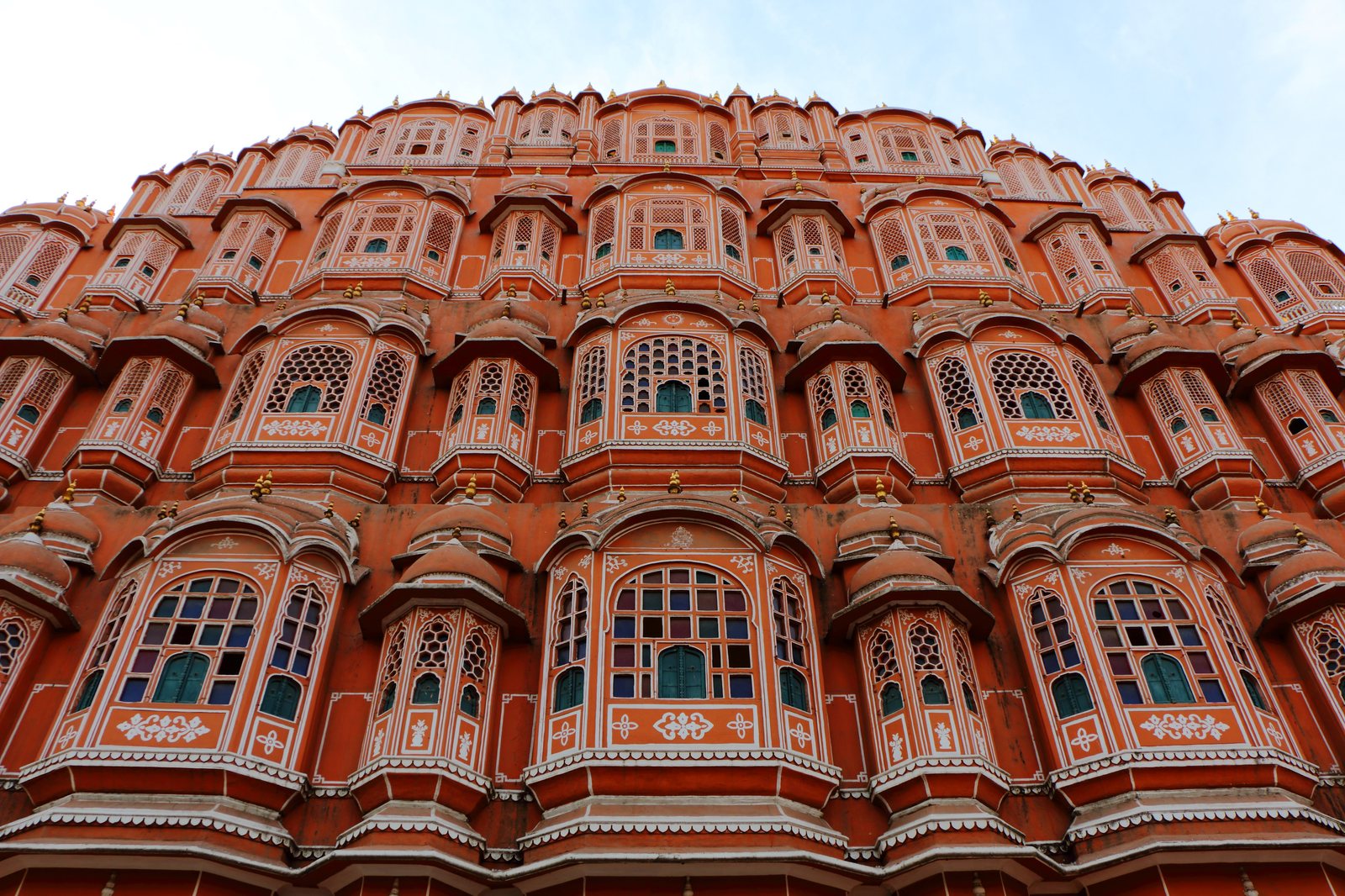
This is a one-day, on-foot route through Jaipur’s walled city: about 6–7 km of walking spread across roughly 12 hours, with the busiest sights placed at opening time and the shopping streets saved for late afternoon.
Most people see Jaipur’s old city from a car window, in a rush between Amber Fort and a shopping stop. That is the tiring way to do it. The walled city was laid out in the 1720s as a grid of wide bazaars and big public squares (chaupars), and that layout is exactly what makes it walkable: the main sights sit within a couple of kilometres of each other, and the streets between them are the point.
The route is built around one idea: crowds and heat both peak at midday. Many day tours head to Amber first, so old city monuments are often calmer right at opening. The plan front-loads the ticketed sights, breaks through the hottest hours, and saves the bazaars for late afternoon, when the streets come alive anyway.
Prices and timings below reflect the state’s 1 January 2026 rate revision and current published schedules. They change, sometimes without notice, so treat them as planning figures and check before you go.
The route at a glance
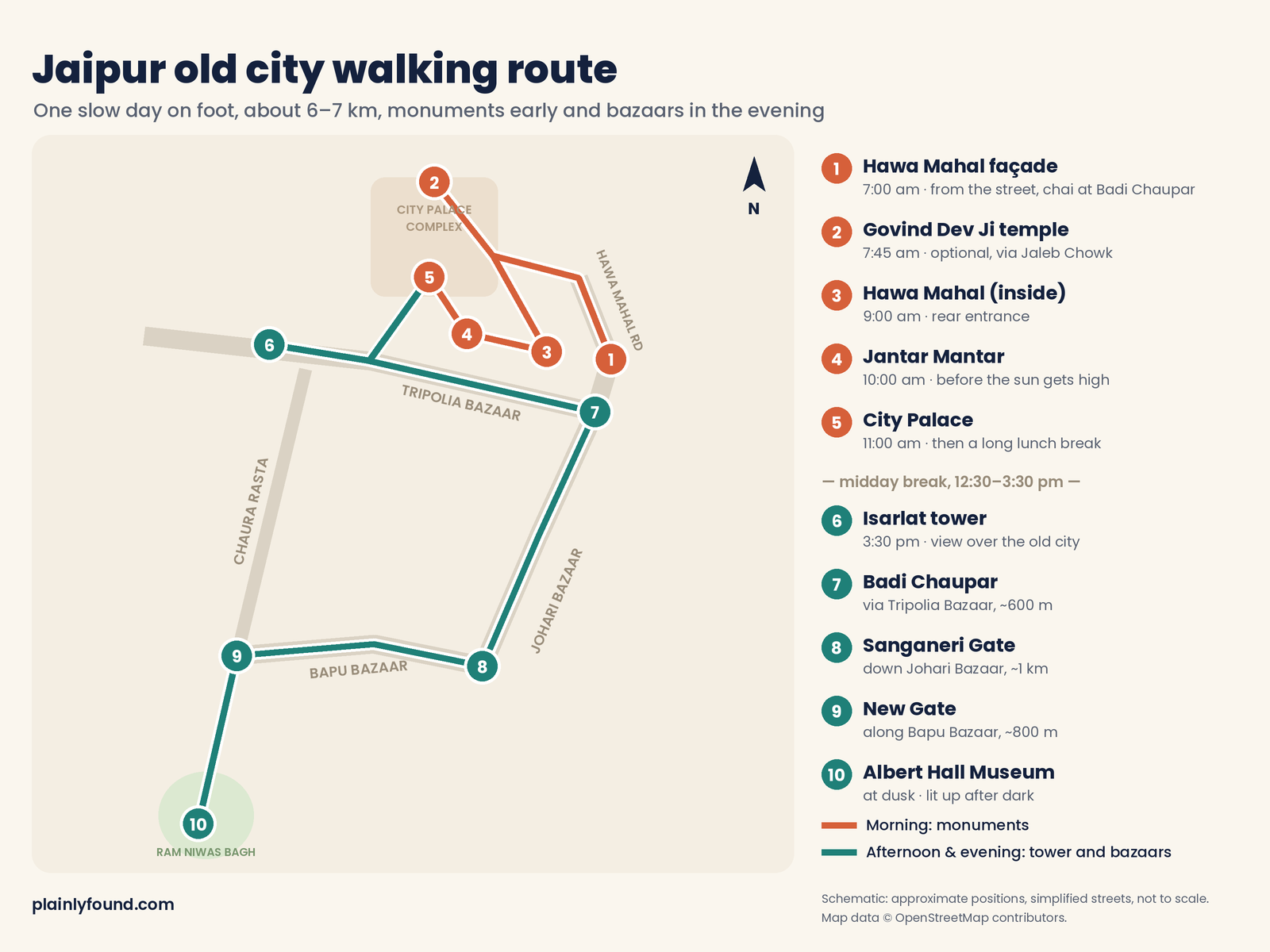
- 7:00 am — Hawa Mahal façade from the street, chai near Badi Chaupar
- 7:45 am — Govind Dev Ji temple (morning darshan), via Jaleb Chowk (~800 m)
- 9:00 am — Inside Hawa Mahal at opening (~500 m)
- 10:00 am — Jantar Mantar, before the sun gets high (~500 m)
- 11:00 am — City Palace, mostly shaded courtyards and galleries (next door)
- 12:30–3:30 pm — Long lunch and rest
- 3:30 pm — Isarlat tower for the view, then Tripolia Bazaar (~500 m from City Palace)
- 4:45 pm — Johari Bazaar south to Sanganeri Gate (~1 km)
- 5:45 pm — Bapu Bazaar to New Gate, then Albert Hall at dusk (~1.3 km)
Distances are approximate. With lunch detours and wandering, expect around 6–7 km for the day, which is easy at a slow pace.
Morning: the monuments, before the rush
7:00 am — Hawa Mahal from the street
Start on the main road (Badi Chaupar to Hawa Mahal road) facing the famous honeycomb front. The façade faces east, so early light falls straight on it, and before the shops roll up their shutters the road is quieter than it will be all day. You do not need a ticket for this view. Rooftop cafés opposite sometimes open early; a chai stall near Badi Chaupar is the reliable option.
7:45 am — Govind Dev Ji temple (optional, free)
Walk north through the Sireh Deorhi gate into Jaleb Chowk and on to the Govind Dev Ji temple, which sits within the City Palace complex. It is a working Krishna temple, and the morning darshan sessions (jhankis) are when it feels most alive. The current schedule lists the Dhoop jhanki at about 7:45–9:00 am (a little earlier on Sundays and Ekadashi); timings change seasonally, so confirm locally. Shoes come off outside, and covered shoulders and knees are expected.
9:00 am — Inside Hawa Mahal
There is no door on the famous front; the ticketed entrance is at the back, reached by a lane off the Tripolia Bazaar side. Opening time is generally listed as 9:00 am. Inside, narrow ramps climb five storeys of small rooms and latticed windows, and by late morning the upper levels can feel jammed. Allow 45 minutes to an hour.
10:00 am — Jantar Mantar
Jantar Mantar is a UNESCO World Heritage Site: an open-air observatory of large masonry instruments built by Sawai Jai Singh II, the city’s founder. It has almost no shade, which is the main reason it comes before noon on this route. The giant Samrat Yantra sundial is the headline; the interpretation centre or a licensed guide makes the rest make sense. Budget about an hour.
11:00 am — City Palace
The City Palace is next door, and its galleries and shaded courtyards suit late morning. It is still partly a royal residence and is run privately, so it is not covered by the government composite ticket and its prices are set separately. 2026 listings put the basic ticket at roughly ₹300–400 for Indian adults and ₹1,000–1,200 for foreign adults; check the palace’s own site. Plan on 1.5–2 hours.
Midday: take the break seriously
Between roughly 12:30 and 3:30 pm, stop: the stone radiates heat and traffic builds. Have a long lunch or head back to your hotel. Johari Bazaar has well-known vegetarian restaurants and sweet shops; if you prefer a proper coffee break in a newer part of town, our shortlist of Jaipur cafes worth the coffee covers places in C Scheme, a short auto ride away.
Carry a refillable water bottle, a cap or scarf, comfortable closed shoes (pavements are uneven), and a small power bank if you navigate by phone — see our guide on choosing a power bank that matches how you use your devices.
Afternoon and evening: towers and bazaars
3:30 pm — Isarlat (Swargasuli) tower
This tall victory tower near Tripolia Gate was built by Sawai Ishwari Singh in 1749, and from the top you get one of the best views over the old city’s grid, rooftops and the Nahargarh ridge. It is a short walk (about 500 m) from the City Palace side. Commonly listed hours end around 4:30 pm, so do not leave it too late. The climb is a narrow internal ramp; skip it if you dislike tight spaces.
4:00 pm — Tripolia Bazaar
Walk east along Tripolia Bazaar back towards Badi Chaupar (roughly 600 m). It is a practical market street of utensils and household goods, and lac bangle workshops cluster in Maniharon ka Rasta, a lane off this stretch.
4:45 pm — Johari Bazaar
From Badi Chaupar, turn south down Johari Bazaar towards Sanganeri Gate, about 1 km. It is known for jewellery, textiles and sweets. Look up as you walk: the uniform pink arcades are the planned city at its most intact.
5:45 pm — Bapu Bazaar, New Gate and Albert Hall
Turn right inside Sanganeri Gate along Bapu Bazaar (textiles, mojaris, block-printed fabric) to New Gate, around 800 m. Just outside, Ram Niwas Bagh holds Albert Hall Museum, about 500 m on. Day galleries generally close at 5:00 pm, but the building is lit after dark and an evening session (currently listed as 7:00–9:30 pm) lets you go in. Masala Chowk, a street-food court in the garden, is an easy dinner to end on.
Tickets: what the day costs
State-run monument rates were roughly doubled from 1 January 2026, the first revision in about a decade, as reported by The Times of India. Current published rates for adults:
- Hawa Mahal, Jantar Mantar, Albert Hall: ₹100 Indian / ₹600 foreign each (Indian students ₹50, foreign students ₹300)
- Isarlat: ₹50 Indian / ₹200 foreign
- Jaipur composite ticket: ₹550 Indian / ₹1,700 foreign (students ₹180 / ₹800), covering Amber, Hawa Mahal, Jantar Mantar, Nahargarh, Albert Hall and several other state sites
- City Palace: separate, privately set price (see above)
Do the maths. For an Indian adult, this route’s four state sites cost about ₹350 individually, less than the ₹550 composite, which only pays off if you add Amber and Nahargarh. For a foreign adult the same four come to about ₹2,000, so the ₹1,700 composite is already cheaper. Check the validity period printed on the composite when you buy. Tickets can be bought at the gates or online through the Rajasthan government’s OBMS booking portal; carry ID, as concessions need proof.
Timing, heat and getting it right
- Season: October to March is the comfortable window. From April to June, daytime heat in Jaipur regularly goes past 40°C. If you visit then, shorten the route, start earlier and make the midday break longer.
- Day of the week: do this on a weekday or Saturday. Rajasthan Tourism notes that Jaipur’s main markets are generally closed on Sundays, which would empty the afternoon half of the route.
- Festivals: monuments may close or change hours on some holidays (Holi/Dhulandi is the usual one), and processions like Gangaur and Teej pass through Tripolia Bazaar, which is wonderful to watch but slow to walk through.
- Dress: light, loose clothing that covers shoulders and knees works for both temples and heat.
Staying safe and unhassled
The old city is busy rather than dangerous. Walk under the arcades, not the carriageway, and watch for scooters. Keep valuables zipped in crowded bazaars. Politely ignore anyone offering a “special” gem shop or claiming a monument is closed today; Jaipur’s well-known gem resale scam starts this way. Hire guides only at ticket counters, and agree auto fares before you get in, or use an app.
If you are packing for a short Jaipur trip, our practical carry-on packing list covers what is actually worth bringing.
FAQ
Can you really walk the Jaipur old city in one day?
Yes. The walled city’s main sights are close together, and this route covers them in about 6–7 km of walking spread across the day. What makes it tiring is the heat, not the distance, which is why the midday break is part of the plan.
What time do Jaipur’s old city monuments open?
Hawa Mahal and Jantar Mantar generally open at 9:00 am and City Palace at 9:30 am. Closing times vary, so check before you go.
Is the composite ticket worth it for this route?
For foreign visitors, usually yes, even for this route alone. For Indian visitors it only pays off if you add Amber Fort and Nahargarh on another day. City Palace is never included.
Is it safe to walk the old city alone?
Generally yes in daytime and early evening. The usual issues are traffic, crowds and touts rather than crime. Stick to main bazaars after dark and keep valuables zipped away.
Bottom line
Jaipur’s old city rewards a slow pace and an early alarm. Façade at 7, ticketed sights from 9 to 12:30, a real break, then the bazaars in golden light, ending at a lit-up Albert Hall. Check prices and timings the day before, avoid Sundays, and the rush mostly happens somewhere else.
Featured photo: “Hawa Mahal. Jaipur, India” by Juan Antonio Segal, via Wikimedia Commons, licensed CC BY 2.0; resized.