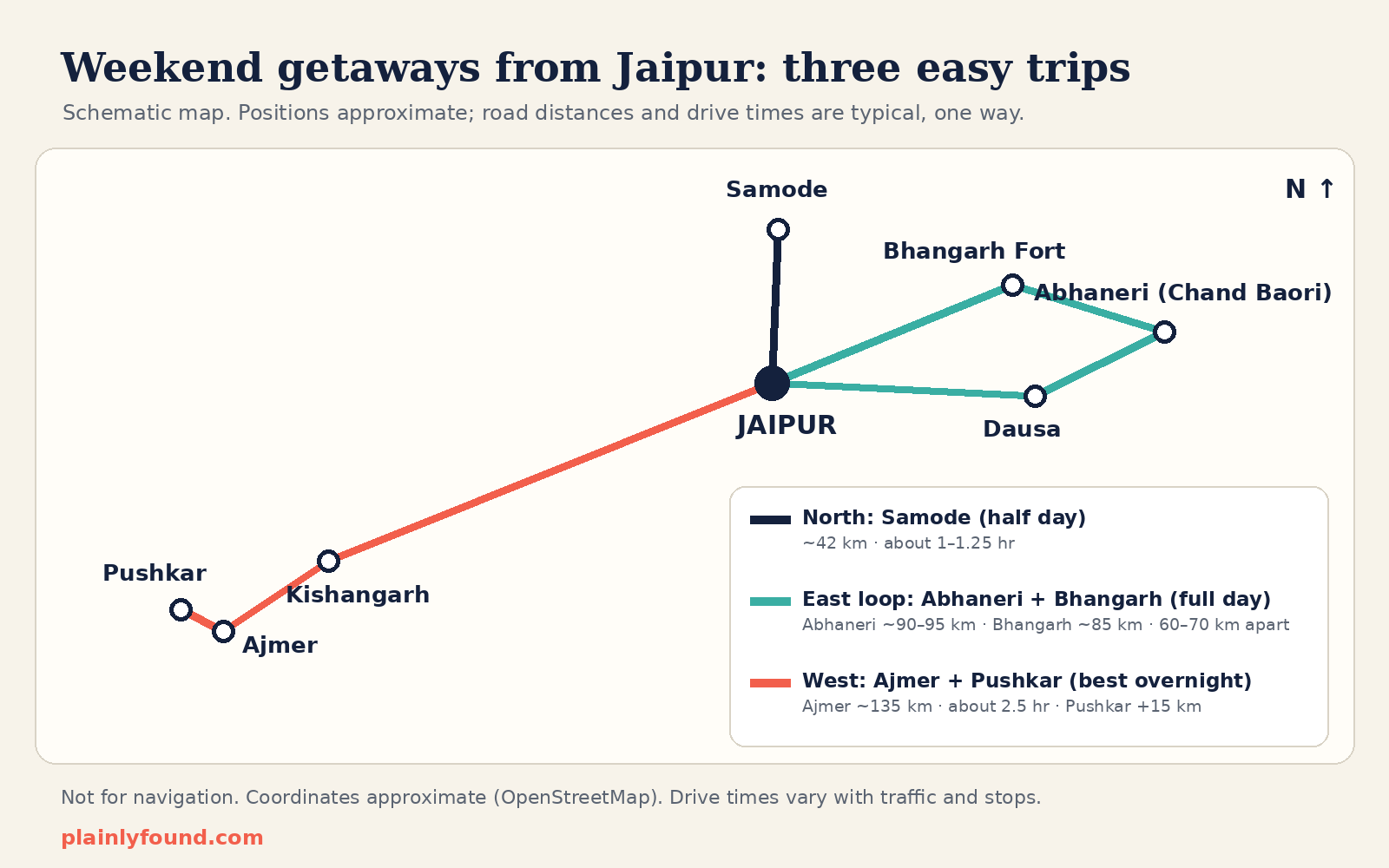
Everything here is within about three hours of Jaipur by road. The eastern pair works as one full day, Samode fits in a morning, and Pushkar with Ajmer is much better with one night away.
Once you have seen Jaipur’s old city, the next question is usually where to go for a day or two without spending most of it in a car. The good news is that some of Rajasthan’s most interesting places sit within about three hours of the city: a thousand-year-old stepwell, an abandoned fort town, a painted palace and a lake town built around temples and ghats.
The common mistake is trying to see them all from one base in one go. They lie in different directions, so the useful way to plan weekend getaways from Jaipur is by direction: one trip east, one trip west, one short trip north. This guide gives you each route with realistic times, rupee costs and the rules that catch people out.
Timings, fees and fares below come from official listings and current 2026 operator quotes. Treat them as planning figures and confirm before you set out.
The options at a glance
| Place | From Jaipur (one way) | Time on site | Best for |
|---|---|---|---|
| Samode | ~42 km, 1–1.25 hr | 2–3 hr | A short palace-and-village escape |
| Abhaneri (Chand Baori) | ~90–95 km, ~2 hr | About 1 hr | Architecture and photography |
| Bhangarh Fort | ~85 km, ~2 hr | 1.5–2 hr | A long walk through ruins in the hills |
| Ajmer | ~135 km, ~2.5 hr | 2–3 hr | The Dargah and Ana Sagar lake |
| Pushkar | ~145–150 km, ~3 hr | Overnight | Lake, ghats, temples, a slower pace |
East: Abhaneri and Bhangarh in one day
These two sit off the Jaipur–Agra road beyond Dausa, roughly 60–70 km apart, so they pair naturally into one loop of around 250 km. Expect 5–6 hours of driving in total and a long but easy day.
Chand Baori, Abhaneri
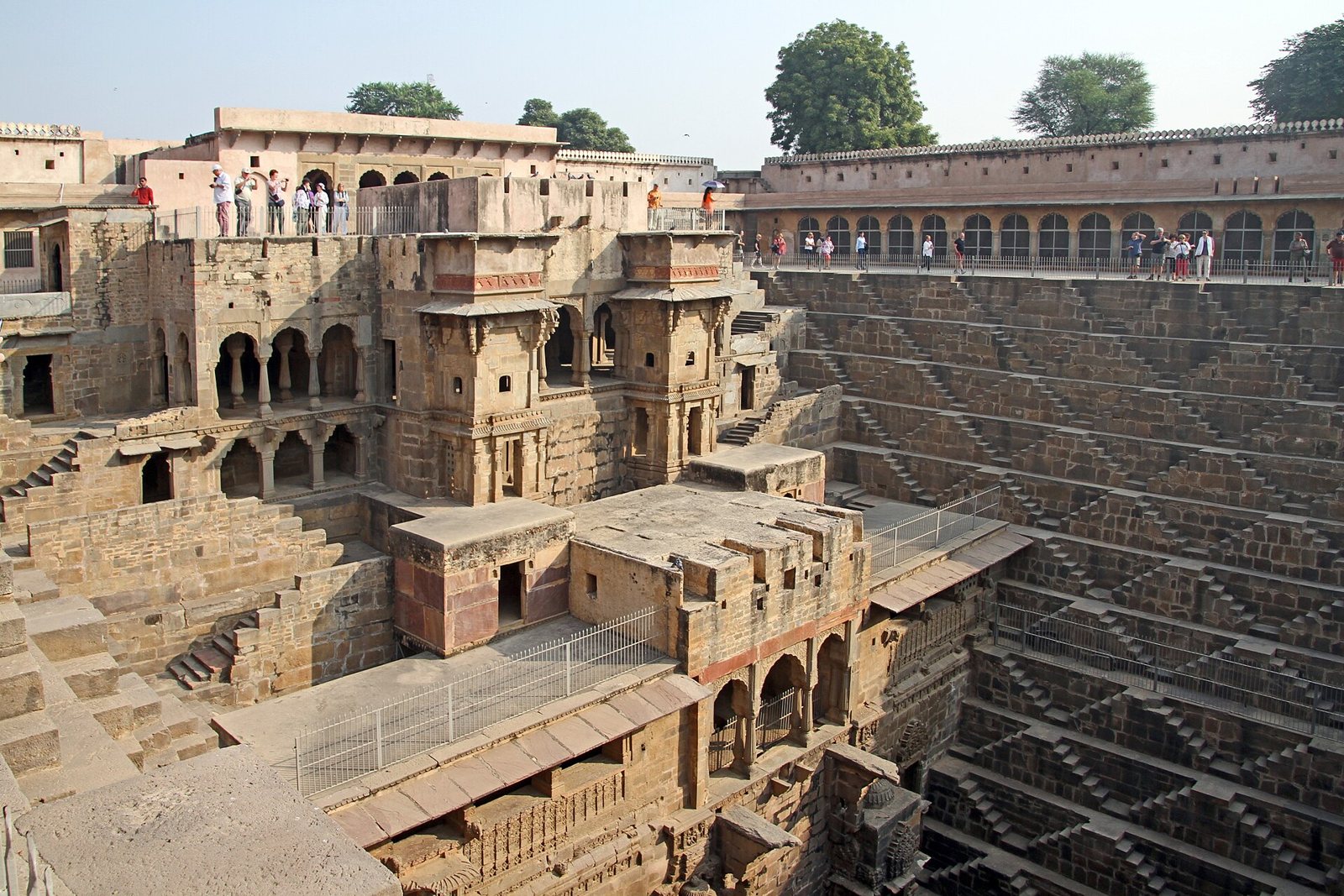
Chand Baori is one of India’s deepest and most photographed stepwells: about 19.5 m deep, with double flights of steps on three sides and a pillared, multi-storey pavilion on the fourth. Rajasthan Tourism dates it to the 9th century and counts about 3,500 steps. The 9th–10th century Harshat Mata temple stands next door and is worth the extra twenty minutes for its carvings.
Set your expectations: you view the well from the galleries around the rim, and the steps themselves are railed off, so don’t plan on walking down. Commonly listed hours are about 7:30 am to 6:30 pm. The ASI Jaipur Circle lists no entry fee, while several recent guides report a small ticket (about ₹20–25 for Indians, ₹250–300 for foreigners), so carry change or UPI either way.
Bhangarh Fort
Bhangarh is a 16th-century fort town in the Aravalli foothills, now a sprawl of ruined bazaars, temples and palace walls. It is famous as “haunted”, but the better reason to go is the walk uphill from the gate, through the old market street to the palace.
It is an ASI-protected monument, and the ASI notice at the gate forbids entry between sunset and sunrise. That rule is enforced, so ignore anyone offering night tours. Opening hours are listed inconsistently (the official Incredible India page says 9 am–5 pm; other listings say about 6 am–6 pm), so plan to be inside between 9 am and 4:30 pm. Entry is about ₹25 for Indians and ₹200–300 for foreigners. Allow 1.5–2 hours and wear proper shoes; the paths are uneven stone.
A sample day
- 7:00 am — Leave Jaipur on the Agra road; breakfast at a highway dhaba near Dausa.
- 9:00 am — Chand Baori and Harshat Mata temple, while the light is soft.
- 10:30 am — Drive to Bhangarh (about 1–1.5 hr).
- 12:00 pm — Walk the fort; eat your packed lunch in the shade.
- 2:30 pm — Head back, reaching Jaipur around 5:00–5:30 pm.
Food options near Bhangarh are thin, so pack snacks and more water than you think you need.
Without a car
Abhaneri is reachable by train or bus to Bandikui, then a short local taxi or auto ride (under 10 km). Bhangarh has no convenient public transport, so for both in one day a hired car is the practical choice.
West: Ajmer and Pushkar (better as an overnight)
Ajmer is about 135 km down NH48, roughly 2.5 hours, and Pushkar is another 15 km over a short hill road. A same-day trip is possible but makes for a 12–14 hour day. Staying one night in Pushkar turns it into a relaxed weekend.
Ajmer Sharif Dargah
The shrine of Khwaja Moinuddin Chishti draws pilgrims of every faith. Cover your head (men and women; a scarf or handkerchief is fine), dress modestly, and leave shoes at the stands outside. A small cloth bag for your shoes helps when crowds are heavy. Incredible India lists the Dargah as open from 5 am to 9 pm in winter and longer in summer. Expect the biggest crowds on Thursdays, Fridays and around the annual Urs, keep valuables close, and politely decline anyone pushing paid “special” access.
Pushkar
Pushkar is a small temple town wrapped around a sacred lake and its ghats. Its Brahma temple is one of very few in India dedicated to Brahma; listed hours are about 6 am–1:30 pm and 3–9 pm, and leather items and phones are restricted inside, so carry less. Pushkar is a vegetarian town and meat and alcohol are not served, so plan meals around that. The lake at sunset is the reason to stay the night: watch it from a ghat, then walk the bazaar after dark. Photographing people bathing on the ghats is not okay, and decline anyone pressing flowers into your hands for a “blessing” that turns into a donation demand.
A simple two-day plan
- Day 1, 7:00 am — Leave Jaipur; Ajmer Dargah by about 9:30–10:00 am.
- 1:00 pm — Lunch in Ajmer, then drive to Pushkar (about 30–40 minutes).
- Evening — Check in, ghats at sunset, bazaar walk.
- Day 2, morning — Brahma temple early, a slow walk around the lake, back in Jaipur by mid-afternoon.
By bus or train
This is the easiest trip to do without a car. Frequent RSRTC buses run from Jaipur’s Sindhi Camp bus stand to Ajmer, and many trains cover Jaipur–Ajmer in around two hours. From Ajmer, local buses and taxis run to Pushkar.
Pushkar Fair 2026
The Rajasthan Tourism festival calendar lists the 2026 Pushkar Fair from 17 to 24 November, with livestock trading usually starting a few days earlier. It is spectacular, but rooms get scarce and expensive. Book early if you want the fair; avoid those dates if you want a quiet weekend.
North: Samode for a half day
Samode is about 42 km from Jaipur, roughly an hour away. Samode Palace is now a private heritage hotel known for its painted Durbar Hall and mirrored Sheesh Mahal. Because it is a hotel and not a public monument, day visits are at the management’s discretion: reported fees range from about ₹500 to ₹1,000 a person (sometimes adjustable against food), and entry can be refused when the hotel is full or hosting a wedding. Call ahead. Even without the interiors, the village and façade make a pleasant outing.
What each trip costs
Most people hire a car with a driver. Current 2026 quotes from Jaipur operators look like this for a sedan; SUVs cost roughly 40–60% more.
- Samode half day: about ₹1,500–2,500 for the car, plus any palace visit fee.
- Abhaneri + Bhangarh: about ₹3,000–4,000 for the car, plus small entry fees.
- Ajmer + Pushkar: about ₹3,200–4,500 round trip. Ask whether tolls are included: the two NH48 plazas come to roughly ₹170 each way for a car. For an overnight, add a driver allowance (often a few hundred rupees a night; confirm when booking).
- Bus or train to Ajmer: a few hundred rupees per person each way, depending on class.
Before you pay, confirm in writing what is included: tolls, parking, driver allowance, waiting time and the kilometre cap.
Timing and packing
- Season: October to March is comfortable. From April to June, daytime heat regularly passes 40°C, so start at dawn and finish by early afternoon.
- Crowds: Ajmer and Pushkar fill up on Fridays, weekends and holidays. Chand Baori is calmest early in the morning.
- Carry: water, snacks, sunscreen, a cap, a scarf for the Dargah, comfortable shoes that slip off easily, small cash, and a charged power bank.
- Dress: clothes that cover shoulders and knees work for every stop on these routes.
- Too far for this list: Ranthambore and Agra take well over three hours each way; give them their own trip.
For an overnight in Pushkar, a small bag is enough; our guide to choosing a carry-on backpack for a 3-day trip and the practical carry-on packing list cover what to bring. If you still have a day in the city, try our slow walking route through Jaipur’s old city.
FAQ
Can I see Abhaneri and Bhangarh in one day from Jaipur?
Yes. Leave by 7 am, see Chand Baori first, then Bhangarh around midday, and you are back in Jaipur by early evening. Plan on 5–6 hours of driving in total.
Is Pushkar a day trip or an overnight from Jaipur?
It can be done in a long day with Ajmer, but one night in Pushkar is far more relaxed and lets you see the lake at sunset.
Can you visit Bhangarh Fort at night?
No. The ASI prohibits entry between sunset and sunrise, and the rule is enforced. Plan to be inside the fort between about 9 am and 4:30 pm.
How much does a taxi from Jaipur to Pushkar cost?
Current quotes for a sedan round trip covering Ajmer and Pushkar are roughly ₹3,200–4,500, with tolls of about ₹170 each way sometimes extra. Overnight trips add a driver allowance.
What is the best time for weekend getaways from Jaipur?
October to March, with early starts. Avoid Pushkar Fair dates (17–24 November in 2026) unless you are going for the fair.
Bottom line
Choose one direction per trip. For a single free day, do Abhaneri and Bhangarh. For a full weekend, do Ajmer with a night in Pushkar. For a free morning, go to Samode. Start early, check fees and hours the day before, and confirm what your driver’s fare includes.
Featured photo: Chand Baori, Abhaneri, by Gerd Eichmann, via Wikimedia Commons, licensed CC BY-SA 4.0; resized.