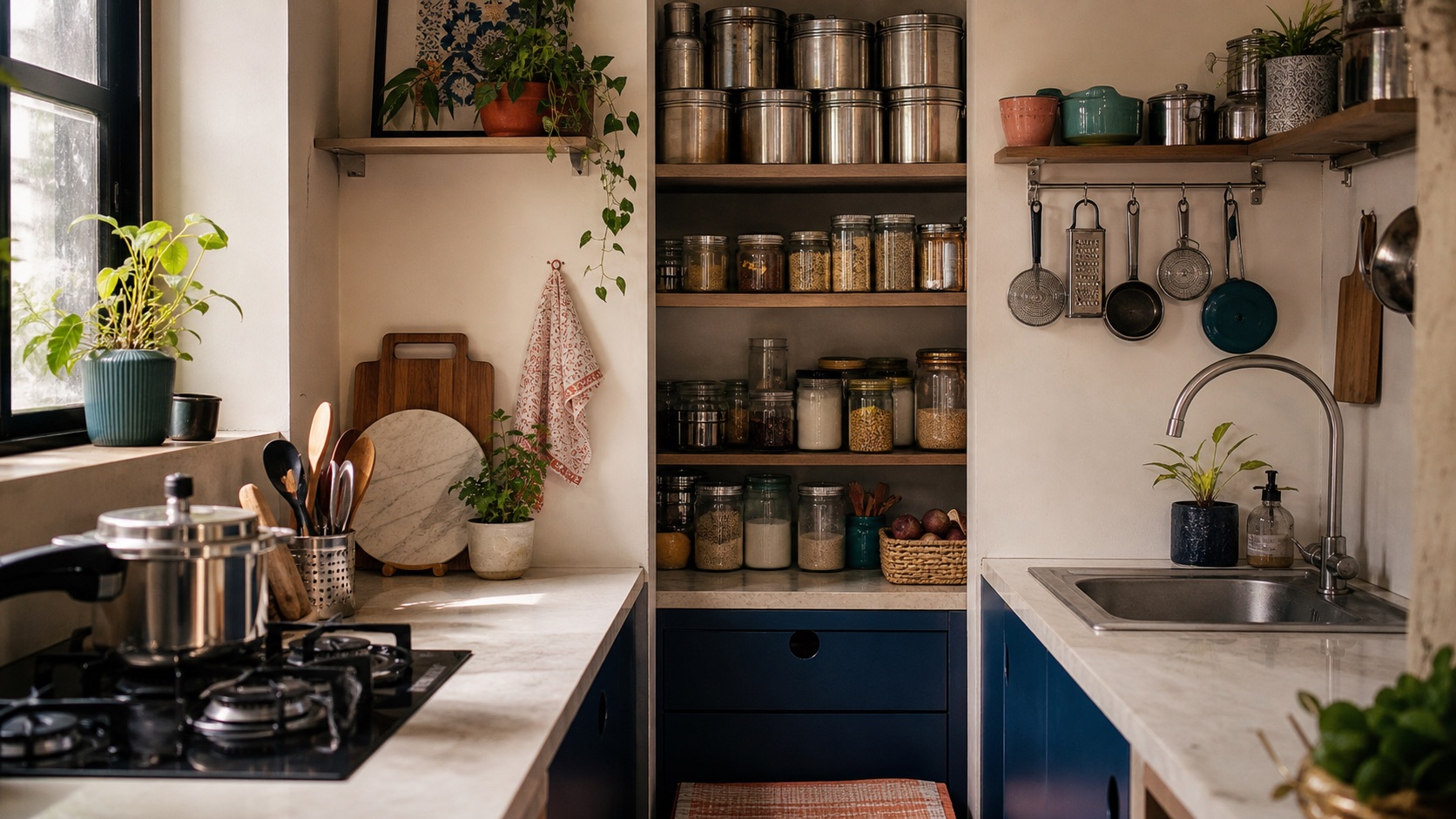
A small kitchen does not always have a storage problem. Often, it has a visibility problem: everyday tools are buried behind rarely used appliances, five open packets occupy the same shelf and the things needed for one task live in four different places.
Before buying racks, jars or drawer organisers, reset the kitchen around how you actually cook. The goal is not an empty, showroom-perfect counter. It is a kitchen where breakfast, chai and dinner take fewer movements.
Start with a no-shopping reset
Choose one cabinet or one stretch of counter—not the entire kitchen. Empty it, wipe it and sort every item into four groups:
Daily: used almost every day.
Weekly: used often, but not constantly.
Occasional: festival cookware, baking tools and serving pieces.
Leave the kitchen: duplicates, broken pieces and appliances you do not use.
Put the daily group back first. That simple order stops occasional items from taking the easiest shelves.
Create zones around real tasks
Organise by activity, not by how a shop displays products. A small Indian kitchen usually benefits from these zones:
Chai and breakfast zone
Keep tea, coffee, sugar, mugs, a small saucepan and the everyday strainer near the kettle or hob. If breakfast includes poha, oats or cereal, place those nearby too.
Everyday cooking zone
Place the kadai, tawa, pressure cooker and most-used spoons close to the hob. Store oil and the daily masala box within easy reach but away from direct heat.
Preparation zone
Keep knives, peelers, cutting boards, mixing bowls and the colander near the clearest piece of counter. This is where vegetables should arrive, be washed and get prepared.
Cleaning zone
Dish soap, scrubbers, cleaning cloths and waste bags belong near the sink. Keep only the current supplies here; bulk refills can live elsewhere.
Use the easiest space for the most-used items
The area between knee and eye level is premium space. Give it to daily plates, glasses, masalas and cookware. Heavy appliances should sit low enough to lift safely. Occasional and lightweight objects can go on higher shelves.
Do not put the mixer grinder on top of a cabinet if that makes using it a project. An appliance that is hard to reach often becomes an appliance you stop using.
Fix packets before buying containers
Packets create visual clutter because they slump, hide behind one another and are difficult to stack. But transferring every ingredient into a matching jar can be expensive and waste space.
Begin with the ingredients you use frequently or buy in large quantities: atta, rice, the main dals, sugar and everyday snacks. Give those dependable containers. Group smaller refill packets upright in an existing basket, tray or cardboard box. Label the front so nothing disappears at the back.
Do not decant an ingredient unless the container closes properly and you can preserve any cooking or expiry information you need.
Reduce duplicates by choosing a working set
Most homes need more than one kadai or saucepan, but not every inherited, gifted or promotional piece needs daily cabinet space. Choose the best working set and move the rest to occasional storage.
A practical starting set might include:
one everyday pressure cooker;
one tawa;
one medium kadai;
one small and one medium saucepan;
one good knife and one small utility knife;
enough plates, bowls, glasses and cutlery for the household plus a few guests.
Keep what genuinely earns its space. “Maybe someday” is not a daily-use category.
Use doors and walls carefully
Hooks can help with lightweight strainers, measuring spoons and cloths, but avoid turning every wall into storage. Anything near the hob will collect grease. Anything mounted on a cabinet door must not prevent the door from closing or overload the hinges.
Use vertical solutions only where they remove a real obstruction. A rail that clears the preparation counter is useful; a decorative rack that holds rarely used tools is just clutter at eye level.
Keep the counter deliberately incomplete
A functional counter can hold the tools you use every day. It should also leave one uninterrupted working area. If the water filter, microwave and appliances consume every surface, decide which movable appliance is used least and give it a nearby cabinet home.
A tray can visually group oil, salt and daily seasonings, but it does not make unnecessary items necessary. Edit first; contain second.
Only then decide what storage to buy
Live with the reset for one week. Notice the repeated problems. Buy an organiser only when you can complete this sentence: “I need this to store these specific items in this measured space.”
Before ordering, measure width, depth and height—including hinges, pipes and door clearance. A perfect-looking shelf that blocks plumbing or prevents a cabinet door from closing is not an upgrade.
A 30-minute maintenance rhythm
Once a week, return misplaced tools to their zones, combine duplicate refill packets, wipe the highest-use shelf and check what needs to be used soon. Once a month, review one cabinet. Small resets are easier to sustain than a dramatic annual reorganisation.
A small kitchen works when its layout follows your cooking, not an internet photograph. Use what you already own, give the best space to the tasks you repeat and purchase storage only after the remaining problem is specific and measurable.
A mixer grinder can be the most-used appliance in an Indian kitchen—or an expensive machine that is too noisy, too bulky and frustrating to clean. The difference is rarely the number printed on the box. It comes down to what you grind, how much you make, whether the jars suit those jobs and whether service is available when a coupler or gasket eventually wears out.
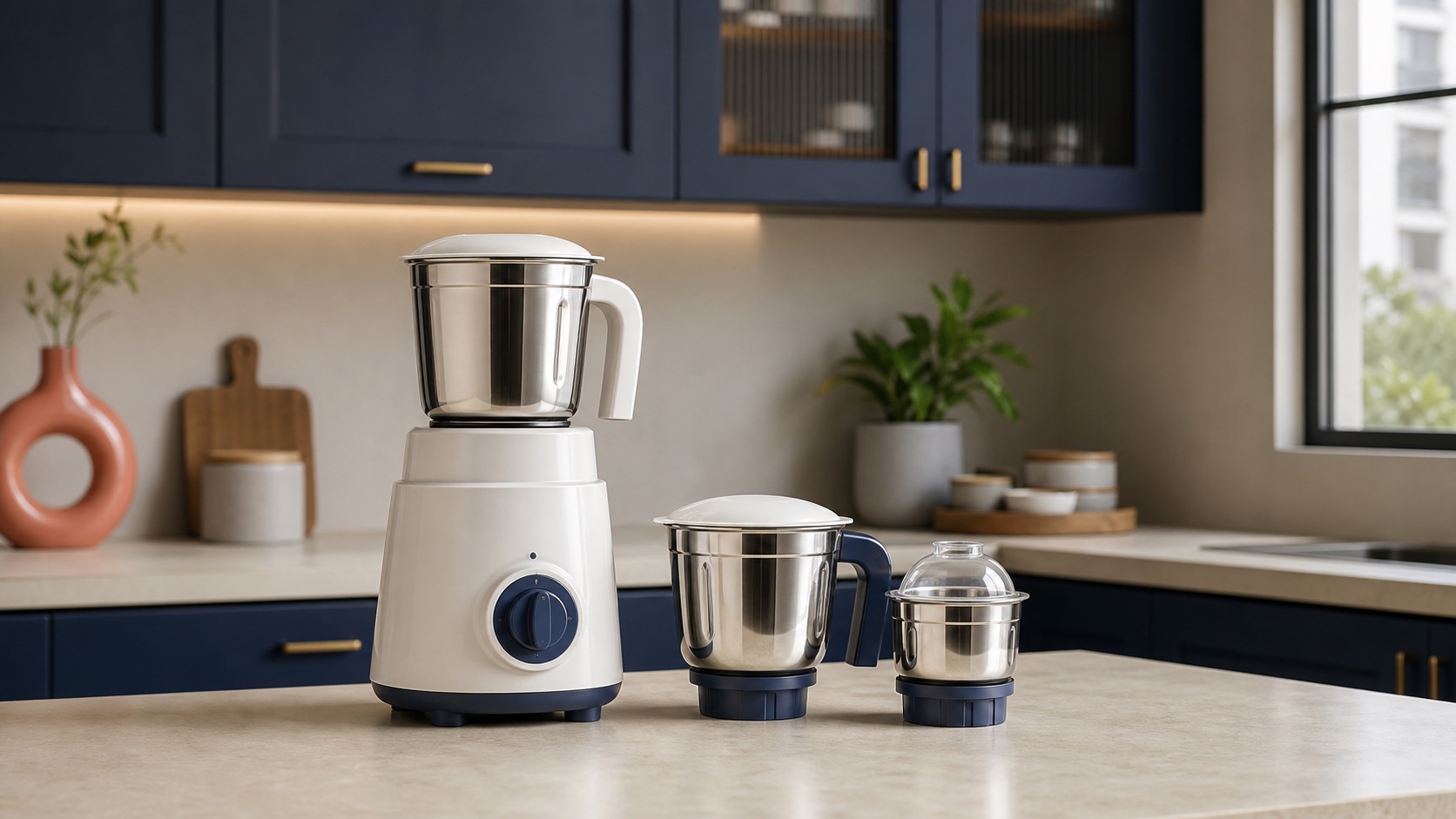
For most small households, a reliable 750-watt mixer grinder with three genuinely useful jars is the sensible middle ground. A lower-powered model can be enough for light blending; a more powerful one may help with frequent, heavy grinding. Neither is automatically “better.”
The short buying checklist
Match the motor to the work: occasional chutney and shakes need less than frequent dosa batter, coconut and masala grinding.
Choose jars by useful capacity: a small chutney jar, a medium dry/wet jar and a larger liquidising jar cover most homes.
Look for overload protection: it helps protect the motor when the jar is overfilled or the mixture is too thick.
Check local service and spare parts: jars, blades, gaskets and couplers matter more after year two than an extra accessory on day one.
Buy for your counter: measure height, base width and cable reach before ordering.
How much power do you actually need?
Wattage describes electrical input, not the complete quality of the appliance. Blade design, motor build, jar shape and how you load it all affect real performance. Treat wattage as a useful filter, not a score.
Around 500 watts can suit a one- or two-person home that mainly makes smoothies, chutneys, soft pastes and small quantities of dry masala. It may need shorter batches and more pauses with tougher ingredients.
Around 750 watts is the practical all-round range for many Indian homes. It usually gives you more headroom for soaked dal, coconut, ginger-garlic paste and routine dry grinding without moving into an unnecessarily large appliance.
900 watts and above makes sense when heavy grinding is frequent, quantities are larger or the manufacturer has paired that motor with robust jars and blades. More power can also mean more noise, weight and cost. Do not pay for it unless your cooking requires it.
The jars matter more than the accessory count
A “five-jar” package is not automatically more useful than a well-designed three-jar set. Think in jobs:
Small chutney jar: important for small quantities of chutney, spice and ginger-garlic paste. A jar that is too wide can leave ingredients below the blade.
Medium grinding jar: the everyday jar for wet masala, coconut, soaked lentils and medium batches.
Large liquidising jar: useful for lassi, shakes, soups and larger wet mixtures. Check the working capacity, not only the total volume.
Juicer attachments, food-processing bowls and special blades can be worthwhile, but only if they replace another appliance you would otherwise buy. Every extra part needs storage and cleaning.
Features worth paying for
Overload protection
Thick batter, too little liquid or an overfilled jar can strain the motor. A resettable overload protector is a useful safeguard. It does not make overloading harmless; you still need to follow the manufacturer’s batch limits and rest times.
Stable feet and a secure jar lock
The base should not walk across the counter during grinding. Firm rubber feet, a stable jar seating and a lid you can hold safely matter more than decorative finishes.
Pulse control
A pulse setting gives better control for coarse masala, chopped nuts and mixtures you do not want to turn into a smooth paste. Three speeds plus pulse is enough for most kitchens.
Replaceable wear parts
Gaskets, blades and couplers wear before the motor in many machines. Before buying, search the brand’s official service network and check whether replacement jars and common parts are sold in India.
What you can safely ignore
Huge accessory counts: they create value only when you will use them.
“Silent” language: mixer grinders are noisy. Compare credible noise information where available, but expect sound during hard grinding.
Looks alone: a beautiful appliance that cannot grind a small chutney batch is still the wrong appliance.
Peak performance claims without context: continuous run time, jar limits and rest intervals matter too.
Questions to answer before you buy
How many people do you cook for?
Do you regularly grind coconut, dosa batter or hard spices?
What is the smallest quantity you need the chutney jar to handle?
Will the appliance stay on the counter or be lifted from a cabinet?
Is authorised service available in your city?
Can you buy a replacement jar, lid, gasket and coupler?
Our practical recommendation
Do not start with a brand name. Start with your hardest weekly task. For a typical two- to four-person home that makes chutney, masala, shakes and occasional batter, shortlist dependable 750-watt models with three stainless-steel jars, overload protection, stable feet and service nearby.
If your needs are lighter, save the money and counter space with a simpler machine. If heavy wet grinding is central to your cooking, compare a higher-powered mixer grinder with a dedicated wet grinder before assuming one appliance should do everything.
The best mixer grinder is not the model with the loudest specification sheet. It is the one whose jar sizes match your food, whose parts you can replace and whose routine cleaning you will not resent.
Open almost any Indian kitchen cabinet and you will find all three: steel dabbas, glass boxes and plastic containers. The difficult part is not deciding which material is “best.” It is knowing which one suits the food, the appliance and the way you actually use your kitchen.
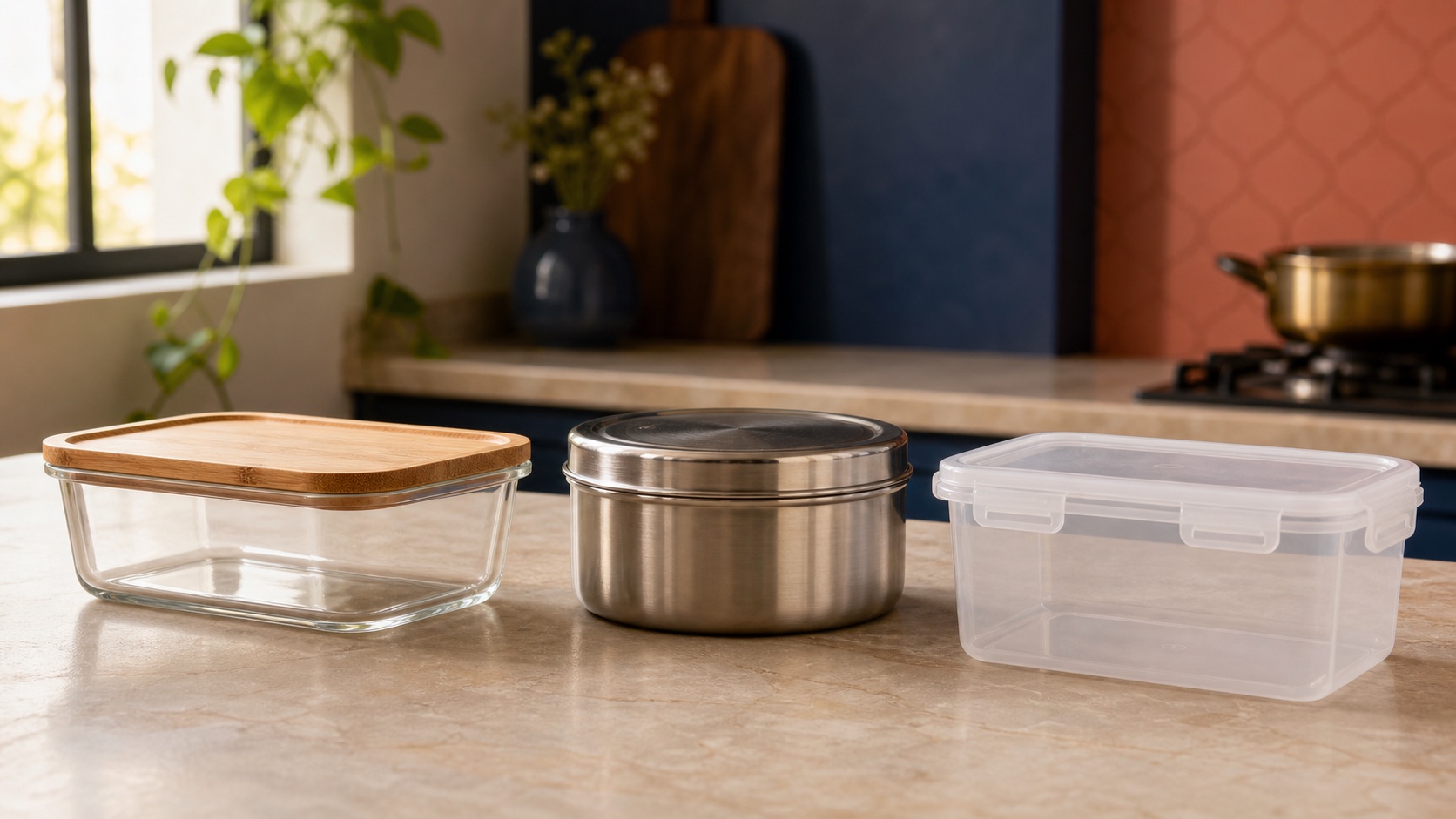
For most homes, the practical answer is a small mixed set: steel for durable dry storage, glass for leftovers that may be reheated, and lightweight food-grade plastic for a few specific jobs. You do not need to replace everything with one material.
The quick answer
Choose stainless steel for atta, rice, dal, spices, snacks and other dry ingredients when durability matters more than visibility.
Choose glass for curries, dals, chutneys and leftovers—especially when you want to see the contents or reheat them in a microwave.
Choose food-grade plastic when low weight, lower cost and easy transport matter, but use it only as labelled and do not heat food in an unlabelled container.
If you want one default for cooked leftovers, glass is the most versatile. If you want one default for pantry staples, stainless steel is usually the most durable.
Glass vs steel vs plastic at a glance
What matters
Glass
Stainless steel
Food-grade plastic
Best use
Cooked food and leftovers
Dry pantry staples
Lightweight storage and transport
Microwave
Only when labelled microwave-safe
No
Only when labelled microwave-safe
Freezer
Only when labelled freezer-safe; leave expansion room
Usually suitable for storage, but not transparent
Only when labelled freezer-safe
Weight
Heavy
Medium to light
Light
Breakage
Can chip or shatter
Very durable
Can scratch, warp or crack
Odour and stains
Resists both well
Resists both well
May retain turmeric stains and strong smells
Visibility
Excellent
Poor unless labelled
Usually good
Typical drawback
Heavy and breakable
Cannot be microwaved
Shorter useful life
When glass is the better choice
Glass works especially well for cooked food. It does not hide what is inside, so yesterday’s dal is less likely to be forgotten at the back of the fridge. It also resists the orange stains and lingering smells that tomato gravies, turmeric, garlic and pickle oil can leave on plastic.
The main advantage is convenience: a container that is specifically labelled microwave-safe can move from the refrigerator to reheating without transferring the food. Check the manufacturer’s instructions first. A normal-looking glass bowl is not automatically safe for a microwave, freezer or oven.
Glass has real disadvantages. A full container is heavy, slippery when wet and risky on a high shelf. Sudden temperature changes may also damage unsuitable glass. Do not pour very hot food into cold glass or move a frozen container directly into high heat unless the manufacturer explicitly permits it. Replace a container that is chipped or cracked.
Glass is best for: cooked dal, sabzi, curry, chutney, cut fruit, meal-prep portions and foods that may be reheated.
When stainless steel is the better choice
Stainless-steel containers are the workhorses of an Indian pantry. They are difficult to break, stack neatly and can last for years. Good-quality stainless steel also resists smells and stains, making it useful for atta, rice, pulses, poha, sugar, tea, coffee and masalas.
Steel is also useful when you want a lighter lunch box without relying on plastic. The trade-off is that you cannot see the contents. Labels—or a consistent shelf system—prevent you from opening five dabbas to find the moong dal.
The biggest limitation is simple: do not put stainless steel in a microwave. If your routine involves frequent reheating, steel creates an extra transfer and another dish to wash. A loose-fitting lid can also make even a sturdy dabba unsuitable for liquids, so check the seal before carrying curry or dal.
Steel is best for: dry staples, spices, snacks, tea and coffee, durable lunch boxes and households that prioritise longevity.
When plastic still makes sense
Plastic is not automatically unsafe, and “plastic-free” is not a requirement for a sensible kitchen. The important distinctions are whether a container is intended for food contact and whether it is suitable for the exact use—cold storage, freezing or microwave heating.
FSSAI’s packaging rules require materials that come into direct contact with food to be food-grade and suitable for the product and the expected storage, mechanical and thermal conditions. That does not mean every takeaway tub or grocery package should become a permanent storage box.
Use a proper food-storage container with clear care instructions. If it is not labelled microwave-safe, do not heat food in it. USDA guidance likewise says to use only cookware manufactured or labelled for microwave use and warns against reheating in cold-storage tubs such as margarine or yoghurt containers.
Discard plastic containers that are cracked, badly scratched, warped or no longer seal properly. Do not reuse single-use takeaway packaging as if it were durable cookware. For hot, oily or strongly coloured foods, glass or steel is often easier to maintain.
Plastic is best for: lightweight snacks, short trips, children’s dry food, high shelves and situations where breakage is a bigger risk than staining.
A sensible starter set for a small Indian kitchen
Do not buy a 30-piece matching set before learning what you cook. A compact starter combination is more useful:
Three or four medium glass containers for cooked leftovers.
Two small glass containers for chutneys, chopped ingredients or single portions.
Four to six stainless-steel containers for rice, atta, dal, sugar and frequently used pantry staples.
Two or three small, clearly labelled food-grade plastic boxes for lightweight or travel use.
Buy individual replacement lids when the brand offers them. A perfectly good container should not become waste because one seal has failed.
Five buying checks that matter more than the material
Check the intended use. Look for explicit food-contact, microwave-safe, freezer-safe or dishwasher-safe labelling instead of assuming.
Test the lid. “Airtight” and “leakproof” are not the same. If you carry liquids, look for a gasket and secure clips.
Measure your shelves. Wide, shallow boxes can waste more space than they save. Square and rectangular containers usually stack more efficiently.
Choose useful sizes. A container should be close to the portion you normally store; too much empty space makes the fridge harder to organise.
Prefer replaceable parts. Lids and silicone gaskets fail before the main container. Replacement availability extends the life of the set.
What should you choose?
Choose based on the job, not on a blanket claim that one material is always best:
If you microwave leftovers often, start with a few labelled microwave-safe glass containers.
If you buy pantry staples in bulk, invest in sturdy stainless-steel dabbas and label them.
If weight and breakage are your biggest concerns, keep a limited number of quality food-grade plastic containers and follow their use instructions.
The most practical kitchen is not all glass, all steel or all plastic. It is one where every box has a clear purpose—and where you own only as many as you can actually stack, clean and use.
Setting up your first kitchen is exciting until every shop, relative and online checklist tells you that you need fifty things before you can cook one meal.
You do not need a matching cookware set, six appliances or a drawer full of specialised tools on day one. You need a small group of dependable basics that match the food you actually cook, the storage you actually have and the number of people you feed.
This first-kitchen checklist is designed for Indian apartments, including compact rental kitchens where pressure cookers, tawas, kadais, masalas and everyday staples all compete for limited space. Start with the essentials, live with the kitchen for a few weeks, and add the rest only when a real need appears.
The short answer: your minimum viable kitchen
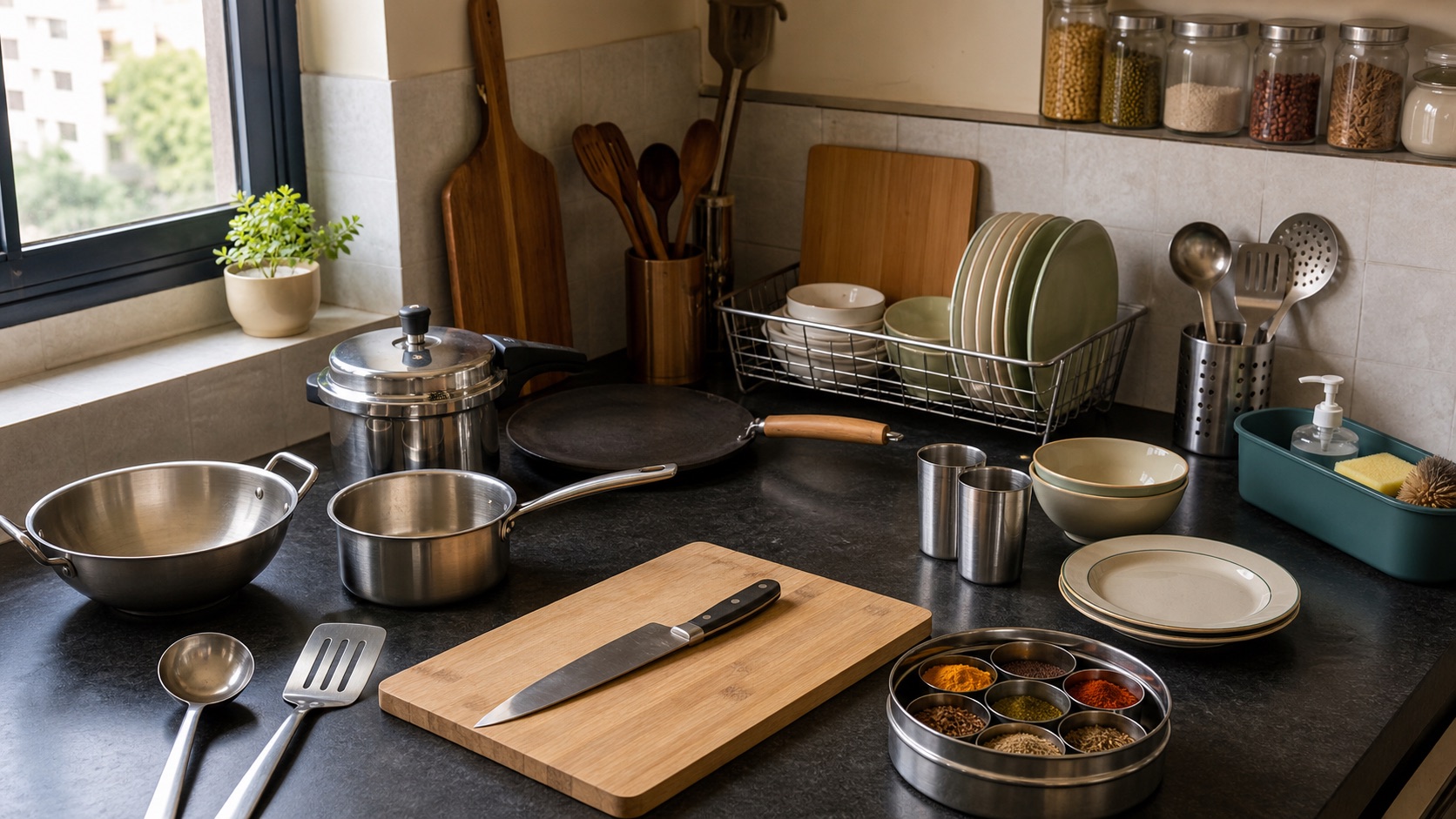
If you need to set up the kitchen this weekend, begin with this compact list:
One pressure cooker or deep saucepan
One medium kadai or frying pan
One tawa, if rotis, dosas or cheelas are part of your routine
One good kitchen knife and one cutting board
A spatula, ladle, serving spoon and pair of tongs
A colander and two mixing bowls
Two place settings per person, plus two for guests
Six to ten food-storage containers in useful sizes
Dishwashing supplies, drying space and a covered waste bin
That is enough to prepare ordinary breakfasts, dals, rice, sabzis, rotis, one-pot meals and reheated leftovers. Everything else can be added after you understand your cooking habits.
Before buying anything, answer five questions
1. What do you cook most often?
A person who makes rotis every day needs a tawa, chakla and belan sooner than someone who mainly cooks rice bowls and pasta. A mixer-grinder may be essential for chutneys and masalas but unnecessary for someone who rarely uses them. Build your kitchen around your real weekly menu—not an idealised version of yourself.
2. How much storage and counter space do you have?
Measure shelves, drawers and the space below the counter before ordering racks or large container sets. In a compact kitchen, every item needs a home. If an appliance will permanently occupy half the worktop, it should earn that space through frequent use.
3. What is already included?
Rental apartments may already include a cooktop, chimney, water purifier or microwave. Check what works, what the landlord maintains and what you are allowed to replace before buying duplicates.
4. How many people will you feed?
Buy for your household plus two visitors, not for a hypothetical dinner party of twelve. Extra plates and giant vessels take up space every day even when they are used twice a year.
5. What is your starting budget?
Spend more on items that affect daily cooking and last for years: a stable pressure cooker, a comfortable knife, dependable cookware and a sturdy cutting board. Save on simple tools such as measuring spoons, peelers and basic storage baskets. Keep part of the budget unspent until you have used the kitchen for a month.
Buy before moving in: the true essentials
Cookware
Pressure cooker: A 3-litre cooker suits one or two people; larger households or batch cooks may prefer 5 litres. Choose a size based on portions, not discounts.
Medium kadai: Useful for sabzi, curries, shallow frying and one-pot meals. Stainless steel is versatile; other materials can be added when you know what you prefer.
Tawa: Buy one if flatbreads, dosas, cheelas or toast are routine foods. A separate dosa tawa can wait unless you make dosas frequently.
Small saucepan: Handy for tea, milk, sauces, noodles, boiling eggs and reheating small portions.
Avoid a large pre-packed cookware set. Sets often include sizes you will not use while missing the one vessel you need every morning.
Preparation tools
One 20–25 cm chef’s knife that feels comfortable in your hand
One smaller utility or paring knife
One large, stable cutting board
Vegetable peeler and simple grater
Colander for washing rice, dals, vegetables and fruit
Two nesting mixing bowls
Measuring cups and spoons if you bake or follow recipes closely
Skip the twelve-piece knife block. Most home cooks repeatedly use one main knife and one small knife. Two knives that stay sharp are more useful than ten poor ones.
Cooking utensils
Flat spatula for the tawa and pan
Deep ladle for dal and curry
Solid serving spoon
Kitchen tongs or chimta
Whisk, only if your usual recipes need one
Match utensils to cookware. Metal tools can damage some coated surfaces, while flimsy plastic tools may not handle high heat well. When in doubt, use sturdy wooden or silicone tools with coated cookware and suitable metal tools with uncoated steel vessels.
Eating and serving
Two dinner plates per person
Two bowls or katoris per person
Two glasses or steel tumblers per person
Cutlery for the household plus two guests
Two mugs if tea or coffee is part of your routine
One medium serving bowl and one tray
Choose stackable shapes and replaceable designs. A practical set that fits the cupboard is better than fragile tableware you are afraid to use.
Food storage
Four to six small containers for spices, leftovers and chopped ingredients
Four medium containers for dals, rice, atta or frequently used staples
One masala dabba or a compact spice system
Labels and a marker, especially for similar-looking grains and flours
Do not buy a 24-piece container set before measuring the shelves. Start small, then add sizes based on the groceries you genuinely keep. Our next guide will compare glass, stainless-steel and plastic food containers in detail.
Cleaning and waste
Dishwashing liquid or bar and two scrubbers
Drying rack or draining mat
Two absorbent kitchen cloths and two cleaning cloths
Covered waste bin and appropriately sized liners
Small brush, dustpan and kitchen-safe surface cleaner
Cleaning gloves if your skin is sensitive or you prefer using them
Plan where wet cloths and scrubbers will dry. A kitchen can own every cleaning product and still smell damp if nothing dries properly.
Buy during the first month
After a few weeks, the kitchen will tell you what it is missing. These items are useful for many households, but they do not all need to arrive on day one.
Mixer-grinder: Move it up the list if you regularly make chutneys, masala pastes, batters or smoothies.
Chakla and belan: Essential for frequent roti makers; unnecessary for households that buy rotis or rarely prepare them.
Tadka pan: Convenient, but a small saucepan can handle the job initially.
Additional storage: Add containers only after seeing which packet sizes and staples you repeatedly buy.
Second cutting board: Useful for separating strong-smelling ingredients or different food-preparation tasks.
Kitchen scissors: Worth buying if you frequently open packets, trim herbs or prepare food with them.
Shelf risers or drawer organisers: Measure first and buy only where they solve a specific storage problem.
Nice-to-have appliances: let your routine decide
Small appliances are where first kitchens become expensive and crowded. An appliance is worth buying when it performs a frequent task noticeably better—not because it appeared in a viral video.
Electric kettle: Useful for tea, coffee and quick hot water, especially in shared homes or rooms with limited cooking access.
Microwave: Valuable for households that reheat food often. Less essential if you cook fresh and reheat easily on the stove.
Air fryer: Consider it only if its capacity suits your household and you expect to use it several times a week.
OTG: Better suited to people who genuinely bake, toast or grill regularly.
Rice cooker: Convenient for frequent rice eaters or anyone who wants hands-off cooking.
Hand blender: Compact and helpful for soups, sauces and some batters, but not a universal replacement for a mixer-grinder.
Toaster or sandwich maker: Buy only if toast or grilled sandwiches are part of the weekly routine.
Before ordering any appliance, decide where it will live, where it will plug in and how it will be cleaned. If there is no sensible answer, wait.
What most first kitchens can skip
Large matching cookware sets with duplicate sizes
Knife blocks containing tools you cannot identify
Oversized dinner sets bought for occasional guests
Single-use cutters for eggs, apples, avocados or one specific vegetable
Bulk container sets that do not fit your shelves or grocery quantities
Countertop organisers purchased before deciding the kitchen layout
Multiple appliances that perform nearly the same task
Decorative jars that are difficult to open, wash or stack
The cheapest unnecessary item is still wasted money, and the most attractive organiser is useless if it makes the counter harder to clean.
A sensible way to divide your starting budget
Prices change constantly, so a percentage-based plan is more useful than a fixed shopping total:
55–60%: cookware, knives and everyday preparation tools
15–20%: plates, bowls, glasses and cutlery
10–15%: storage and organisation
5–10%: cleaning and waste management
10–15% reserve: items you discover you need during the first month
If an appliance is essential to your cooking style, budget for it separately rather than sacrificing every basic tool to afford it.
Printable first-kitchen checklist
Buy before moving in
Buy after a few weeks
Only if your routine needs it
Pressure cooker or deep saucepan
Mixer-grinder
Air fryer
Medium kadai
Chakla and belan
OTG
Tawa, if used regularly
Tadka pan
Microwave
Two useful knives
Second cutting board
Rice cooker
Cutting board and colander
Kitchen scissors
Electric kettle
Spatula, ladle, spoon and tongs
Extra storage containers
Sandwich maker
Basic tableware
Measured shelf organisers
Speciality baking tools
Six to ten storage containers
Serving dishes
Single-purpose gadgets
Dishwashing and waste supplies
Additional cookware
Large dinner sets
Frequently asked questions
How many utensils does one person need?
For one person, two plates, two bowls, two glasses, two mugs and two sets of cutlery are usually enough, plus two extra place settings for visitors. Increase quantities when you entertain frequently or do not wash dishes every day.
Which appliance should I buy first?
There is no universal answer. A mixer-grinder is often valuable in Indian cooking, but an electric kettle may matter more in a hostel-style setup, while a microwave may be the priority for someone who meal-preps. Buy the appliance that supports a task you already perform several times a week.
Should I buy everything online?
No. Online shopping is useful for comparing specifications, sizes and reviews, but knives, pressure cookers and heavy cookware can be worth handling in person. Local shops may also make replacement parts and exchanges easier. Compare the complete value, not only the displayed discount.
What should I prioritise in a very small kitchen?
Choose nesting bowls, stackable containers and multipurpose cookware. Keep counters mostly clear and avoid buying organisers until you have measured the available space. Items used daily should be easiest to reach; occasional tools can live higher or deeper in storage.
Start small and improve the kitchen you actually use
A well-equipped first kitchen is not the one with the most products. It is the one where everyday cooking feels straightforward, tools are easy to find and cleaning does not become a second project.
Buy the minimum viable kitchen first. Cook in it for a month. Notice what slows you down, what stays untouched and what you borrow repeatedly. Those observations will produce a better kitchen than any one-size-fits-all shopping list.