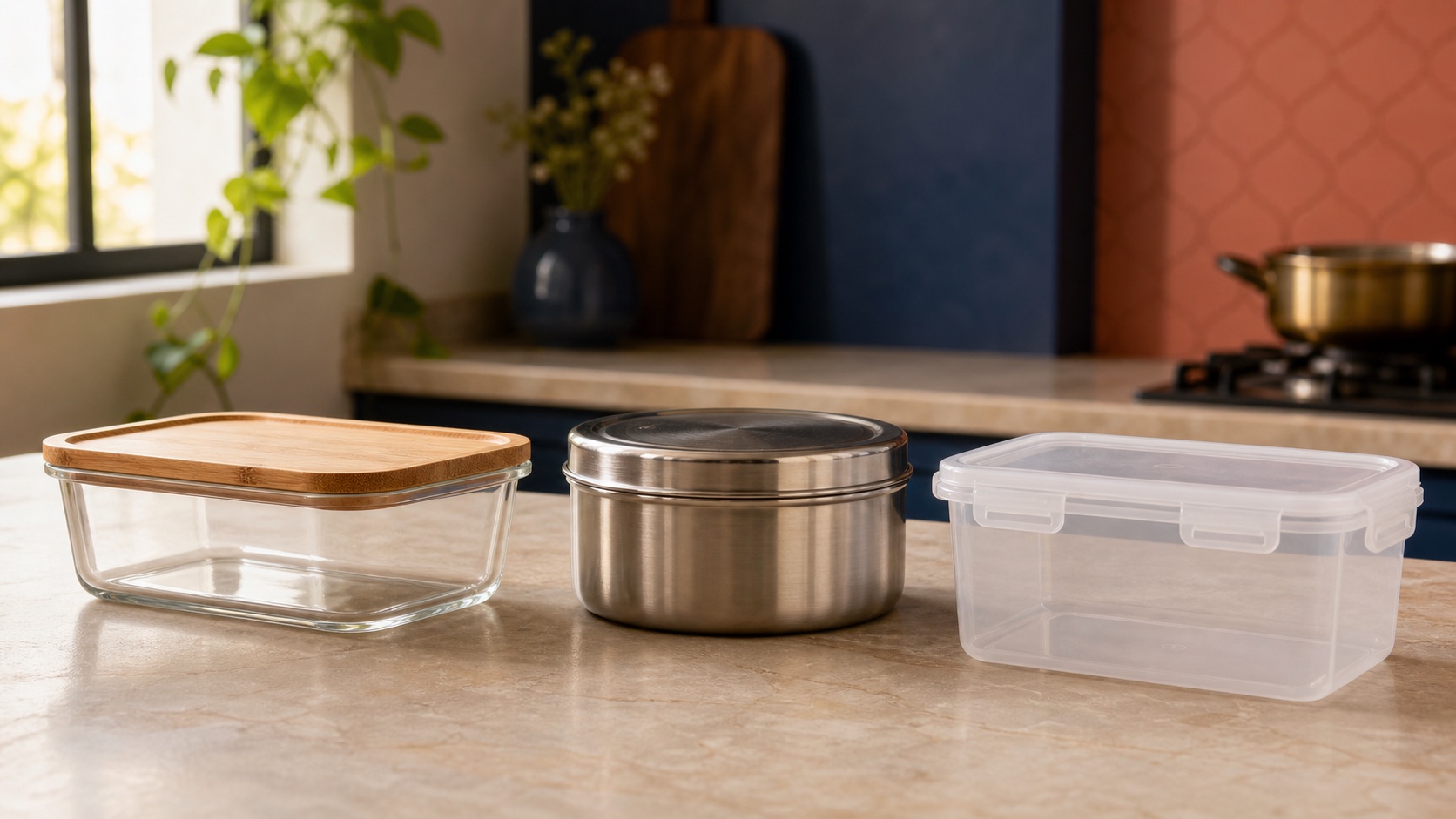
Open almost any Indian kitchen cabinet and you will find all three: steel dabbas, glass boxes and plastic containers. The difficult part is not deciding which material is “best.” It is knowing which one suits the food, the appliance and the way you actually use your kitchen.
For most homes, the practical answer is a small mixed set: steel for durable dry storage, glass for leftovers that may be reheated, and lightweight food-grade plastic for a few specific jobs. You do not need to replace everything with one material.
The quick answer
- Choose stainless steel for atta, rice, dal, spices, snacks and other dry ingredients when durability matters more than visibility.
- Choose glass for curries, dals, chutneys and leftovers—especially when you want to see the contents or reheat them in a microwave.
- Choose food-grade plastic when low weight, lower cost and easy transport matter, but use it only as labelled and do not heat food in an unlabelled container.
If you want one default for cooked leftovers, glass is the most versatile. If you want one default for pantry staples, stainless steel is usually the most durable.
Glass vs steel vs plastic at a glance
| What matters | Glass | Stainless steel | Food-grade plastic |
|---|---|---|---|
| Best use | Cooked food and leftovers | Dry pantry staples | Lightweight storage and transport |
| Microwave | Only when labelled microwave-safe | No | Only when labelled microwave-safe |
| Freezer | Only when labelled freezer-safe; leave expansion room | Usually suitable for storage, but not transparent | Only when labelled freezer-safe |
| Weight | Heavy | Medium to light | Light |
| Breakage | Can chip or shatter | Very durable | Can scratch, warp or crack |
| Odour and stains | Resists both well | Resists both well | May retain turmeric stains and strong smells |
| Visibility | Excellent | Poor unless labelled | Usually good |
| Typical drawback | Heavy and breakable | Cannot be microwaved | Shorter useful life |
When glass is the better choice
Glass works especially well for cooked food. It does not hide what is inside, so yesterday’s dal is less likely to be forgotten at the back of the fridge. It also resists the orange stains and lingering smells that tomato gravies, turmeric, garlic and pickle oil can leave on plastic.
The main advantage is convenience: a container that is specifically labelled microwave-safe can move from the refrigerator to reheating without transferring the food. Check the manufacturer’s instructions first. A normal-looking glass bowl is not automatically safe for a microwave, freezer or oven.
Glass has real disadvantages. A full container is heavy, slippery when wet and risky on a high shelf. Sudden temperature changes may also damage unsuitable glass. Do not pour very hot food into cold glass or move a frozen container directly into high heat unless the manufacturer explicitly permits it. Replace a container that is chipped or cracked.
Glass is best for: cooked dal, sabzi, curry, chutney, cut fruit, meal-prep portions and foods that may be reheated.
When stainless steel is the better choice
Stainless-steel containers are the workhorses of an Indian pantry. They are difficult to break, stack neatly and can last for years. Good-quality stainless steel also resists smells and stains, making it useful for atta, rice, pulses, poha, sugar, tea, coffee and masalas.
Steel is also useful when you want a lighter lunch box without relying on plastic. The trade-off is that you cannot see the contents. Labels—or a consistent shelf system—prevent you from opening five dabbas to find the moong dal.
The biggest limitation is simple: do not put stainless steel in a microwave. If your routine involves frequent reheating, steel creates an extra transfer and another dish to wash. A loose-fitting lid can also make even a sturdy dabba unsuitable for liquids, so check the seal before carrying curry or dal.
Steel is best for: dry staples, spices, snacks, tea and coffee, durable lunch boxes and households that prioritise longevity.
When plastic still makes sense
Plastic is not automatically unsafe, and “plastic-free” is not a requirement for a sensible kitchen. The important distinctions are whether a container is intended for food contact and whether it is suitable for the exact use—cold storage, freezing or microwave heating.
FSSAI’s packaging rules require materials that come into direct contact with food to be food-grade and suitable for the product and the expected storage, mechanical and thermal conditions. That does not mean every takeaway tub or grocery package should become a permanent storage box.
Use a proper food-storage container with clear care instructions. If it is not labelled microwave-safe, do not heat food in it. USDA guidance likewise says to use only cookware manufactured or labelled for microwave use and warns against reheating in cold-storage tubs such as margarine or yoghurt containers.
Discard plastic containers that are cracked, badly scratched, warped or no longer seal properly. Do not reuse single-use takeaway packaging as if it were durable cookware. For hot, oily or strongly coloured foods, glass or steel is often easier to maintain.
Plastic is best for: lightweight snacks, short trips, children’s dry food, high shelves and situations where breakage is a bigger risk than staining.
Storage is only one part of the setup. Our first-kitchen checklist for Indian apartments separates genuine day-one essentials from purchases that can wait.
A sensible starter set for a small Indian kitchen
Do not buy a 30-piece matching set before learning what you cook. A compact starter combination is more useful:
- Three or four medium glass containers for cooked leftovers.
- Two small glass containers for chutneys, chopped ingredients or single portions.
- Four to six stainless-steel containers for rice, atta, dal, sugar and frequently used pantry staples.
- Two or three small, clearly labelled food-grade plastic boxes for lightweight or travel use.
Buy individual replacement lids when the brand offers them. A perfectly good container should not become waste because one seal has failed.
Five buying checks that matter more than the material
- Check the intended use. Look for explicit food-contact, microwave-safe, freezer-safe or dishwasher-safe labelling instead of assuming.
- Test the lid. “Airtight” and “leakproof” are not the same. If you carry liquids, look for a gasket and secure clips.
- Measure your shelves. Wide, shallow boxes can waste more space than they save. Square and rectangular containers usually stack more efficiently.
- Choose useful sizes. A container should be close to the portion you normally store; too much empty space makes the fridge harder to organise.
- Prefer replaceable parts. Lids and silicone gaskets fail before the main container. Replacement availability extends the life of the set.
What should you choose?
Choose based on the job, not on a blanket claim that one material is always best:
- If you microwave leftovers often, start with a few labelled microwave-safe glass containers.
- If you buy pantry staples in bulk, invest in sturdy stainless-steel dabbas and label them.
- If weight and breakage are your biggest concerns, keep a limited number of quality food-grade plastic containers and follow their use instructions.
The most practical kitchen is not all glass, all steel or all plastic. It is one where every box has a clear purpose—and where you own only as many as you can actually stack, clean and use.