RO removes dissolved salts. UV kills germs. UF filters them out without electricity. Most Indian homes need one or two of these, rarely all of them, and a ₹300 TDS meter tells you where to start.
Walk into any appliance store in India and the purifiers are sold on stages: 7-stage, 9-stage, RO+UV+UF+Alkaline+Copper. The pitch is that more stages means safer water. It doesn’t. A purifier is only as good as its match to your source water, and the wrong match wastes money, wastes water, or leaves the real problem untouched.
This guide explains what RO, UV and UF actually do, how to find out what your tap water needs, and how to read the spec sheet before you pay. It is written for apartments and independent houses on municipal supply, borewells or tanker water.
RO, UV and UF in one minute
- RO (reverse osmosis): pushes water through a very fine membrane that removes most dissolved solids, including salts, hardness and many dissolved contaminants such as fluoride, nitrate and arsenic. It needs electricity and water pressure, and it sends part of the water down the drain as reject.
- UV (ultraviolet): a lamp inactivates bacteria, viruses and cysts so they cannot multiply. It removes nothing from the water: no dissolved salts, no chemicals, no mud. It needs electricity and clear water, because cloudy water shields germs from the light.
- UF (ultrafiltration): a hollow-fibre membrane physically blocks particles, bacteria and cysts. It works on tap pressure without electricity and wastes no water, but it does not remove dissolved salts, and virus removal depends on the membrane’s pore size.
- Activated carbon: almost every purifier has a carbon stage. It improves taste and odour and reduces chlorine and some organic chemicals. It is a supporting stage, not a disinfection method.
Everything else on the box (alkaline, copper, mineral, “Zinc boost”) is an add-on. None of them make unsafe water safe.
Step 1: Find out what is in your water
Check the TDS
TDS (total dissolved solids) is the amount of dissolved salts and minerals in the water, measured in mg/L, which is the same number as ppm. A pen-style TDS meter costs a few hundred rupees online, and many purifier service technicians carry one. Test water straight from the tap you will connect the purifier to, on two or three different days, because tanker and borewell water can swing a lot.
The Indian drinking water standard, BIS IS 10500:2012, sets the acceptable TDS limit at 500 mg/L. Up to 2,000 mg/L is tolerated only when no other source exists. The same standard sets total hardness at 200 mg/L acceptable and 600 mg/L permissible.
Know what a TDS meter can’t tell you
A TDS meter shows how much is dissolved, not what it is. Water with a TDS of 250 can still carry bacteria, and water with a TDS of 400 can contain fluoride above the safe limit. If you are on a borewell, live in an area known for fluoride or arsenic, or have a newborn or someone with a weak immune system at home, get a proper lab test. State public health engineering departments and NABL-accredited private labs test drinking water for a few hundred to a couple of thousand rupees, depending on how many parameters you choose. Ask for TDS, hardness, fluoride, nitrate, iron, arsenic and coliform bacteria at a minimum.
Note your source
Where the water comes from matters as much as the number:
- Treated municipal supply is usually low to moderate in TDS but can pick up germs from old pipes and overhead tanks. Disinfection is the main need.
- Borewell water is often higher in TDS and hardness, and in some regions carries fluoride, arsenic, iron or nitrate. This is where RO genuinely earns its place.
- Tanker water is unpredictable: the same building can get very different water from week to week. Test more than once before deciding.
Step 2: Match the technology to your water
Use your results with these rules of thumb:
- TDS under about 300, municipal supply, clear water: UV, UF or UV+UF with a carbon stage. RO is unnecessary and will strip out minerals you don’t need to lose.
- TDS about 300 to 500: the grey zone. If the water tastes fine and a lab test shows no fluoride, arsenic or nitrate problem, UV+UF is still enough. If it tastes salty or leaves heavy scale, an RO with a TDS controller is reasonable.
- TDS above 500, or a lab test showing fluoride, arsenic, nitrate or heavy metals: RO, usually combined with UV or UF as a germ backstop.
- No reliable electricity, or frequent long power cuts: a gravity UF or a good gravity-based filter, since RO and UV stop working when the power does.
- Muddy or yellowish water: whatever you choose, it needs a sediment pre-filter. Iron-rich borewell water may need a separate iron-removal filter before the purifier, or the membrane will clog fast.
Avoid buying RO for low-TDS water because it feels safer. In 2019 the National Green Tribunal directed the government to stop RO use where supply TDS is below 500 mg/L, citing water wastage and mineral loss. That direction has not been turned into a household ban, and RO purifiers are still freely sold, but the reasoning behind it is sound.
Step 3: Read the spec sheet properly
ISI mark and BIS standards
BIS has separate standards for each type: IS 16240 for RO, IS 14724 for UV and IS 19197 for UF purifiers. The RO standard, IS 16240:2023, became mandatory under a quality control order from 16 March 2026, so new RO purifiers sold in India should carry the ISI mark with a licence number you can check on the BIS website. The government’s 2024 statement on RO rules summarises how the standard and the Water Purification System (Regulation of Use) Rules fit together. If a listing has no ISI licence number, treat that as a warning sign.
Recovery rate (for RO)
Recovery is the share of input water that comes out as drinking water. Older or cheaper RO units can send well over half the water to the drain. IS 16240 requires manufacturers to declare a recovery rating, so look for it on the box or spec sheet, and favour higher numbers. Either way, plan to collect the reject water for mopping, washing vehicles or flushing, rather than letting it run to the drain.
Storage tank and flow rate
RO purifies slowly, so most have a 6 to 10 litre storage tank. For a family of four drinking and cooking with purified water, 7 to 8 litres is comfortable. UV and UF units are often on-demand with no tank. Check the stated purification rate in litres per hour if your household fills bottles in a rush every morning.
Maximum feed TDS
Every RO has a maximum input TDS it is rated for, often 1,500 to 2,000 mg/L. If your borewell is close to that, look for a commercial-grade membrane or a model rated higher, or the membrane will wear out quickly.
TDS controller and add-ons
A TDS controller (or mineraliser) blends back a little water that has skipped the RO membrane, so the output does not taste flat. It is useful on RO units. Alkaline and copper cartridges are mostly about taste and marketing. They aren’t harmful, but don’t pay a big premium for them.
Step 4: Budget for the running cost
The sticker price is only the start. Filters, membranes and service visits add up over the years, and they differ by brand and city. Before you buy, ask the seller or check the brand’s website for:
- The price of a full filter set and how often it should be replaced (sediment and carbon filters are typically 6 to 12 months).
- The membrane replacement interval and price (RO and UF membranes often last 2 to 3 years, less with high-TDS or muddy water).
- UV lamp life, usually around a year of use.
- What an annual maintenance contract (AMC) covers, and whether it includes the membrane or only the small filters.
Add the purifier price to three years of filters and AMC, and compare that total, not the box price. A cheap purifier with expensive proprietary filters often ends up costing more.
Installation tips that save trouble
- Use a dedicated socket near the purifier, ideally with a stabiliser or surge protection if your area has voltage swings.
- Check water pressure. RO needs a minimum inlet pressure. Low-pressure overhead tank lines may need a booster pump, which most RO units include.
- Plan the reject line into a bucket or a storage container instead of the sink drain.
- Clean the storage tank during every service, and don’t leave the purifier unused for weeks without flushing it first.
If you are setting up a new kitchen, our first kitchen checklist for an Indian apartment covers what else is worth buying early, and our guide to organising a small Indian kitchen helps you find wall space for a wall-mounted purifier. For the air in the same home, see how to choose an air purifier for an Indian city apartment.
Quick checklist before you buy
- Measured TDS on at least two days, from the tap you will use
- Lab test done if you are on a borewell or in a fluoride or arsenic area
- Technology matched to the water: RO only where TDS or contaminants need it
- ISI mark and licence number checked
- Recovery rate, tank size and maximum feed TDS confirmed
- Three-year cost of filters and AMC added up
- Plug point, pressure and reject-water plan sorted
FAQ
Do I need an RO purifier if my water TDS is below 200?
Usually not for the TDS itself. Under BIS IS 10500, TDS up to 500 mg/L is acceptable for drinking, so low-TDS municipal water mainly needs germs removed. A UV or UF purifier, often with a carbon stage, is the better fit. Get RO only if a lab test shows a specific problem like high fluoride, arsenic or nitrate.
What TDS level needs RO?
As a working rule, consider RO when tap water is consistently above about 500 mg/L, the BIS acceptable limit, or when a lab test shows dissolved contaminants such as fluoride, arsenic, nitrate or heavy metals that UV and UF cannot remove. Above 2,000 mg/L the BIS standard says the source should not be used for drinking at all.
Is UV or UF better for municipal water?
UV is the stronger disinfectant and inactivates bacteria and viruses, but it needs electricity and clear water. UF works without power and physically filters bacteria and cysts, but cannot be relied on for every virus. Many homes on treated city supply pick UV+UF so they get both.
Does RO water remove minerals my body needs?
RO removes most dissolved minerals, including calcium and magnesium. Most of those come from food rather than water, but very low-TDS water can taste flat. A TDS controller or mineral cartridge can bring some back; it is a comfort feature, not a substitute for correct sizing of the purifier to your water.
How often should water purifier filters be changed?
Follow the manufacturer’s schedule, which is typically 6 to 12 months for sediment and carbon filters, around a year for UV lamps, and 2 to 3 years for RO and UF membranes, depending on usage and water quality. A sudden change in taste, slow flow or rising TDS on the output are signs to service it earlier.
Bottom line
Test first, then buy. Low-TDS city water usually needs UV, UF or both, not RO. High-TDS borewell water, or water with fluoride, arsenic or nitrate, is where RO is worth its cost and its reject water. Check the ISI mark, the recovery rate and the three-year filter bill, and ignore the stage count on the box.
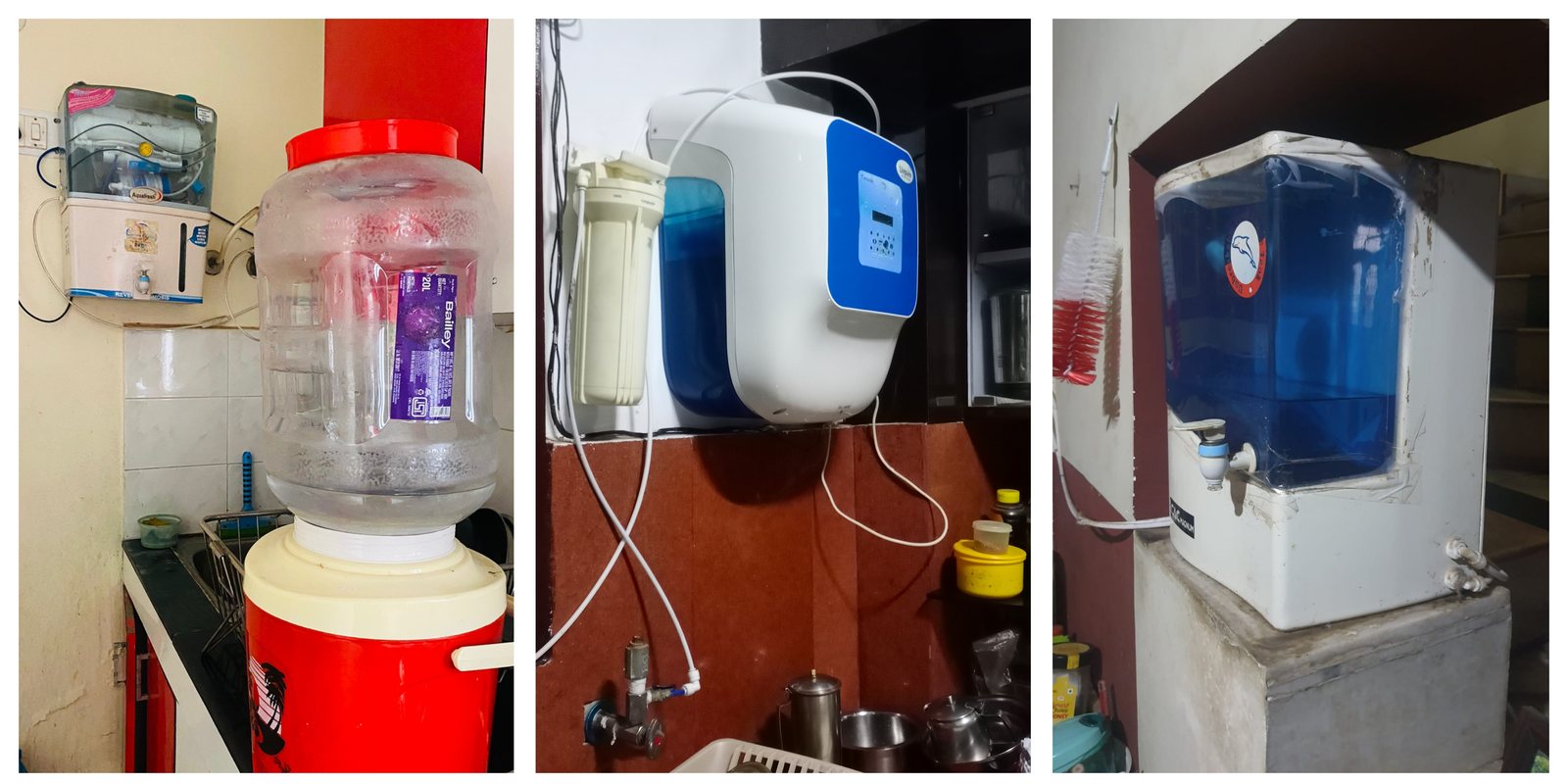
Featured photo: “Home water filters, water purifiers, and bottled water in India” by FacetsOfNonStickPans, via Wikimedia Commons, licensed CC BY-SA 4.0; cropped and resized. This article is general guidance, not a substitute for a lab test of your own water.