In an Indian city apartment, filter grade and replacement cost matter almost as much as the sticker price. Size for about five air changes an hour, insist on a real HEPA grade, and budget for filters before you buy.
Air purifiers are sold with confident square-foot claims and long filter-life promises. Indian apartments complicate both: rooms are rarely sealed, ceilings are often taller than the 8 ft many ratings assume, and outdoor PM2.5 keeps leaking in through gaps even when windows are shut. The useful decision is not “which brand looks best,” but whether the unit can clean your room fast enough, with a filter you can actually replace without regret.
This guide is a buying framework for city apartments — Delhi-NCR winters included, but also Hyderabad, Mumbai, Bengaluru and other metros where winter or seasonal spikes still push indoor air past comfortable levels. It focuses on room size, CADR, HEPA grades, and filter costs in India. It does not invent lab tests or personal trial data.
Why Indian apartments need honest sizing
Outdoor fine particulate matter (PM2.5) is the main reason people buy purifiers in Indian cities. During winter 2025–26, analysis of CPCB monitoring data by the Centre for Research on Energy and Clean Air found Delhi’s average PM2.5 around 163 µg/m³, with many days in the “Very Poor” and “Severe” bands on India’s AQI scale. Mumbai and Chennai also sat above India’s national ambient standards on winter averages; Bengaluru was closer to the limit but still well above the WHO’s stricter guideline of 5 µg/m³ annual PM2.5.
Hyderabad and other southern metros are usually cleaner than Delhi-NCR in winter, but they are not “clean enough to ignore.” CSE’s winter 2024–25 megacity note put Hyderabad’s winter average near 52 µg/m³ — still above India’s annual standard of 40 µg/m³. Cooking, incense, dust from construction, and traffic near the building all add indoor load on top of whatever comes through windows and balcony doors.
A purifier only helps the room it sits in. Closed doors stop clean air from travelling. One living-room unit will not reliably clean bedrooms. Plan room by room, starting with where people sleep or where someone with asthma or allergies spends the most time.
CADR and room size: the formula that actually matters
CADR (Clean Air Delivery Rate) is the volume of filtered air the machine delivers per hour. AHAM-certified units report separate scores for smoke, dust and pollen; for Indian PM2.5, use the smoke CADR — the smallest-particle score. Indian and European listings usually print CADR in m³/h; if you only see CFM, multiply by about 1.7 (1 CFM ≈ 1.699 m³/h).
Coverage claims on boxes are often calculated at a gentle 1–2 air changes per hour. For healthier indoor air, aim closer to 5 air changes per hour (ACH) — the ballpark used in CDC clean-air guidance and close to AHAM’s certified suggested-room basis (~4.8 ACH). For allergies, asthma, or heavy Delhi-winter infiltration, 5–6 ACH is a safer planning target. Add a 20–30% buffer if doors leak, windows are old, or the layout is open-plan.
Formula: required CADR (m³/h) = floor area (m²) × ceiling height (m) × ACH.
Example: a 150 sq ft (~14 m²) bedroom with a 10 ft (~3 m) ceiling at 5 ACH needs about 210 m³/h smoke CADR. A unit advertised for “400 sq ft” may only deliver that much honest cleaning in a much smaller room.
Quick CADR targets for common apartment rooms
These are planning ranges at roughly 10 ft ceilings and 5 ACH — not brand recommendations. Size up further for NCR winters or open living-dining areas.
- Compact bedroom / study (120–180 sq ft): about 180–250 m³/h smoke CADR
- Master bedroom (180–250 sq ft): about 250–350 m³/h
- Living room (300–450 sq ft): about 400–600 m³/h, or two smaller units
- Open living + dining: size to the combined volume, not the corner you place the unit in
AHAM’s consumer rule of thumb is related: smoke CADR in CFM should be at least about two-thirds of the room area in sq ft at a standard 8 ft ceiling. Taller Indian ceilings need more capacity for the same floor area.
Filter type: True HEPA, carbon, and labels to skip
For particulate pollution, you want a mechanical HEPA filter with a stated grade. Under the European EN 1822 classification used on many Indian product sheets:
- H13: at least 99.95% efficiency at the most penetrating particle size (around 0.3 µm) — a sensible minimum for Indian city use
- H14: 99.995% — stricter, useful but not mandatory if CADR and sealing are strong
“True HEPA” usually means the seller is distinguishing the filter from marketing phrases, but it is not itself an H13 certificate. Prefer listings that name H13 (or H14) in the specifications, not only in marketing copy.
Skip or treat with caution: HEPA-type, HEPA-like, HEPA-style, and bare “99% HEPA” with no grade. Those phrases are not EN 1822 grades and can underperform on fine PM2.5.
HEPA handles particles. Cooking smells, incense and many VOCs need activated carbon (granular carbon in meaningful weight, not a thin printed sheet). A washable pre-filter that catches hair and coarse dust protects the expensive HEPA and is the cheapest maintenance habit you can keep.
Ozone generators and “activated oxygen”
Avoid devices marketed as ozone generators or “activated oxygen” purifiers for occupied rooms. Ozone is a respiratory irritant; the US EPA and WHO have long flagged ozone-generating air cleaners as a concern indoors. Ioniser or plasma modes can also produce ozone as a by-product. Prefer a mechanical HEPA + carbon design. If a unit has an ioniser, choose one you can switch off, and favour models that claim low or zero ozone emission rather than ozone as a feature.
Filter costs in India: budget the second year
The purchase price is only the entry fee. In Indian retail as of 2025–2026, indicative ranges for domestic units look roughly like this (market bands, not a quote for one model):
- True HEPA (H13) cartridge: about ₹1,200–₹6,500
- Activated carbon panel: about ₹800–₹5,000
- Combined HEPA + carbon cartridge: about ₹1,800–₹8,000
- Typical annual filter spend: often about ₹2,000–₹6,500 in moderate cities; higher (sometimes ₹4,000–₹14,000+) with premium brands, heavy use, or Delhi-NCR winters
Rated filter life of 6–12 months (or longer) assumes milder particulate loads. In high-AQI winters, many households replace HEPA or combo cartridges sooner — sometimes in 4–8 months — because performance drops even if a timer still says “OK.” Clean the washable pre-filter every 2–4 weeks so the HEPA is not doing coarse-dust work.
Before you buy the machine, search the exact replacement filter SKU on Amazon, Flipkart or the brand site. Check price, whether it is in stock, and whether third-party filters exist. A cheap purifier with scarce ₹5,000 combo filters is a worse deal than a mid-range unit with plentiful ₹2,000–₹3,500 cartridges.
Placement and habits that make CADR real
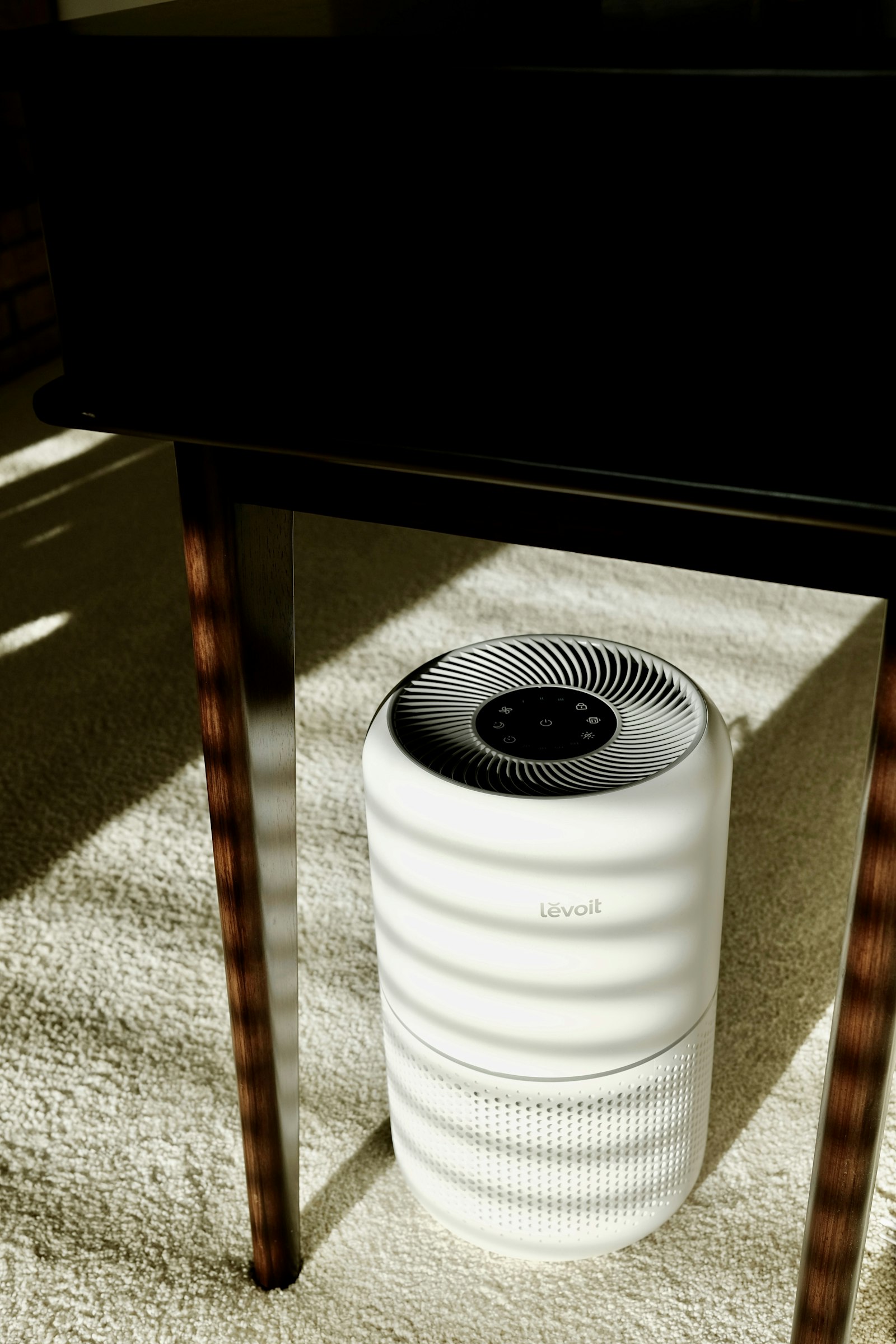
Leave space around intake and outlet grills. Crowding a unit against a wall or under a shelf cuts airflow. Keep doors closed while cleaning a bedroom. Run the purifier on a higher setting when outdoor AQI spikes, then drop to a quieter sleep mode once the room reading stabilises — if the unit has a particle sensor and a trustworthy display.
Purifiers do not replace ventilation forever. On better-air days, brief airing still helps with CO₂ and indoor smells. On severe days, keep windows shut and let the correctly sized unit do the work. For renters, a freestanding unit needs no landlord permission — similar to other plug-in home upgrades.
If you are also weighing other floor-care gadgets for the same flat, the same “does this fit my layout?” test applies to robot vacuums: the product only works when the home matches what it is good at. The same sizing-before-brand habit applies when you replace a noisy, power-hungry ceiling fan — start with sweep, BEE service value and wattage in our BLDC ceiling fan buying guide.
A short pre-purchase checklist
- Measure length × width; note ceiling height; convert to m² and metres
- Calculate required smoke CADR at 5 ACH (6 if asthma/allergies or NCR winter)
- Confirm True HEPA with an H13 (or H14) grade — not “HEPA-type”
- Check carbon filter weight/role if cooking smells or VOCs matter
- Look up replacement filter price, life, and stock before paying for the unit
- Skip ozone generators; switch off unused ioniser modes
- Buy one unit per priority room; do not expect hallway spillover to clean bedrooms
- Prefer a clear PM2.5 number display over vague colour LEDs alone
FAQ
Is one air purifier enough for a 2BHK?
Usually no, if you want both bedrooms and the living room cleaned well. Treat each closed room as its own volume. Many households start with the primary bedroom, then add a living-room unit.
Should I buy a bigger CADR than the formula suggests?
A modest oversize helps you run quieter speeds and absorb leaks. In Delhi-NCR winters, sizing up by roughly 20–30% (or more for open plans) is common practice among careful buyers. Extreme oversizing is unnecessary if the smoke CADR already meets 5–6 ACH.
Do UV or ioniser stages replace HEPA?
No. For PM2.5 in Indian cities, mechanical HEPA (plus carbon when you need gases/odours) is the core. Extra stages are optional; ozone-producing stages are a reason to walk away or disable the mode.
How often should I replace filters in India?
Follow the manufacturer’s range, then shorten it if outdoor AQI is routinely poor or if indoor PM2.5 stops falling quickly in a closed room. Washable pre-filters should be cleaned every few weeks. Budget annual consumables using current INR prices for your model’s filter SKU, not a generic “filters last two years” claim.
Bottom line
Choose an air purifier the way you would choose any other useful home tool: measure the job, then buy capacity. For an Indian city apartment, that means calculating CADR from room volume and a real ACH target, insisting on a graded HEPA filter, planning filter replacements in rupees, and placing units room by room. The box’s square-foot claim is marketing. Your floor plan and winter AQI are the brief.
Sources: CPCB air quality data and the AHAM CADR directory.