Pick firmness by how you sleep, measure your cot before you order, and buy where there is a real trial and a warranty that covers sagging. Words like “orthopaedic” and “premium” have no fixed meaning in India.
Mattress shopping in India is mostly labels: orthopaedic, premium, multi-layer comfort, medium-firm, hybrid, “up to 60% off”. None of these terms has a legal or BIS definition, so two mattresses with the same label can be very different inside. Knowing how to choose a mattress comes down to a few numbers you can ask any brand for.
This guide is based on published brand policies, BIS documents and foam industry references, not hands-on testing.
Start with four honest questions
- What is wrong with your current bed? Sagging, waking up hot, a restless partner, or a first mattress that has flattened out. Each needs a different fix.
- How do you sleep? Side sleepers usually need a softer top so the shoulder and hip can sink in. Back sleepers usually do well on medium-firm. Stomach sleepers usually need firmer, so the hips don’t dip.
- What is your real budget? Decide it before you see the crossed-out MRP, not after.
- How hot is your room? A Hyderabad, Chennai or Delhi summer changes which materials make sense, more than most guides admit.
Marketing terms, decoded
When a product page sounds impressive but says little, ask for the right-hand column.
| Label | What it usually means | What to ask for |
|---|---|---|
| Orthopaedic / ortho | Usually just firm. There is no Indian standard or medical test behind the word. | Support core material, density and thickness |
| Premium foam | Could be anything from basic PU foam to high-resilience foam | Foam type (PU, HR, memory, latex) and density in kg/m³ |
| Multi-layer comfort | More than one layer, which tells you nothing about the layers | Each layer listed with material and thickness |
| High-resilience (HR) | A bouncier, more durable grade of polyurethane foam, if genuine | HR density, and which layer it is in |
| Hybrid | Springs plus foam, or sometimes foam plus coir or latex | Spring type (pocket or bonnell), coil count, foam on top |
| Medium-firm | The brand’s own firmness scale; one company’s medium is another’s firm | A firmness number on their scale, and a trial period |
Firmness is not support
Firmness is how the top feels when you press it. Support is whether the whole mattress keeps your spine roughly straight through the night. A soft top over a solid core can be very supportive, and a hard, cheap mattress can still sag in a year.
Density is not firmness
Foam density (kg/m³) tells you how much material is packed into the foam, which mostly predicts how long it lasts. Firmness is a separate setting the factory chooses. The US Polyurethane Foam Association points out that high-density foam can be made very soft and low-density foam very firm.
The numbers that actually matter
1. A layer-by-layer spec sheet
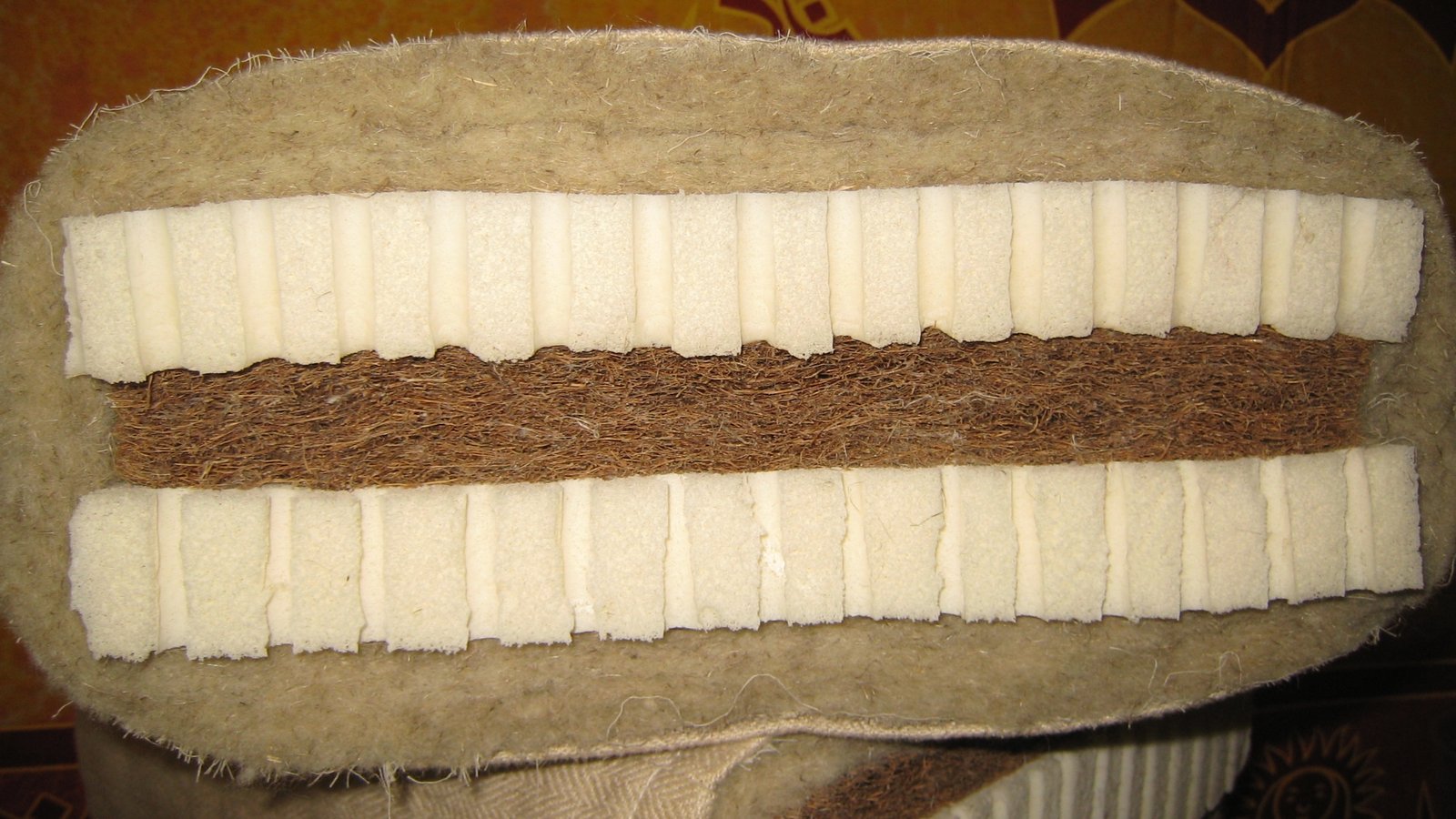
A good listing reads like a recipe: for example, 1 inch of memory foam, 1 inch of HR foam, then 6 inches of support foam at a stated density. If a brand only gives the total thickness and a list of adjectives, ask customer care for the layer breakdown.
2. Foam density, compared like for like
Density only means something when you compare the same type of foam. Rough guides from foam makers and industry references:
- PU or HR support foam: below about 28 kg/m³ is budget and tends to dip early. Sources disagree on the sweet spot: Sparsh, an Indian foam maker, treats 32 kg/m³ as a reasonable mid-tier core, while several buying guides want 40 kg/m³ or more for long life. Treat 32 to 40+ as the range to look for.
- Memory foam comfort layers: these run denser, roughly 48 to 64 kg/m³ (3 to 4 lb per cubic foot) for decent quality.
- Bonded (rebonded) foam: very dense, often 80 to 120 kg/m³, and very firm. It is durable but feels hard, which is why many “ortho” mattresses use it.
3. Firmness numbers, if you can get them
Foam firmness is measured as ILD or IFD. Most Indian listings don’t show it, and test methods differ, so compare it only within one brand. As a rough guide from foam suppliers, values below about 20 feel soft, 20 to 30 medium, 30 to 40 medium-firm to firm, and above 40 firm.
4. Thickness that matches your weight
A 4-inch foam mattress is likely to bottom out under a heavier adult. Six inches is a common baseline, and eight inches or more leaves room for a proper comfort layer over the core. Check any weight limit on the product page.
The Indian details most guides skip
Sizes aren’t standard, so measure the cot
An Indian “king” can be 72 × 78, 72 × 84 or 78 × 78 inches, and a “queen” is usually 60 × 78 but not always. Measure the inside of your bed frame, length and width, and order by inches, not by name. Some trial policies, such as Duroflex’s and Sleepyhead’s, exclude custom sizes, and Duroflex charges ₹2,500 in logistics if you order the wrong size.
Heat, humidity and the box bed
In hot cities, latex, coir-hybrids, pocket springs and open-cell or gel foams usually sleep cooler than plain memory foam. In monsoon months, a mattress sitting flat on a solid plywood box bed has nowhere to breathe, which can lead to damp and fungus underneath. Slatted bases help; on a box bed, lift and air the mattress now and then. A ceiling fan matters as much as the mattress here, and our BLDC ceiling fan guide covers quiet, efficient options for bedrooms.
Roll-packed delivery
Most foam mattresses now arrive rolled and compressed, which suits narrow stairs and small lifts. Give them a day or two to expand fully; Wakefit says up to 72 hours. Note that some rolled products carry fewer guarantees: Wakefit’s warranty, for instance, excludes its roll-up mattresses.
Prices and the permanent sale
Rough queen-size ranges from current listings: basic coir or foam from about ₹4,000 to ₹12,000, a 6-inch memory foam mattress from a D2C brand around ₹10,000 to ₹15,000, and latex, pocket-spring or thicker hybrids from about ₹25,000 upwards. Brands like Wakefit, The Sleep Company, Sleepyhead, Duroflex, Sleepwell and Kurlon run “up to 60% off” banners most of the year, so compare the price you will actually pay across two or three sites, and ignore the MRP.
Trial and warranty: read the exclusions
A 100-night trial is now common, and it is the best protection against buying the wrong firmness. But the terms differ:
- Where you bought it: The Sleep Company’s trial covers only its own website and stores, not Amazon or Flipkart orders. Duroflex’s 100-day return applies to selected standard-size mattresses bought on its website.
- Which models: Sleepyhead lists the models covered, and asks you to unbox and use the mattress within 30 days of delivery.
- Condition: every brand inspects the returned mattress. Stains or damage can void the refund, so use a protector from day one.
- Warranty on sagging: Wakefit and The Sleep Company both cover sagging only beyond 1 inch (about 2.5 cm), and exclude normal softening and comfort issues. Wakefit covers only the foam, not the cover or zip. Later-year claims are often settled pro rata.
What about back pain?
The best-known trial on this, published in The Lancet in 2003, gave 313 adults with chronic low back pain either a firm or a medium-firm mattress. The medium-firm group reported less pain in bed and less disability after 90 days. It is one study on spring mattresses, but reason enough to doubt “harder is better for your back”. If back pain is ongoing, see a doctor rather than expecting a mattress to fix it.
Your mattress checklist
- Inside of the cot measured in inches, and the mattress ordered to match
- Layer-by-layer spec: material and thickness of every layer
- Support foam density stated, ideally 32 kg/m³ or more for PU/HR
- Firmness chosen for your sleep position, with a number on the brand’s scale if offered
- Material choice that suits your city’s heat and humidity
- At least a 100-night trial, valid where you are buying
- Warranty that covers sagging, with the depth stated
- Return pickup terms and any fees in writing
- Optional: ISI mark to IS 13489, which BIS certifies voluntarily for bed mattresses (see the BIS product manual)
Once the mattress is sorted, the rest of the bedroom is easier than it looks. Our guide to making a room feel finished without buying more furniture and the one on layering lamps instead of one overhead light are good next steps.
FAQ
How do I choose the right mattress firmness?
Go by sleep position. Side sleepers usually need a softer top so the shoulder and hip can sink in, back sleepers usually suit medium-firm, and stomach sleepers usually need firmer. Use the trial period to confirm.
Is an orthopaedic mattress better for back pain?
Not necessarily. Orthopaedic has no standard definition for mattresses in India and usually just means firm. A 2003 Lancet trial found medium-firm mattresses did better than firm ones for people with chronic low back pain. For ongoing pain, see a doctor.
What foam density should a good mattress have?
Compare like with like. For PU or HR support foam, aim for about 32 kg/m³ or more; some guides suggest 40 kg/m³ for longer life. Memory foam layers run denser, roughly 48 to 64 kg/m³ for decent quality.
What size mattress should I buy in India?
Measure the inside of your bed frame and order by inches, not by the name. An Indian king can be 72 × 78, 72 × 84 or 78 × 78 inches, and carpenter-made cots often differ from brand charts.
Is a 100-night mattress trial really free?
Usually the return pickup and refund are free if the mattress passes inspection, but conditions apply. Trials may cover only the brand’s own website, only certain models or only standard sizes, and stains or damage can void the refund.
Bottom line
Treat every label as a question, not an answer. Get the layers, the foam density and the firmness on paper, match them to how you sleep and how hot your room gets, measure the cot, and buy where the trial and warranty are clear.
Featured photo: cross-section of a coconut-fibre, foam and wool mattress by D-Kuru, from Wikimedia Commons, licensed CC BY-SA 3.0 AT; cropped and resized.