Then check for a seat slider, height-adjustable lumbar and arms, a multi-lock synchro tilt, a stated Class 4 gas lift and a written warranty split by part.
Almost every office chair under ₹15,000 is sold with the same words: ergonomic, 4D, BIFMA, 135° recline. Those words don’t tell you whether the chair will fit you at hour seven of a workday. A ₹9,000 chair that fits will serve you better than a ₹15,000 one that doesn’t.
This guide is built from workplace ergonomics guidance, the BIS furniture rules, brand spec sheets and current Indian listings, not from hands-on testing.
Start with three fit checks
Do these before comparing spec sheets. Online, compare the listed seat depth and height range against your own measurements, and keep the box until the return window ends.
1. Seat depth: two to three fingers behind the knee
Sit all the way back so your lower back touches the backrest. You should be able to fit two to three fingers (about 7 to 9 cm) between the front edge of the seat and the back of your knee, as Oregon OSHA’s workstation guide puts it. A seat that is too deep is the most common bad fit: shorter people end up perching on the front edge and the backrest does nothing.
This is why a seat slider (seat-depth adjustment) is the single most useful feature in this price range. Most chairs have a fixed seat around 43 to 51 cm deep, so without a slider you are betting on your leg length.
2. Lumbar: at belt level, and ideally adjustable
The lumbar support should sit in the small of your back, roughly at the height of your belt. Slide a hand behind your lower back while seated: if the support is pressing your mid-back or your hips instead, it’s in the wrong place. If you are noticeably shorter or taller than average, insist on height-adjustable lumbar rather than a fixed bulge or a loose strap-on pillow.
3. Seat height: feet flat, forearms level with the desk
With your feet flat on the floor, your thighs should be roughly level and your forearms level with the desk or keyboard. Many Indian desks are about 72 to 76 cm tall, and some study tables are higher, so check the chair’s top seat height as well as the bottom. If you have to raise the chair so far that your feet dangle, add a footrest. The US OSHA chair guidance suggests the same fix.
Armrests: height adjustment is the one that counts
Listings sell 2D, 3D and 4D arms. Height adjustment matters most, so your forearms rest lightly with relaxed shoulders. Extra directions (forward-back, in-out, pivot) help if you type with your forearms supported. The real dealbreaker is arms that hit the desk edge and stop you pulling in close; they need to drop low enough to slide under, or come off.
The spec-sheet checklist
Once a chair passes the fit checks, these are the specs worth reading closely:
| Spec | What to look for | Why |
|---|---|---|
| Seat depth | A slider of about 5 cm, or a fixed depth that suits your legs | The most common poor fit |
| Lumbar | Height-adjustable (often listed as 2D) | A fixed lumbar suits only average heights |
| Tilt mechanism | Synchro tilt with multi-position lock | Lets you lean back and lock at an angle you choose, not just upright or fully reclined |
| Gas lift | Class 3 or 4, actually stated | An unstated class is a warning sign |
| Weight rating | Comfortably above your weight | Ratings of 120 to 150 kg are common here |
| Castors | Soft PU castors for tiles and marble | Hard nylon wheels can be noisy and slide on smooth floors |
| Warranty | In writing, split by part | Mechanism and gas lift vs mesh and foam |
What Class 3 and Class 4 really mean
The class refers to the gas cylinder under the seat, tested under the European standard EN 16955. Class 4 is rated for heavier use than Class 3. It is a test of that one part, so “Class 4 gas lift” on a listing does not mean the whole chair was tested. “BIFMA tested” claims are similar: they may cover one part or the brand’s own tests.
Mesh, foam or leatherette in Indian weather
- Mesh back: the best choice for a room without AC, or a humid city. It lets air through and stays cool through long summer afternoons.
- Foam seat with fabric: what most chairs in this range use, and fine for long sitting. A moulded foam seat with a rounded front edge is easier on the thighs than a thin, flat one.
- Leatherette (PU): fine in an air-conditioned office, but in heat it gets sweaty and the surface tends to peel or crack. Most gaming chairs use it, along with a strap-on lumbar pillow, which is why they rarely suit 8-hour workdays.
If your work room gets hot, a quiet ceiling fan helps more than any chair material; our BLDC ceiling fan guide covers that.
The ISI mark on office chairs
Under the Furniture (Quality Control) Order, 2025, work chairs must meet IS 17631:2022 and carry the ISI mark under a BIS licence. That applied to large and medium makers from 13 February 2026 and to micro and small makers from 13 August 2026. Look for the ISI mark with IS 17631 and a CM/L licence number on the chair or its label; you can verify the number in the BIS Care app.
It isn’t yet a perfect filter. Very small Udyam-registered units (investment up to ₹25 lakh and turnover up to ₹2 crore) are exempt, and a February 2026 amendment lets sellers clear stock made before the deadline for up to a year. So a chair without the mark isn’t automatically illegal, but a marked one gives you a tested baseline.
What ₹15,000 buys today
Office chair MRPs are often inflated, with “50% off” listed almost permanently, so compare the actual selling price across the brand’s own store, Amazon and Flipkart. Roughly:
| Budget | What you usually get |
|---|---|
| ₹3,000 to ₹6,000 | Basic mesh chair, fixed seat, simple tilt lock, fixed or 1D arms. Fine for a few hours a day. |
| ₹6,000 to ₹10,000 | Synchro tilt with multi-lock, adjustable lumbar, 3D arms, Class 4 gas lift; some include a seat slider. |
| ₹10,000 to ₹15,000 | Seat slider and 4D arms become common, along with better mesh, headrests and longer warranties. |
Three examples of how real listings compare. These are not recommendations, since we haven’t tested them, and prices seen in October 2026 will move:
| Chair | What the listing says | Price seen |
|---|---|---|
| Wakefit Gravita (multi-lock, seat slider variant) | Synchro multi-lock tilt, 3D arms, Class 4 gas lift, 120 kg, 3-year warranty, DIY assembly | About ₹6,000 to ₹9,800 depending on variant and sale |
| Green Soul Jupiter Pro | Seat slider, 2D lumbar, 4D arms, synchro tilt with lock, Class 4 gas lift, 5-year warranty on the new chair (only 6 months on the “renewed” one) | About ₹10,800 to ₹11,000 on Amazon, Flipkart and the brand store |
| Featherlite Liberate (medium back) | Flexible lumbar frame, multi-lock, height-only arms, Class 4 gas lift, 150 kg, 3-year warranty; no seat slider and a fixed 43 cm seat | About ₹15,500 on Amazon, ₹16,449 on the brand store |
Notice how they trade off: the Liberate has a short fixed seat that suits shorter users but not tall ones, while the Jupiter Pro adds a slider and 4D arms at a lower price. That is the fit-first idea in practice.
Warranty, service and assembly
- Read the warranty in parts. Many chairs cover the mechanism and gas lift for longer than the mesh, foam and arm pads. Get the terms on the product page or invoice, not just the box.
- Check service in your city. A gas lift or mechanism that fails in year two is easy to fix only if spare parts reach you.
- Assembly is usually DIY and takes about 30 minutes with the supplied tools.
Set it up properly once it arrives
Adjust in this order: seat height, then seat depth, then lumbar, then arms, then tilt tension. After that, bring the screen to eye level; our laptop stand and monitor height guide covers the numbers. Good light matters too: see the desk lamp for long work hours guide. For the rest of the desk, there are 9 desk gadgets that actually help and a guide to mechanical vs membrane keyboards.
No chair fixes ongoing back or neck pain on its own. If pain lasts beyond a few days of a better setup, see a doctor or physiotherapist.
FAQ
Is ₹15,000 enough for a good office chair in India?
Yes, for most people. Between about ₹7,000 and ₹15,000 you can get a seat slider, adjustable lumbar, height-adjustable arms, a multi-lock synchro tilt and a Class 4 gas lift. Spend more only if the chair doesn’t fit your body.
Mesh or foam seat: which is better for Indian summers?
A mesh back keeps you cooler in a room without AC. Seats are usually foam with fabric on top, which is fine; avoid leatherette if you work in a hot, humid room, because it gets sweaty and tends to crack.
What is a Class 4 gas lift?
It’s a strength class for the gas cylinder under the seat (EN 16955). Class 4 is tested for heavier loads than Class 3. It doesn’t make the whole chair certified, so still check the chair’s own weight rating.
Do office chairs need an ISI mark now?
Work chairs come under the Furniture (Quality Control) Order, 2025 and need the ISI mark under IS 17631:2022: from 13 February 2026 for larger makers and 13 August 2026 for micro and small ones. Very small units and older stock have exemptions, so an unmarked chair isn’t automatically illegal yet.
Is a gaming chair good for 8-hour workdays?
Usually not under ₹15,000. Most rely on a loose strap-on lumbar pillow and leatherette that gets hot, and few have a seat slider.
Bottom line
Under ₹15,000, buy for fit, not features: the right seat depth, lumbar at belt level and a seat height that suits your desk. Then look for a slider, adjustable lumbar and arms, a multi-lock synchro tilt, a stated Class 4 gas lift and a written warranty, and compare real selling prices rather than MRPs.
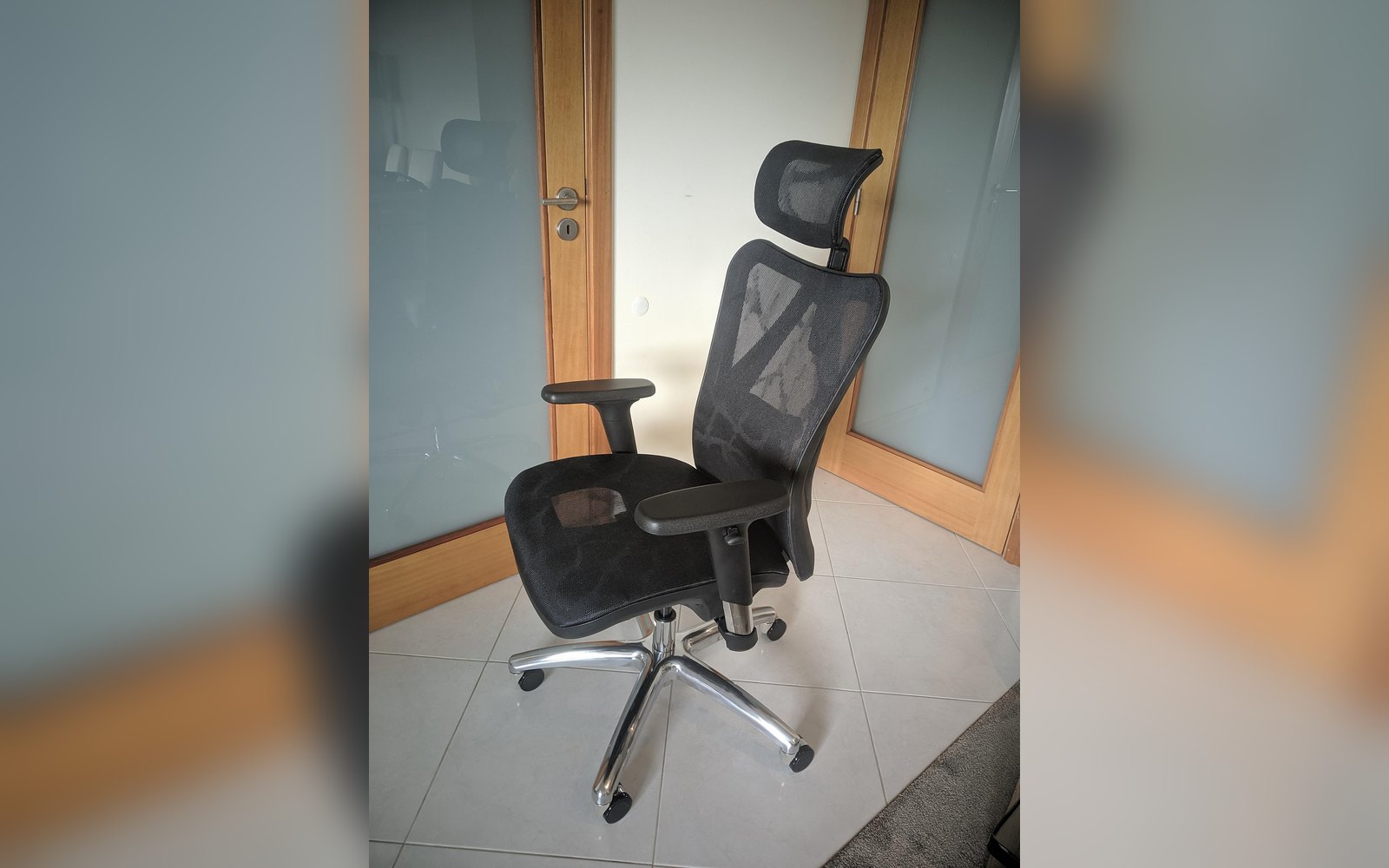
Photo: mesh office chair with headrest and adjustable arms, by Waldyrious, from Wikimedia Commons, licensed CC BY-SA 4.0, placed on a blurred background. Prices, specs and warranty terms from brand and seller listings in October 2026. They will change.