A pressure cooker that is too small turns an ordinary batch of dal into a risky overfilling problem. One that is unnecessarily large takes more space, feels heavier at the sink and may be awkward for everyday portions.
For most Indian households, the right size is determined less by the number printed on the carton and more by three things: how many people you feed, what you cook under pressure, and how much empty space that food needs while expanding.
The short answer
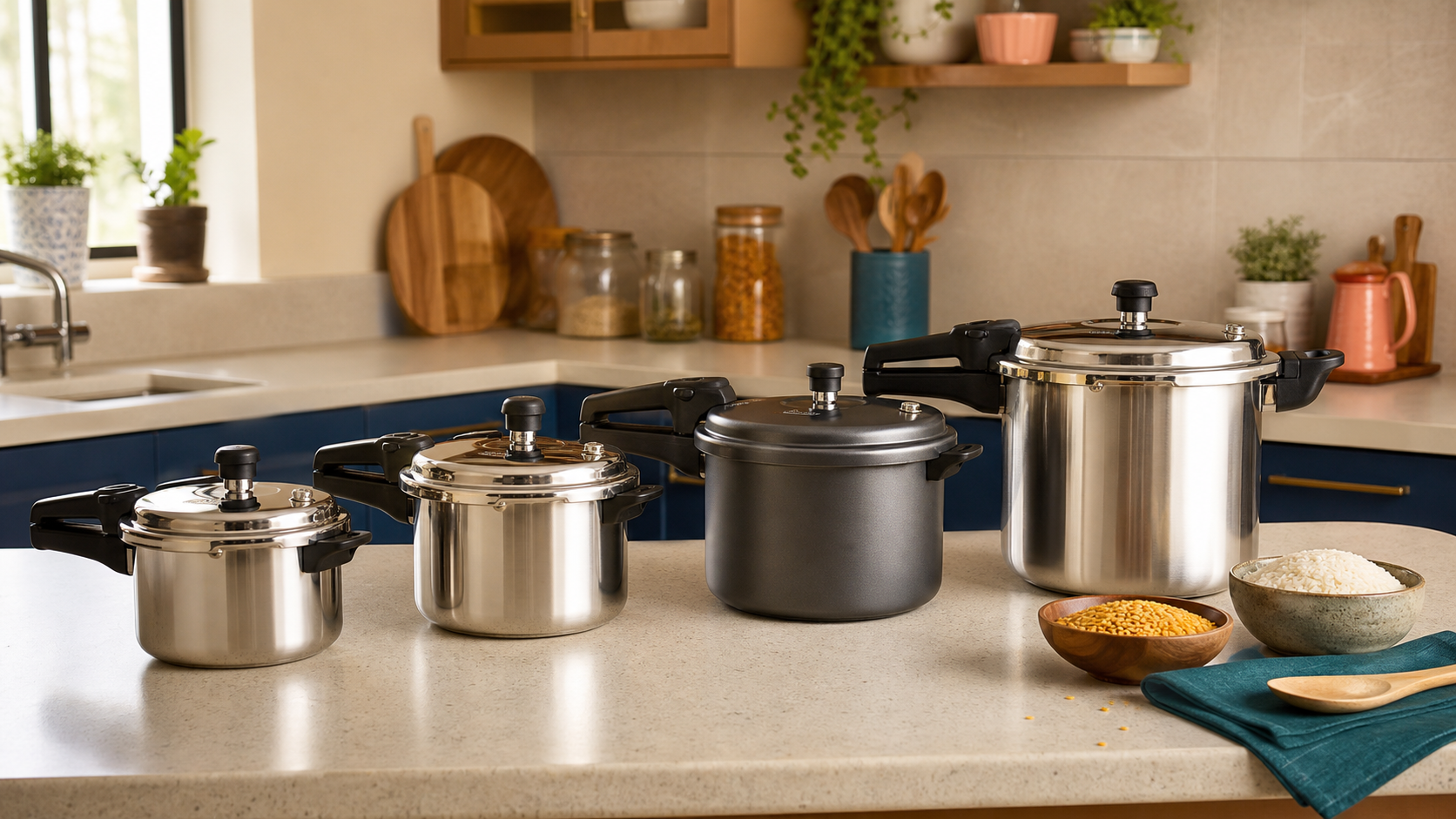
Choose 1.5 litres for one person or genuinely small side-dish quantities; 2 litres for one to two people and compact batches; 3 litres as the most flexible starting size for two to four people; and 5 litres for larger households, batch cooking or stacked containers.
These are starting points, not universal serving guarantees. Cooker shape, recipe, portion size and the manufacturer’s fill limits all change the usable capacity.
Pressure-cooker sizes at a glance
| Nominal size | A sensible starting household | Best suited to | Main limitation |
|---|---|---|---|
| 1.5 L | 1 person; occasionally 2 | Small dal, vegetables, potatoes, a side dish | Little room for expanding foods or guests |
| 2 L | 1–2 people | Daily rice or dal in modest quantities | Can feel tight for batch cooking |
| 3 L | 2–4 people | Everyday dal, rice, curries and many pot-in-pot meals | Not ideal for large batches or frequent guests |
| 5 L | 4–7 people, depending on the dish | Meal prep, larger portions and stacked containers | Heavier, bulkier and excessive for tiny portions |
Hawkins, for example, describes some 1.5-litre models as suitable for one to two people, 2-litre models for two to three, 3-litre models for three to four and 5-litre models for five to seven. Treat those figures as manufacturer guidance for those models—not as a promise that every recipe or every brand will serve the same number.
Nominal capacity is not usable cooking capacity
The litre rating describes the cooker’s total stated volume with the lid closed. You cannot safely fill that entire space with food and water. Steam needs room to circulate, and the vent must remain unobstructed.
Published Hawkins instructions say that solid foods should generally stay below two-thirds of the cooker body’s capacity. Liquids and foods that expand or froth, including rice and many lentils, should generally stay below half. Dals that froth or sprout heavily may need to remain below one-third. Your own model’s manual always takes priority.
| Cooker size | Approx. two-thirds | Approx. half | Approx. one-third |
|---|---|---|---|
| 1.5 L | 1.0 L | 0.75 L | 0.5 L |
| 2 L | 1.3 L | 1.0 L | 0.7 L |
| 3 L | 2.0 L | 1.5 L | 1.0 L |
| 5 L | 3.3 L | 2.5 L | 1.7 L |
These figures are simple fractions rounded for planning. They are not fill instructions for a particular cooker. Use the maximum marks and safety directions supplied with the product.
Who should choose a 1.5-litre cooker?
A 1.5-litre cooker makes sense when one person cooks small, fresh portions and does not expect one vessel to handle every task. It can be convenient for a small quantity of dal, boiled potatoes, vegetables or a side dish.
Its weakness is not quality; it is headroom. Rice, rajma, chana and frothing dals need significant empty space. A small cooker can reach its safe working limit faster than expected once both food and water are added. If you regularly cook for two people, host guests or want leftovers, 1.5 litres may become the second cooker rather than the main one.
Who should choose a 2-litre cooker?
Two litres is a compact everyday option for one or two people who cook measured portions. It gives slightly more flexibility than 1.5 litres without occupying much more storage.
Choose it when you prefer cooking rice and dal separately, rarely batch-cook and already know your usual quantities. Skip it as your only cooker if you often prepare chana, rajma, soups or enough food for the next day.
Why 3 litres is the safest starting recommendation for many homes
A 3-litre cooker is often the best compromise for a couple or a household of up to four. It is still manageable to lift and wash, but it leaves more usable space for expanding foods and is more accommodating when portions change.
It can serve as the primary cooker in a first Indian-apartment kitchen. Before buying, check whether your preferred separator or pot-in-pot containers actually fit the model; litre capacity does not tell you the internal diameter.
Who genuinely needs a 5-litre cooker?
Choose 5 litres when you regularly feed four or more people, prepare food for multiple meals, cook larger quantities of pulses or use stacked containers. The extra headroom is valuable even when the cooker is not filled to its maximum.
The trade-off is physical. A 5-litre cooker is wider or taller, heavier when full and more demanding to wash and store. In a compact kitchen, confirm shelf depth, handle clearance and the available hob space before purchasing. Our guide to organising a small kitchen around daily tasks can help you decide whether it deserves permanent counter access.
Six questions that reveal the right size
- What is your largest frequent batch? Size for the meal you cook every week, not the festival meal you cook twice a year.
- Do you cook foods that expand or froth? Rice, dal and beans require more empty space than dense vegetables.
- Do you want leftovers? A couple cooking four portions may need the same capacity as a larger household eating one meal.
- Will you use separators? Check internal diameter and height, not only litres.
- Can you lift and clean it comfortably? A larger cooker filled with food and water becomes meaningfully heavier.
- Does it match your cooktop? Look for explicit induction compatibility if required; a flat base alone is not enough evidence.
Should you buy one cooker or two?
For a new kitchen, begin with one size that handles the majority of your meals. A 3-litre cooker is the most sensible single starting point for many couples and small families. Live with it before adding another.
A two-cooker combination becomes useful when the jobs are genuinely different—for example, a 2- or 3-litre cooker for daily rice and dal plus a 5-litre cooker for batch cooking or guests. Do not buy a matching set merely because the per-piece price appears lower.
Safety checks matter more than colour or discount
- Look for the BIS Standard Mark and product information referring to the applicable domestic pressure-cooker standard. BIS currently identifies IS 2347:2023 for domestic pressure cookers.
- Read the model-specific manual before first use. Fill limits and minimum liquid requirements can vary.
- Confirm that the vent, pressure-regulating device, gasket and safety-relief system are intact and clean.
- Check that genuine gaskets, safety valves and handles are available locally or through authorised service.
- Never force open a pressurised cooker or interchange lids, gaskets or valves between models unless the manufacturer explicitly permits it.
Our practical recommendation
If you are choosing your first and only pressure cooker, start with 3 litres for a one- to four-person household unless your cooking pattern clearly points elsewhere. Choose 1.5 or 2 litres only when your portions are reliably small. Move to 5 litres when batch cooking, stacked containers or a larger household makes the additional usable capacity worthwhile.
The goal is not to buy the biggest cooker your shelf can hold. It is to choose the smallest size that safely handles your largest regular meal without crowding the vent or forcing you to ignore the manual’s fill limits.
Sources and editorial note
- Bureau of Indian Standards: Product Manual for Domestic Pressure Cooker, IS 2347:2023
- Hawkins: Basic Product Information and capacity limits
- Hawkins: Important safeguards for pressure cookers
- Hawkins: Published model capacities and household guidance
This guide compares published capacity and safety information; it does not claim hands-on testing of every model. Product instructions supplied by the manufacturer should always override general guidance.