For most 2BHK flats that means a 700 to 1,100 VA pure sine wave inverter and one 150Ah to 200Ah tubular battery. ACs, geysers, irons and induction cooktops stay off it.
Shops often sell inverters by flat size: “2BHK? Take 1,100 VA and a 150Ah battery.” That can leave you with a battery that dies in two hours or an inverter that trips when the fridge starts. Sizing one yourself takes ten minutes and a pen.
This guide draws on manufacturer spec sheets, BIS documents and current Indian prices, not hands-on testing.
Step 1: list what must run during a cut
List only what you truly need during a cut, then check each label. Typical figures:
| Appliance | Typical running watts | Notes |
|---|---|---|
| Ceiling fan, ordinary (induction) | 70 to 75 W | The biggest load in most flats |
| Ceiling fan, BLDC | 28 to 35 W | Less than half the load; see our BLDC ceiling fan guide |
| LED bulb or batten | 9 to 20 W each | Old tube lights and CFLs draw more |
| Wi-Fi router and fibre box | 10 to 20 W together | Small but essential for work |
| LED TV (32 to 43 inch) | 40 to 80 W | Check the label |
| Laptop charging | 45 to 65 W each | Gaming laptops can draw 100 W+ |
| External monitor | 20 to 30 W | 24-inch LED class |
| Refrigerator | 100 to 200 W running | Start-up surge about 3 to 4 times running watts |
Leave out anything that heats; more on that below.
Step 2: convert watts to VA
Inverters are sold by VA, and deliver fewer watts than that number. Most buying guides use this rule:
- VA = total watts ÷ 0.8 for fans, lights and electronics.
- Divide by 0.7 instead if a fridge or other motor is a big part of the load.
- Add 20 to 30% headroom so it isn’t running flat out.
- Check the surge rating if a fridge is on the list; its compressor briefly pulls several times its running watts.
One trap: the model number is not the rating. The Luminous Zelio+ 1100, for example, is a 900 VA inverter rated for a 756 W load, according to Luminous’ own listing. Always read the VA and watt figures in the spec table.
Step 3: size the battery for backup hours
The battery decides how long the inverter lasts. The formula every calculator uses:
Backup hours = battery Ah × 12 V × usable share × inverter efficiency ÷ load in watts
Sources disagree on the usable share: conservative guides assume about 50% of a lead-acid battery, calculators based on MNRE figures use 75%, and lithium allows 80 to 90%. Take inverter efficiency as about 85%.
Worked example: a 150Ah tubular battery running 300 W gives 150 × 12 × 0.5 × 0.85 ÷ 300 ≈ 2.5 hours at the cautious end and about 3.8 hours at 75%. That matches the 3 to 4 hours most battery makers quote for this load. A 12.8 V, 100Ah lithium battery gives roughly 3 to 3.5 hours at the same load.
A 1,500 VA or larger inverter usually runs on two batteries (a 24 V system), which doubles the stored energy and the weight.
Three ready answers for a typical flat
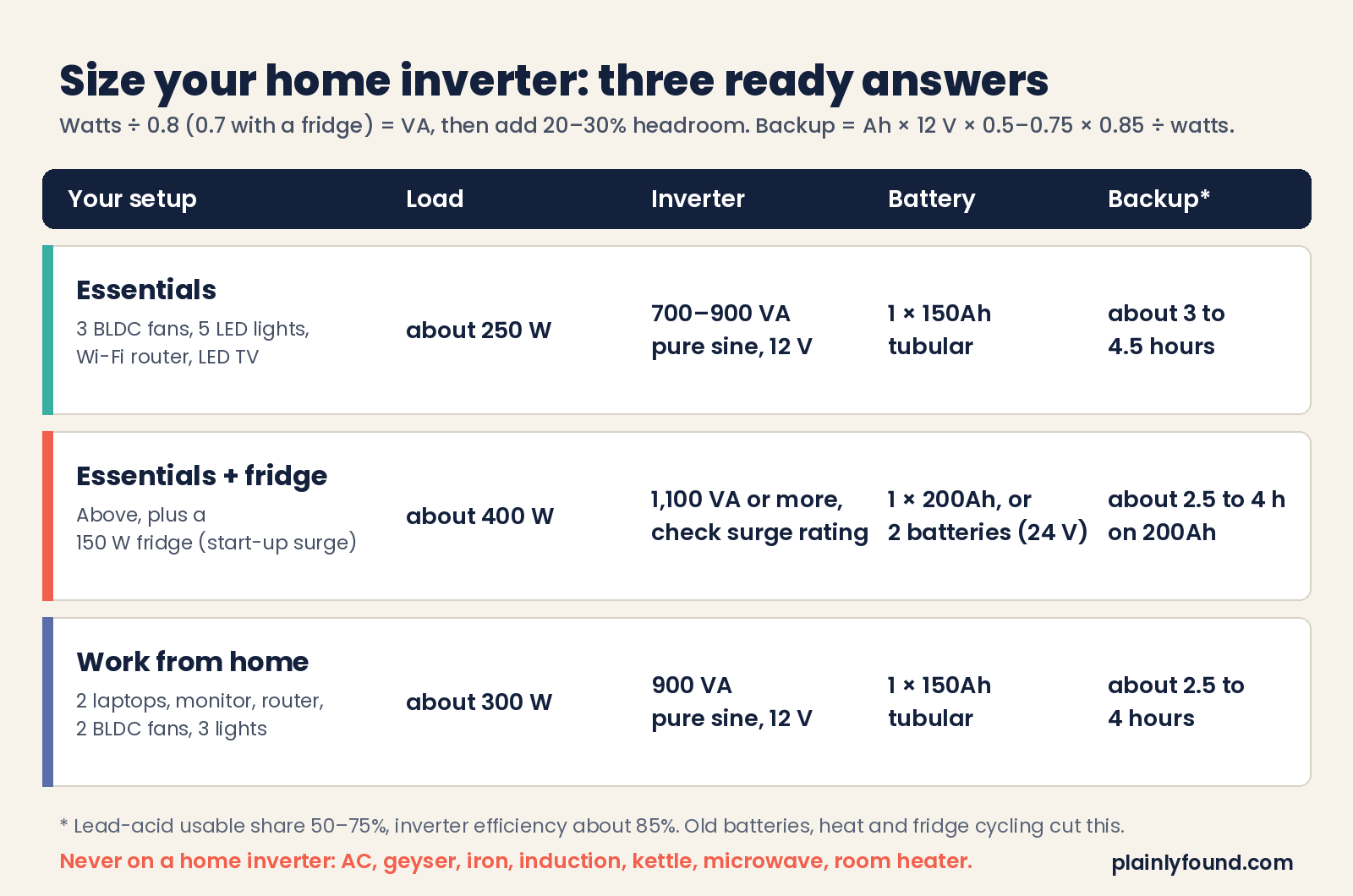
- Essentials (3 BLDC fans, 5 LED lights, router, TV, about 250 W): 700 to 900 VA with one 150Ah tubular battery, about 3 to 4.5 hours.
- Essentials plus fridge (about 400 W): 1,100 VA or more with a good surge rating, and a 200Ah battery or a two-battery 24 V system, about 2.5 to 4 hours on 200Ah.
- Work from home (2 laptops, a monitor, router, 2 BLDC fans, 3 lights, about 300 W): 900 VA with one 150Ah tubular, about 2.5 to 4 hours.
Swapping three 75 W fans for BLDC fans cuts about 130 W, roughly an extra hour of backup. When working from home, the laptops have their own batteries; the router is what really needs backup. Our 9 desk gadgets post and laptop stand guide cover the rest of a home office.
If your cuts are short, a power bank or small router UPS may be enough for phones and Wi-Fi; see our power bank guide.
What not to put on a home inverter
- AC, geyser, room heater and iron: these draw roughly 1,000 to 3,000 W or more, beyond what a normal home inverter can supply.
- Induction cooktop, kettle and microwave: same problem; our kettle and induction guide explains why induction needs mains power.
- Water pump motor: only if the system was specifically sized for its start-up surge.
- Heavy loads on cheap plugs or extension boards: our smart plugs guide explains why 16A loads need proper 16A points.
Inverter vs home UPS, and why pure sine wave matters
In India the two names are used loosely for the same box. What matters is the mode switch: UPS mode changes over quickly and holds output in a narrower band (Luminous lists 180 to 260 V for the Zelio+), which suits desktop PCs; eco mode accepts a wider range to save battery.
Buy pure sine wave. Square wave models can make fans hum and don’t suit BLDC fans, laptops or inverter fridges, and the price gap is now small.
Tubular, flat plate or lithium?
- Flat plate: cheapest, fine for occasional short cuts, shorter life.
- Tall tubular: the default for frequent cuts. Exide lists 1,000 cycles at 80% depth of discharge for its Invamaster range, and Luminous quotes 1,250 for its Inverlast range. Needs distilled water top-ups and weighs about 57 to 58 kg at 150Ah.
- Lithium (LiFePO4): Microtek’s 12.8 V, 100Ah battery is rated for 3,500 to 4,000+ cycles at 80% depth of discharge, weighs about 12 to 14 kg and needs no water. The catch: it lists compatibility only with Microtek’s Next-Gen inverters, and lithium needs an inverter with a lithium charging profile.
Buying checklist
- Pure sine wave output, with VA, watt and surge ratings stated.
- BIS registration on the inverter. UPS and inverters up to 10 kVA are on the BIS compulsory registration list (IS 16242 Part 1), so look for the R-number on the box or label.
- Battery compatibility: flat plate, tubular, SMF and lithium need the right charging profile.
- Charging current to suit your battery (a 150Ah Luminous Inverlast lists a boost charging rate of about 15 A), plus a UPS/eco mode switch.
- Protection: overload, short-circuit and deep-discharge cut-off.
- Warranty in two numbers: full replacement months plus pro-rata months. Exide’s Invamaster is 60 months (36 free + 24 pro-rata) and its Invatubular range 66 months (48 + 18). Many inverters carry 24 to 36 months, sometimes depending on the seller.
- Local service, free installation and a buyback price for the old battery.
What it costs in India
Prices swing around Diwali, and dealers quote lower “with old battery” prices, so compare like with like. Checked in October 2026:
| Item | Spec | Price seen |
|---|---|---|
| Luminous Power Sine M 1100 | 900 VA, pure sine | ₹6,599 on Luminous’ online store |
| Luminous Zelio+ 1100 | 900 VA / 756 W, pure sine, 36-month warranty | ₹7,590 on Amazon.in; ₹8,699 on Luminous’ store |
| Exide InvaMaster IMTT1500 | 150Ah tall tubular, 36 + 24 months | ₹14,478 on Amazon.in; from about ₹12,300 at dealers with exchange (MRP ₹23,393) |
| Luminous Inverlast ILTT18048N | 150Ah tall tubular, 36 + 24 months | About ₹12,200 with old battery to ₹16,399 without, at online dealers |
| Microtek MLB1280060 | 12.8 V, 100Ah LiFePO4, 5-year warranty | About ₹18,499 on Amazon.in; ₹20,190 on Microtek’s store |
So a branded pure sine wave inverter plus one 150Ah tubular battery comes to roughly ₹19,000 to ₹25,000 before installation. Complete lithium systems from retailers commonly run ₹45,000 to ₹90,000 or more.
Placement, safety and rented flats
Lead-acid batteries give off hydrogen while charging, which can become explosive in a sealed space. Luminous’ battery safety note says to keep them in a ventilated, shaded spot such as a balcony, out of direct sun, away from flames, with the water level at the recommended mark.
- Not in a closed cupboard or a bedroom corner with no airflow, and not on a sunny terrace; heat also shortens lead-acid life.
- Check the float indicator regularly and top up with distilled water only, as the manual says.
- Monsoon flooding: if water may reach the battery, switch off the inverter and mains supply and have it checked before use.
- Disposal: return the old battery to the dealer or an authorised collector, never the dustbin.
In a rented flat, ask the landlord or society before adding inverter wiring. Connecting an inverter to the distribution board, or choosing which points it backs up, is a job for a licensed electrician, who should fit a proper changeover so the inverter can never feed power back into the mains. Don’t attempt it yourself.
FAQ
What size inverter do I need for a 2BHK flat?
For fans, lights, a router and a TV (about 250 W with BLDC fans), a 700 to 900 VA pure sine wave inverter and one 150Ah tubular battery give roughly 3 to 4.5 hours. Add the fridge and move up to about 1,100 VA with a 200Ah battery.
How many hours will a 150Ah battery run my inverter?
A healthy 150Ah lead-acid battery runs a 300 W load for roughly 2.5 to 4 hours (Ah × 12 V × 50 to 75% usable × 85% efficiency ÷ watts). Older batteries and hot rooms give less.
Is a home UPS different from an inverter?
In India the names are used loosely for the same box. Look for pure sine wave output and a UPS mode, which switches over quickly for computers.
Can an inverter run an AC, geyser or induction cooktop?
No. They draw roughly 1,500 to 3,000 W, while a typical 900 VA home inverter is rated for about 750 W.
Tubular or lithium battery: which should I buy?
Tall tubular costs less and suits most flats with a ventilated spot. Lithium (LiFePO4) is lighter, maintenance-free and rated for far more cycles, but costs more and often needs the same brand’s inverter.
Bottom line
Size from your own list, not the shop’s. For most flats that means a 700 to 1,100 VA pure sine wave inverter and a 150Ah to 200Ah tubular battery in a ventilated spot, with BLDC fans to stretch the backup and heavy appliances kept off it.
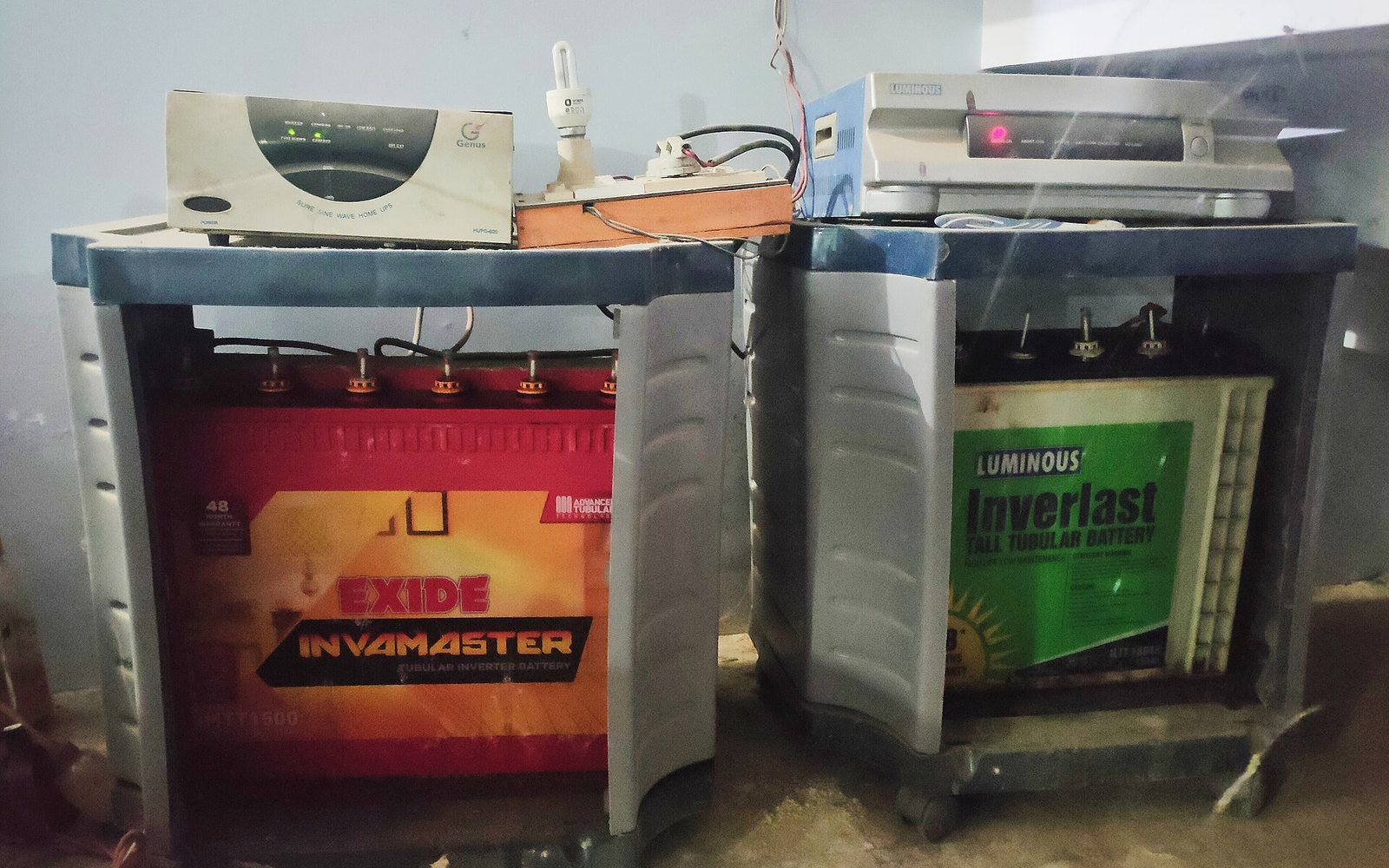
Photo: inverters with Exide and Luminous tubular batteries in an Indian home, by Deepanshu.sr9, from Wikimedia Commons, licensed CC BY-SA 4.0, cropped and resized. Warranty terms from Exide and seller listings. Prices checked in October 2026 and will change.