Before you buy, check three things: a 16A socket near the counter, which of your vessels are magnetic, and the ISI mark on the box.
If you rent, you may not be able to fit a hob, the cylinder runs out at the worst time, or the kitchen is one counter wide. An electric kettle and an induction cooktop are the two appliances that fill that gap. This guide covers what each does well, the wiring and cookware checks to do first, and what to look for on the listing.
It is based on manufacturer specifications, BIS documents and current Indian retail prices, not hands-on testing.
What each one is actually good for
| Job | Electric kettle | Induction cooktop |
|---|---|---|
| Water for tea, coffee, instant noodles, poha or oats | Yes, fastest | Works, but slower to set up |
| Chai with milk, dal, rice, sabzi | No | Yes |
| Pressure cooking | No | Yes, with an induction-base cooker |
| Rotis | No | Works on a flat iron tawa; no direct flame for phulkas |
| Gas backup when the cylinder runs out | Partly | Yes, as long as there is power |
If you are deciding between gas and induction for a permanent kitchen, our two-burner vs three-burner gas stove guide covers the gas side.
Check the socket before you buy
Match the appliance to a 6A or 16A point
Indian homes have two common socket sizes. At 230 V, a 6A socket carries about 1,380 W and a 16A socket about 3,680 W. Kettles sold in India typically draw 1,300 to 1,800 W, and induction cooktops 1,200 to 2,100 W.
- Induction cooktop: always a 16A, three-pin, earthed socket.
- Kettle at 1,500 W or more: use a 16A point. Electrician guides differ on smaller kettles: some say a kettle under 1,500 W is fine on a 6A counter socket, others put every kettle on 16A. If in doubt, use the 16A point.
- Never use an adaptor, travel plug or thin multi-plug extension board to fit a 16A plug into a 6A socket.
One circuit, two heavy loads
Run together, a kettle and an induction plate can draw 3,000 W or more. In many older flats the kitchen sockets share one circuit, and that can trip the MCB. Test it: run each appliance on its own for 20 minutes and feel the plug and socket. If anything gets warm, smells or trips, stop and ask the landlord for an electrician. Don’t fit a bigger MCB to stop the tripping; that just makes the wiring the weak point.
Don’t put either appliance on a cheap smart plug either; our smart plugs guide explains why 16A loads need a genuine 16A rating with headroom.
Voltage swings
Listings quote surge protection (4 kV on the Prestige PIC 20, 6,000 V on Havells’ Evo Cook range). That helps with spikes, not long low-voltage spells; if fluctuations are frequent, ask an electrician about a stabiliser.
Do a cookware audit first
Induction only heats vessels with a magnetic base. Before you buy the cooktop, take a fridge magnet around your kitchen:
- Magnet sticks firmly to the base: it should work.
- Magnet doesn’t stick: it won’t heat. This usually includes the old aluminium pressure cooker, aluminium patilas and idli stands, copper and brass vessels, glass and clay pots, and some stainless steel.
- Base shape: flat bases work best. A deep round-bottom kadhai touches the glass at one point and heats unevenly.
- Base size: very small vessels may not be detected; check the minimum pan size in the manual.
Budget for at least an induction-base pressure cooker and a flat kadhai or tawa. Our pressure cooker size guide helps you pick the right size before replacing it.
Electric kettle checklist
- Capacity: 1.0 to 1.2 litres for one or two people, 1.5 litres for a small family, 1.7 to 1.8 litres for larger households.
- Material: a stainless steel body and, ideally, a steel lid. Glass is taste-neutral but fragile; skip all-plastic bodies.
- Concealed element: a flat steel base is easier to clean than an exposed coil.
- Safety: auto shut-off at boiling, boil-dry protection and a lid that locks.
- Cool-touch or double-wall body if children are around; single-wall steel kettles get very hot.
- Wattage: higher boils faster. A full 1.5 litres takes roughly 5 to 7 minutes at 1,350 to 1,500 W.
Hard water tip: descale every few weeks: boil a mix of water and white vinegar, or water with a spoon of citric acid, leave it for 30 minutes, rinse, then boil and throw away one full kettle of clean water.
Induction cooktop checklist
- Wattage for your cooking: buying guides put about 1,200 to 1,400 W for tea, milk and reheating (or weak wiring), around 1,600 W for two or three people, and 1,800 to 2,100 W for families who pressure-cook and fry daily.
- Real power levels, including a genuinely low setting for milk and simmering dal.
- Pan detection, auto-off and overheat protection, plus a timer and a child lock.
- Warranty on the coil, not just the product. Havells lists 3 years on the coil plus 1 year on the product for its Cook Pro PB 16, and Philips lists 3 years on the coil for the HD4995/00. The Prestige PIC 20 lists 1 year.
- Service reach: check for a service centre in your city; many no-name imports have none.
What they cost in India
Prices move daily around Diwali sales, and many MRPs are inflated, so compare the selling price. Checked in October 2026:
| Model | Key spec | Price seen |
|---|---|---|
| Pigeon Amaze Plus kettle | 1.5 L, 1,300 W | About ₹449 to ₹548 (Amazon.in, per ChoicePilot and ShopFino) |
| Prestige PKOSS kettle | 1.5 L, 1,350 W, steel lid | ₹649 on Amazon.in; ₹750 on Prestige’s own store |
| Havells Aqua Plus kettle | 1.2 L, double wall | About ₹1,769 (ShopFino, 10 October) |
| Philips HD9306 kettle | 1.5 L, 1,800 W | About ₹2,595 (Flipkart, per Pricee) |
| Prestige PIC 20 induction | 1,600 W, push buttons | ₹2,120 on Amazon.in (26 October); ₹1,812 to ₹2,299 through October; ₹2,470 on Prestige’s store |
| Havells Cook Pro PB 16 induction | 1,600 W, 3-year coil warranty | ₹3,990 on havells.com |
| Philips HD4995/00 induction | 2,100 W, 3-year coil warranty | ₹3,649 on Amazon.in |
A basic, branded pair costs roughly ₹2,700 to ₹3,000. Add an induction-base pressure cooker if yours is aluminium.
Running cost
Watts × hours ÷ 1,000 gives units (kWh). A 1,600 W cooktop on full power for 30 minutes uses 0.8 units; at an example tariff of ₹7 per unit that is about ₹5.60. Real use is usually lower; check the per-unit rate on your bill.
Power cuts and gas shortages
Induction is a good backup when the LPG cylinder runs out, but it stops in a power cut. A home inverter’s usable output is roughly 0.7 to 0.8 times its VA rating, so a 1,100 VA inverter gives well under 1,000 W, not enough for a 1,600 W cooktop. If cuts are common where you live, keep a gas option too.
The ISI mark: what changed on 1 October 2026
The Safety of Household, Commercial and Similar Electrical Appliances (Quality Control) Order, 2026 (S.O. 1739(E), dated 6 April 2026) makes the ISI mark under IS 302 (Part 1):2024 compulsory for household electrical appliances. Its list includes cooking ranges and hobs and appliances for heating liquids, the categories that cover induction cooktops and kettles. The BIS list of upcoming QCOs gives 1 October 2026 as the enforcement date.
As the Standphill India explainer of the order notes, that date applies to large, medium and foreign manufacturers; small enterprises have until 1 January 2027 and micro enterprises until 1 April 2027, and certified makers can sell declared older stock for up to six months. So unmarked units can still be on shelves for a while. Prefer a box and product with the ISI mark and a CM/L licence number, which you can check in the BIS Care app.
What to skip
- “Kettle cookers” for milk and noodles: milk scorches onto the base. Boil water in the kettle; cook on the induction.
- Paying extra for preset menus: most people use two or three power levels and the timer.
- A 2,100 W cooktop when your only heavy-duty socket is doubtful: a 1,600 W model is gentler on old wiring.
- Multi-plug extension boards and adaptors for either appliance.
- No-name imports with no ISI mark and no service centre near you.
Setting up from scratch? Our first kitchen checklist covers the rest of the basics, and our renter-friendly smart home gadgets post has more upgrades that don’t need the landlord’s permission.
FAQ
Can I run an induction cooktop from a normal 6A socket?
No. A 6A socket carries about 1,380 W at 230 V, and most induction cooktops draw 1,200 to 2,100 W. Use a 16A earthed socket with a 16A plug, never an adaptor or a multi-plug extension board.
Will my old pressure cooker work on induction?
Only if its base is magnetic. Do the magnet test: if a fridge magnet sticks firmly to the base, it should work. Most older aluminium cookers, patilas, idli stands and copper or brass vessels won’t, so budget for an induction-base cooker.
Can I use the kettle and the induction cooktop at the same time?
Together they can draw 3,000 W or more, which an older rented-flat kitchen circuit may not handle. Run one at a time unless they are on separate 16A points.
Is the ISI mark compulsory for kettles and induction cooktops now?
Under the Quality Control Order for household electrical appliances (S.O. 1739(E)), the ISI mark under IS 302 (Part 1):2024 is mandatory from 1 October 2026 for large, medium and foreign manufacturers, 1 January 2027 for small firms and 1 April 2027 for micro firms. Declared older stock can still be sold for up to six months, so check the box.
Can a home inverter run an induction cooktop?
Usually not. An inverter’s real output is roughly 0.7 to 0.8 times its VA rating, so a 1,100 VA unit gives well under 1,000 W, while even small induction cooktops draw 1,200 W or more.
Bottom line
Check the socket and your vessels first, then buy for your actual cooking: a steel kettle in the 1.2 to 1.5 litre range and a 1,600 W induction cooktop with a coil warranty, both carrying the ISI mark. Run them on 16A points, and keep a gas or cylinder backup if power cuts are common.
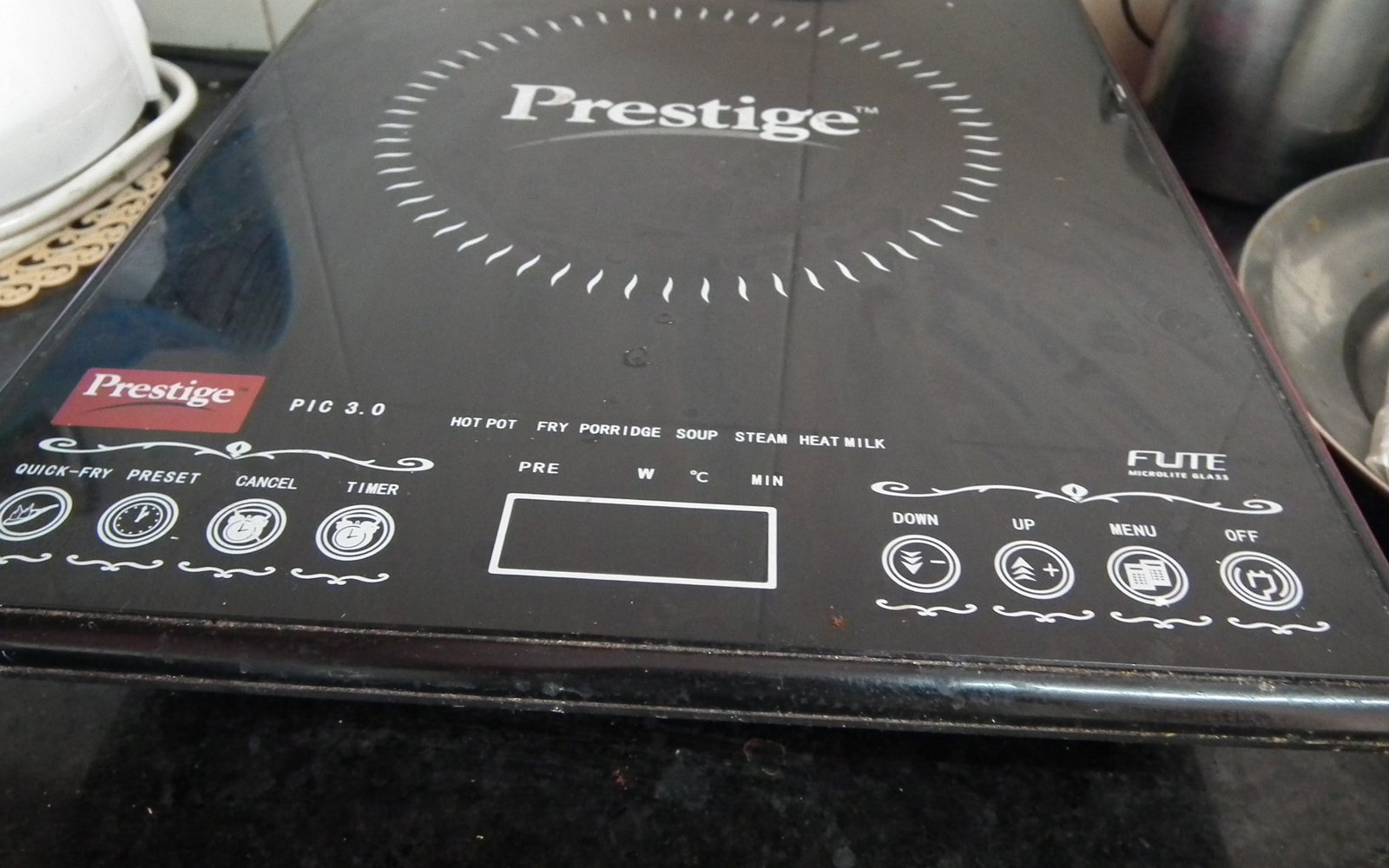
Photo: Prestige induction cooker in an Indian kitchen by Rameshng, from Wikimedia Commons, licensed CC BY-SA 3.0, cropped and resized. Prices checked between 10 and 26 October 2026 and will change.