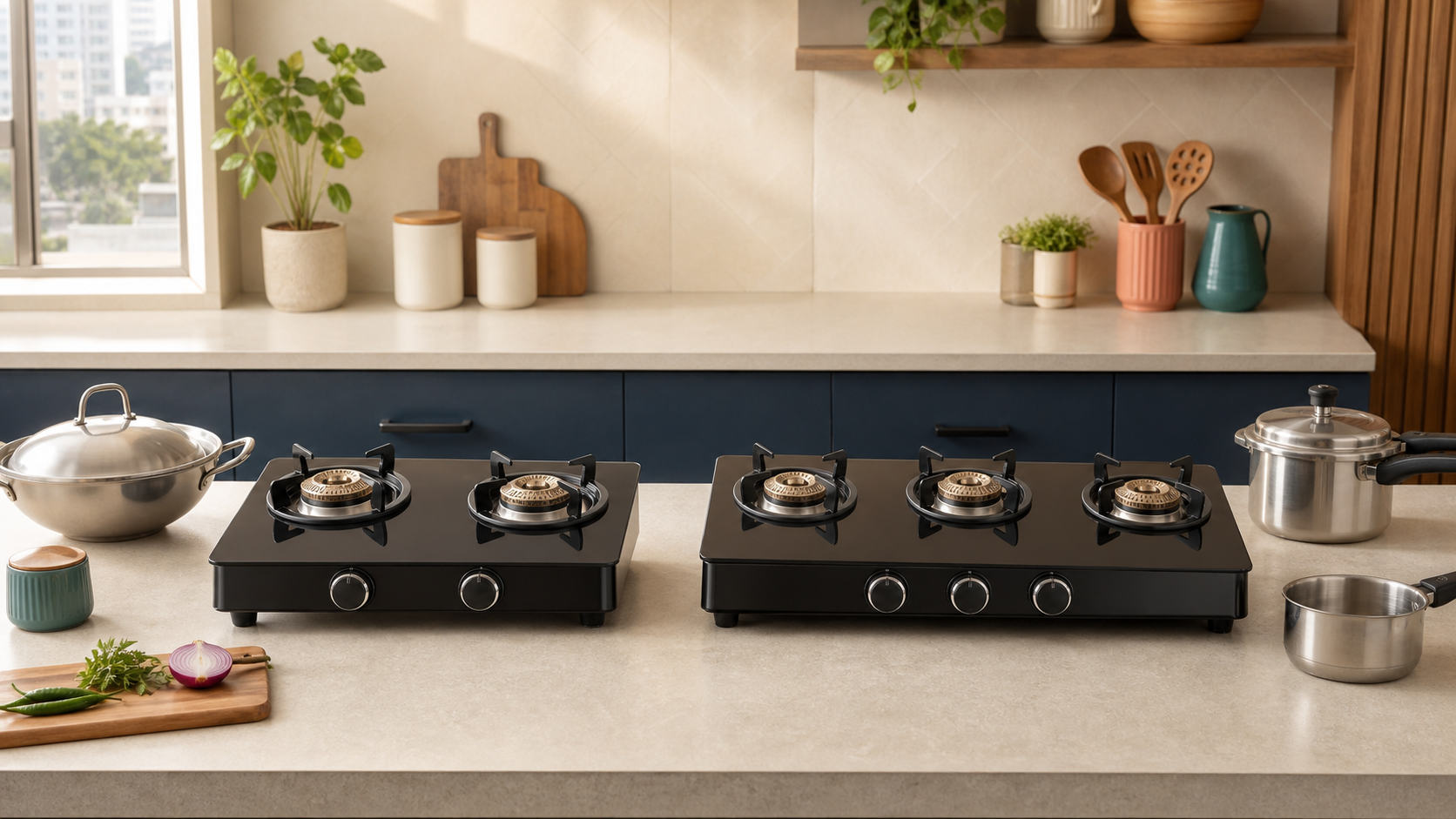
A three-burner gas stove is not automatically better than a two-burner model. The better choice is the one that lets your real vessels sit safely, leaves useful preparation space on the counter and matches how many dishes you genuinely cook at the same time.
The short answer
Choose two burners for a compact counter, one main cook or meals usually made in sequence. Choose three burners when you regularly run three genuinely compatible vessels at once and have measured enough width around the stove. Burner spacing matters more than the number printed on the box.
Two burners vs three burners at a glance
| Decision | Two-burner stove | Three-burner stove |
|---|---|---|
| Best fit | Compact kitchens and simpler routines | Wider counters and frequent parallel cooking |
| Large-vessel comfort | Often easier to place a kadai and pressure cooker together | Depends heavily on burner spacing and layout |
| Simultaneous dishes | Two, with straightforward access | Up to three if vessel handles do not collide |
| Cleaning | Fewer supports, burners and tight gaps | More components and a wider surface |
| Common mistake | Buying too narrow a model for two large vessels | Assuming all three burners remain usable with wide cookware |
Start with the counter, not the family-size label
Household size is only a rough clue. A couple making roti, sabzi and dal together may benefit from three burners more than a family that prepares one-pot meals in sequence. Measure the kitchen before using labels such as “small family” or “medium family” to decide.
Record the clear width and depth of the counter, then account for the gas inlet, wall, backsplash and space needed to turn handles without hitting anything. Keep preparation room beside the stove instead of allowing the appliance to consume the entire worktop.
Burner count does not reliably predict dimensions. Official product listings illustrate the variation: one Prestige two-burner model is listed at 44 × 44 cm, while another brand’s two-burner model is approximately 66 × 39.5 cm. Listed three-burner models also range from compact arrangements to approximately 80 cm wide. Compare the exact dimensions of the exact model—not an assumed category size.
Vessel spacing is the real three-burner test
Three visible burners do not guarantee three usable cooking positions. Put the diameters of your usual cookware on paper: the pressure cooker size you actually use, your widest kadai, the tawa and a saucepan. Add room for handles and fingers.
A triangular layout can fit three smaller vessels while becoming awkward with a wide tawa or kadai. A long linear layout may offer better separation but require substantially more counter width. Look for product photographs taken from above and published measurements between burner centres when available.
If shopping offline, take the diameter and handle-to-handle width of your two largest everyday vessels. Place similarly sized vessels on the display stove. If they touch, tilt or block the knobs, the nominal third burner will not solve your problem.
When a two-burner stove is the better choice
- Your counter is compact and you need preparation space beside the flame.
- One person normally cooks and prefers moving logically between two pans.
- You regularly use a wide tawa, large kadai or pressure cooker.
- Most meals involve one main dish plus rice, roti or dal.
- You value easier cleaning and fewer tight gaps around pan supports.
- You are building a first kitchen with a controlled starting budget.
Do not buy the narrowest two-burner stove blindly. Two burners placed too close together can still prevent a large kadai and pressure cooker from sitting flat at the same time.
When a three-burner stove earns the extra space
- You routinely cook three components in parallel—for example dal, sabzi and rice.
- Morning or evening meals must be completed within a short window.
- Two people sometimes work at the stove together.
- The counter is wide enough for the appliance and a separate preparation zone.
- Your usual vessel diameters fit the published burner layout without overlap.
A third burner is useful when it changes the workflow, not simply when it looks more capable. If it mostly holds a spoon rest while the other two burners run, you have paid for width rather than speed.
Will three burners save time or LPG?
A third burner can reduce elapsed cooking time when three dishes genuinely need heat at once. It does not automatically reduce gas consumption. Total use depends on burner ratings, flame level, vessel size, cooking duration and whether the third burner changes the sequence.
A large flame extending beyond the base of a small pan wastes heat regardless of burner count. Match small vessels to the smaller burner, use lids where appropriate and reduce the flame after boiling or pressure is reached.
Do not compare stoves using the number of burners alone. Published burner ratings and total gas consumption provide more useful information, although real household use will still depend on cooking behaviour.
Check the burner mix, not only the burner count
A useful three-burner layout normally combines burner sizes so that a small saucepan does not need the same flame as a wide kadai. Check which burner is large, medium or small and whether the control knobs clearly correspond to the layout.
Also inspect:
- Pan-support stability: rounded vessels and a pressure cooker should sit without rocking.
- Knob clearance: hands should not pass close to a hot vessel to adjust another burner.
- Drip-tray access: removable components should come out without dismantling half the stove.
- Inlet position: it must suit the LPG hose or authorised PNG connection without sharp bends.
- Service access: burners, knobs and valves should have genuine replacements and authorised support.
LPG and PNG are not interchangeable labels
Check the exact fuel configuration before purchase. Some stoves are sold for LPG; others are dedicated to PNG; some manufacturers permit conversion by authorised service. Do not treat conversion as a do-it-yourself nozzle change. Follow the appliance manufacturer and gas supplier’s instructions.
Safety and certification checks
The Bureau of Indian Standards published IS 4246:2025 for domestic gas stoves and built-in hobs used with LPG. It covers areas including flame stability, combustion quality, resistance to draught, thermal shock, pan-support design, gas connections and marking. When buying, look for the BIS Standard Mark and verify the licence/product details applicable to the model.
- Install and use the stove according to the manufacturer and gas supplier’s instructions.
- Keep the area ventilated and combustible plastic, cloth and packaging away from the stove.
- Inspect the LPG hose for damage and follow the replacement interval specified by the supplier or appliance manufacturer.
- Never search for a gas leak with a match, lighter or other flame.
- If you smell gas, turn off the supply when it is safe to do so, avoid operating electrical switches or flames, ventilate the area and contact the authorised gas provider.
- Keep burner ports clean and dry so the flame remains stable.
A five-minute decision test
- Measure the clear countertop width and depth.
- Write down the three dishes you most often cook together.
- Measure your widest kadai, tawa and pressure cooker, including handles.
- Compare those measurements with the exact burner layout and overall product dimensions.
- Choose three burners only if all three positions remain useful and you retain preparation space.
This approach is more reliable than deciding from household size alone. It also prevents the stove from creating the kind of counter congestion addressed in our guide to organising a small Indian kitchen without buying more storage.
Our practical recommendation
Choose a well-spaced two-burner stove for a compact first kitchen, a one- or two-person cooking routine, or frequent use of wide vessels. Choose three burners when parallel cooking is a regular habit and your measurements confirm that the third position remains usable.
Do not sacrifice safe vessel spacing and all your preparation space for a burner you might occasionally use. A thoughtfully placed two-burner stove can be more functional than a cramped three-burner model.
Sources and editorial note
- Bureau of Indian Standards: IS 4246:2025 overview for domestic gas stoves and built-in hobs
- Prestige: Example two-burner product dimensions and fuel-conversion information
- Prestige: Example three-burner product dimensions
- Glen: Example two-burner dimensions and burner ratings
- Glen: Example three-burner dimensions, layout and certification information
This guide compares published specifications and practical layout considerations; it does not claim hands-on testing of every stove. Installation and safety instructions from the manufacturer and authorised gas supplier always take priority.