The deciding number is humidity, not temperature. Many homes end up with both: a cooler for the hall and the hot dry months, and one AC for the bedroom and the sticky ones.
Every April, people in Jaipur, Jodhpur, Kota and other dry-heat cities ask the same thing: is a cooler enough, or is it time for an AC? The honest answer depends on the month.
This guide works it out month by month from IMD climate normals for Jaipur, then covers sizing, rupee running costs and upkeep. It’s based on IMD data, government guidance, maker specs and current Indian listings, not hands-on testing.
Why humidity, not heat, decides
A cooler doesn’t make cold air. It pulls hot outdoor air through wet pads, and the water that evaporates takes heat with it. Drier air can absorb more water, so it cools more.
The limit is the wet-bulb temperature: the temperature a wet cloth reaches in that air. No cooler can push air below it. A good honeycomb pad gets about 80 to 90% of the way there; old wood-wool (aspen) pads manage roughly 50 to 70%. So the useful number is the gap between the air temperature and the wet-bulb temperature. In dry air the gap is wide. In humid air it shrinks to almost nothing, and the cooler just adds moisture.
An AC moves heat outside and also dries the room, so it works in any weather, at a much higher running cost.
Jaipur, month by month
The table below uses IMD’s 1991 to 2020 climatological normals for Jaipur at 5:30 pm, roughly the hottest part of the day. The last column is our estimate of the air coming out of a cooler with honeycomb pads at about 80% efficiency. The room itself will run a few degrees warmer than that, because walls, roof and people add heat.
| Month | Air temp | Humidity | Wet-bulb | Cooler output (est.) | Verdict |
|---|---|---|---|---|---|
| March | 34.5 °C | 42% | 24.2 °C | about 26 °C | Cooler works well |
| April | 37.5 °C | 37% | 25.5 °C | about 28 °C | Cooler works well |
| May | 39.9 °C | 31% | 25.8 °C | about 29 °C | Cooler at its best |
| June | 35.2 °C | 49% | 26.0 °C | about 28 °C | Good early, fading late |
| July | 29.7 °C | 71% | 25.5 °C | about 26 °C, but damp | Fan or AC |
| August | 28.5 °C | 75% | 25.2 °C | about 26 °C, but damp | Fan or AC |
| September | 29.8 °C | 70% | 25.4 °C | about 26 °C, but damp | Fan or AC |
| October | 29.6 °C | 67% | 24.8 °C | about 26 °C | Fan is usually enough |
In May the cooler takes about 11 °C off the air; even on a 43 °C afternoon, air leaving a good cooler is around 30 °C. From July to September it only takes about 3 °C off air that’s already humid, and the room gets clammy. That’s the season when coolers get their bad name.
June is split: dry pre-monsoon heat first, then a humidity jump once the monsoon arrives. Other dry-heat cities follow a similar pattern; check your city’s IMD normals.
Three questions before you buy
- How humid are your hottest months? If afternoon humidity stays under about 50% when it’s hottest, a cooler can carry you. If it’s above about 65 to 70%, a cooler mostly makes air damp.
- Can the room stay ventilated? A cooler needs a window near it and an opening on the opposite side. In a sealed room it stops cooling within an hour or two.
- Do you need it for sleep? Humidity rises after sunset, so coolers work less well at night. If you sleep with the room closed, plan for an AC there.
When a cooler is enough
- A hall, study or bedroom that can keep a window open.
- March to mid-June in Jaipur and other dry-heat cities.
- Homes with frequent power cuts: a cooler runs on a home inverter (see our inverter sizing guide); an AC usually doesn’t.
- A non-AC work room, paired with a mesh office chair so you’re not sweating into the backrest.
When an AC is worth it
- You need comfort through July to September, not just April and May.
- The room has to stay closed: for sleep, noise, dust or security.
- A top-floor flat with a sun-baked roof, where the room heats up faster than a cooler can flush it.
- You want to keep dust out. A cooler pulls outdoor air in all day, so it can’t be paired with an air purifier, which needs closed windows.
For most Jaipur homes the sensible plan is both: a desert cooler for the hall and the dry months, and one 1.5-ton inverter AC in the main bedroom. In the humid months, a BLDC ceiling fan alone often does as much as a cooler, for far less power.
Sizing a cooler: go by airflow, not tank size
Tank litres only tell you how long it runs between refills. What cools the room is air delivery, in cubic metres an hour (m³/h).
- Rule of thumb: engineering guides commonly suggest 20 to 40 air changes an hour for evaporative cooling in hot, dry climates. Work out the room’s volume, multiply by about 30, and treat brand airflow claims as roughly 25% optimistic. A 12 x 14 ft bedroom with a 10 ft ceiling is about 48 m³, so look for around 1,500 m³/h on the box after that discount, i.e. a claim near 2,000.
- Air throw should be longer than the room’s long side.
- Tank: on dry afternoons a big desert cooler can empty much of a 100 L tank in a day. Auto-fill from a tap saves a lot of bucket trips.
Cooler checklist
- Honeycomb pads, not aspen wood wool. They cool better and last longer, especially in hard water.
- A pump suited to hard water. Jaipur’s groundwater is often hard, and scale kills pumps and clogs pads. Check your tap water’s TDS (our water purifier guide explains how), rinse pads monthly and expect to replace them sooner in hard-water areas.
- BIS Standard Mark. Evaporative coolers must meet IS 3315:2019 and carry the BIS mark under the Air Cooler and Air Filters (Quality Control) Order, 2025, in force since April 2025 for larger makers and October 2025 for micro enterprises.
- Inverter compatible label, if you’ll run it during power cuts. Ask whether that covers all fan speeds.
- BLDC motor if budget allows: lower power and longer inverter backup.
- Covered tank or mosquito net, dust filter, 4-way swing and castor wheels.
- Warranty that names the motor and pump.
- Safety: water and electricity sit together, so use a properly earthed socket, especially with metal-body coolers. If you’re unsure about the wiring, get a licensed electrician to check it.
Running cost in rupees
Assumptions: 8 hours a day for 30 days, and about ₹8 a unit, which is JVVNL’s ₹7 slab for 151 to 500 units a month plus electricity duty and surcharge. Your bill will differ with your slab and hours.
| Appliance | Power | Units a month | Cost a month |
|---|---|---|---|
| Desert cooler, standard motor | About 185 to 210 W (Symphony and Crompton listings) | About 45 to 50 | About ₹360 to ₹400 |
| Desert cooler, BLDC motor | About 100 W | About 25 | About ₹200 |
| 1.5-ton 5-star inverter AC | Varies; label assumes 1,600 hours a year | About 140 to 240 in a Jaipur summer (our estimate) | About ₹1,100 to ₹1,900 |
The AC row is an estimate. BEE star labels give annual units based on 1,600 hours of use spread across mild and hot days; a 5-star 1.5-ton model is rated around 680 to 760 units a year. Jaipur’s 40 °C+ afternoons push real use above that average.
What they cost to buy
| Option | Example | Price seen (2 Nov 2026) |
|---|---|---|
| 100 L desert cooler | Crompton Optimus 100 L | ₹12,499 (Flipkart) |
| 100 L desert cooler | Bajaj XForce 100 L | ₹13,429 (Flipkart) |
| 100 L desert cooler | Symphony Storm 100 XL | ₹14,954 (Flipkart; up about 16% in a month) |
| 1.5-ton 5-star inverter split AC | Daikin FTKM50XV16 | ₹49,999 (Flipkart), plus installation |
Examples, not recommendations; prices swing with the season, so check price history. Budget extra for split AC installation and copper pipe.
Upkeep that actually matters
- Empty, scrub and dry the tank every week. Open cooler tanks are a major dengue mosquito breeding site; the National Center for Vector Borne Diseases Control says water standing in coolers for more than a week is a warning sign.
- Drain it fully when you stop using it, especially once the monsoon starts, and don’t reuse last season’s grass pads.
- Clean the pads and dust filter monthly in dusty months.
FAQ
Is a cooler enough for Jaipur summers?
From March to mid-June, yes, if the room stays ventilated. May afternoons average about 31% humidity, so a good honeycomb cooler can take around 10 to 12 °C off the air. It struggles from the monsoon until October.
Does a desert cooler work in the monsoon?
Barely. At 70 to 75% afternoon humidity in July and August, a cooler takes only about 3 °C off the air and makes the room damper. A fan or an AC feels better.
Can I run a cooler in a closed bedroom at night?
Not well. A closed room gets muggy within an hour or two. Keep a window or door open opposite the cooler, or use an AC for a closed bedroom.
Will a desert cooler run on a home inverter?
Usually. Most desert coolers draw about 150 to 250 W, within a normal 900 to 1,100 VA home inverter’s reach; a 1.5-ton AC is not. Check for an inverter-compatible label.
How often should I clean the cooler tank?
Weekly while in use: empty, scrub and dry it before refilling, so dengue mosquitoes can’t breed. Drain it fully when you stop using it.
Bottom line
In a dry-heat city, check your hottest months’ humidity before choosing. If it’s low and the room stays ventilated, a honeycomb desert cooler sized by airflow will carry you through spring and early summer for a few hundred rupees a month. For humid months and closed bedrooms, add an AC. Just visiting? Plan our weekend getaways from Jaipur for October to March, when you need neither.
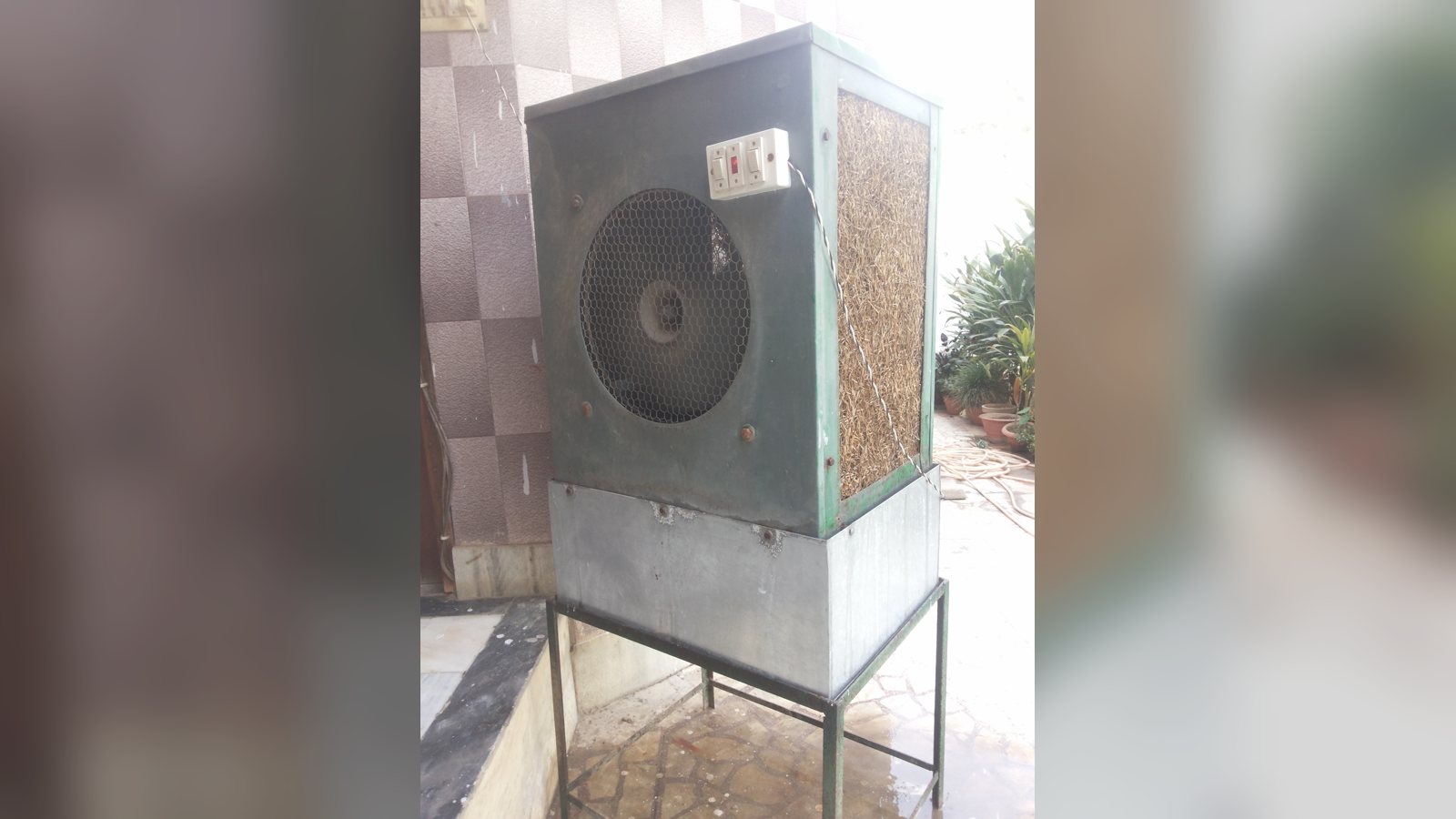
Photo: a traditional metal desert cooler in North India, by Utkarshsingh.1992, from Wikimedia Commons, licensed CC BY-SA 1.0, placed on a blurred background. Climate figures: IMD Climatological Tables 1991–2020, Jaipur station, 17:30 IST. Cooler output column is our calculation at 80% pad efficiency. Prices from Smartprix/Flipkart listings on 2 November 2026; they will change.