Buy for the sensor, not the brand. For smog and cooking smoke you want a laser PM2.5 sensor. For a stuffy closed bedroom you want a true NDIR CO2 sensor. Treat TVOC and formaldehyde readings as rough hints. Always compare raw µg/m³, not the AQI number, because many devices use the US scale, not India’s.
The monitor on the shelf says 38, and the SAMEER app says your city is at 180. Is the room fine, or is the monitor lying? Usually they are measuring different things.
This guide is about the monitor, not the purifier. If you are still choosing a purifier, start with our guide to air purifiers for Indian apartments. Here we cover what each sensor can do, which reading matters, why Indian and US AQI numbers don’t match, and what each price buys in November 2026.
Start with the problem you’re trying to solve
Each worry needs a different sensor, and a cheap “6-in-1” box often does none of them well.
| Your worry | Reading that matters | Sensor to look for |
|---|---|---|
| Smog, dust, cooking smoke; is my purifier working? | PM2.5 (and PM10) in µg/m³ | Laser (light-scattering) particle sensor |
| Stuffy bedroom, headaches, windows shut all winter | CO2 in ppm | NDIR (non-dispersive infrared) CO2 sensor |
| New paint, new furniture, strong cleaning products | TVOC, formaldehyde (HCHO) | Metal-oxide or electrochemical sensor; trend only |
In a North Indian winter, PM2.5 matters most. CO2 comes second, because shutting windows against smog is what makes bedrooms stuffy.
Are cheap air quality monitors accurate?
Accurate enough for direction, not for decimals. Here’s how each reading holds up.
PM2.5: laser sensors are decent, with one big catch
Nearly every home monitor estimates particles by shining a laser through a small air stream and counting the scattered light. It converts counts into µg/m³ using assumptions about particle size and density. That’s why two good monitors in the same room can differ by 10 to 20%. Makers’ own specs admit it: Airveda states a maximum error of ±10% or ±10 µg/m³, and Prana Air quotes ±10% up to 150 µg/m³ and ±15% above that.
Some very cheap units use older infrared-LED dust sensors rather than lasers. They are cruder still. If a listing doesn’t say “laser” anywhere, assume it isn’t.
The catch is humidity. Particles absorb water and swell in damp air, so they scatter more light and the monitor reads high. Field studies keep finding the same pattern: low-cost optical sensors start overestimating above roughly 70 to 75% relative humidity, and the error grows quickly after that. In a foggy Delhi or Lucknow morning, or a monsoon week in Mumbai, an inflated reading may be water rather than smoke.
CO2: “eCO2” is not CO2
A real CO2 reading needs an NDIR sensor, which measures how much infrared light CO2 absorbs. Many cheap monitors show “CO2” or “eCO2” (equivalent CO2) that is really a guess made from a VOC sensor. It jumps when you fry onions or spray a cleaner, even though CO2 hasn’t changed much. If the spec sheet doesn’t name NDIR, treat the CO2 figure as decoration.
NDIR sensors drift slowly over months. Good ones can be reset outdoors, where fresh air sits at roughly 420 ppm.
TVOC and formaldehyde: trend only
Low-cost VOC sensors react to everything from agarbatti and perfume to paint fumes, and can’t tell them apart. Use them to see whether a room is improving after fresh paint, not to read the exact level. A “danger” alert from a ₹1,500 box is a reason to ventilate, not to panic.
Why your monitor and the SAMEER app disagree
India’s National AQI, published by CPCB and shown in its SAMEER app, uses different cut-offs from the US EPA’s AQI. Many imported and app-based monitors default to the US scale, so the same air gets a different number and colour. The US also tightened its PM2.5 scale in 2024: “Good” now ends at 9.0 µg/m³ instead of 12.
| PM2.5 (µg/m³) | India NAQI (CPCB) | US AQI (EPA, 2024) |
|---|---|---|
| 0–30 | Good | Good up to 9.0, then Moderate |
| 31–60 | Satisfactory | Moderate to 35.4, Unhealthy for sensitive groups to 55.4, then Unhealthy |
| 61–90 | Moderately polluted | Unhealthy |
| 91–120 | Poor | Unhealthy |
| 121–250 | Very poor | Unhealthy to 125.4, Very unhealthy to 225.4, then Hazardous |
| Above 250 | Severe | Hazardous |
Take one reading: 50 µg/m³. On CPCB’s scale that works out to an index of about 83, “Satisfactory”. On the US scale it is about 137, “Unhealthy for sensitive groups”. Same air, two very different alarms. CPCB explains its bands in its note on the National Air Quality Index.
Official AQI also uses 24-hour outdoor averages, while your monitor shows the last few seconds indoors. So set your monitor or app to show raw PM2.5 in µg/m³ and compare µg/m³ to µg/m³.
Which readings to act on
- PM2.5 indoors: lower is better. With a purifier running in a closed room, you should see it fall steadily within 20 to 30 minutes. If it barely moves, check the room size, the fan speed and the filter (see our filter replacement guide).
- CO2: outdoor air is about 420 ppm. Health Canada’s residential guideline sets 1,000 ppm as a 24-hour average limit, mainly as a sign of poor ventilation. A bedroom that climbs well past 1,000 ppm overnight needs a little fresh air: a window open a crack, a door left ajar, or an exhaust fan for a few minutes.
- Humidity: worth having, because it tells you when PM2.5 readings may be inflated, and whether winter air is dry enough to need a humidifier (our cool mist vs warm mist guide covers that).
The real trade-off in a Delhi winter is between PM2.5 and CO2: open the window and particles come in, keep it shut and CO2 builds up. A monitor that shows both lets you choose short airing breaks when outdoor PM2.5 is lowest, often in the afternoon, instead of guessing.
What you get at each price (November 2026)
| Budget | What you usually get | Examples checked |
|---|---|---|
| Under ₹2,500 | Generic “6-in-1” units; sensor types often not named, CO2 usually estimated | DeWire 6-in-1 at ₹1,889 on Amazon.in (CO2 sensor type not stated) |
| ₹3,000–₹6,000 | Laser PM2.5/PM10, basic app, small battery | Prana Air Pocket PM2.5 at ₹3,990 on its brand site; 3–4 hours of battery, so it’s for spot checks |
| ₹10,000–₹19,000 | Laser PM sensor calibrated by the maker, Wi-Fi history; some add temperature and humidity | Airveda PM2.5/PM10 monitor ₹10,999; Airveda Aurora (adds PM1, temperature, humidity) ₹18,999 |
| ₹20,000–₹30,000 | Laser PM plus true NDIR CO2, temperature and humidity | Airveda Pulse ₹23,999; Pulse Touch ₹29,925 (brand site) |
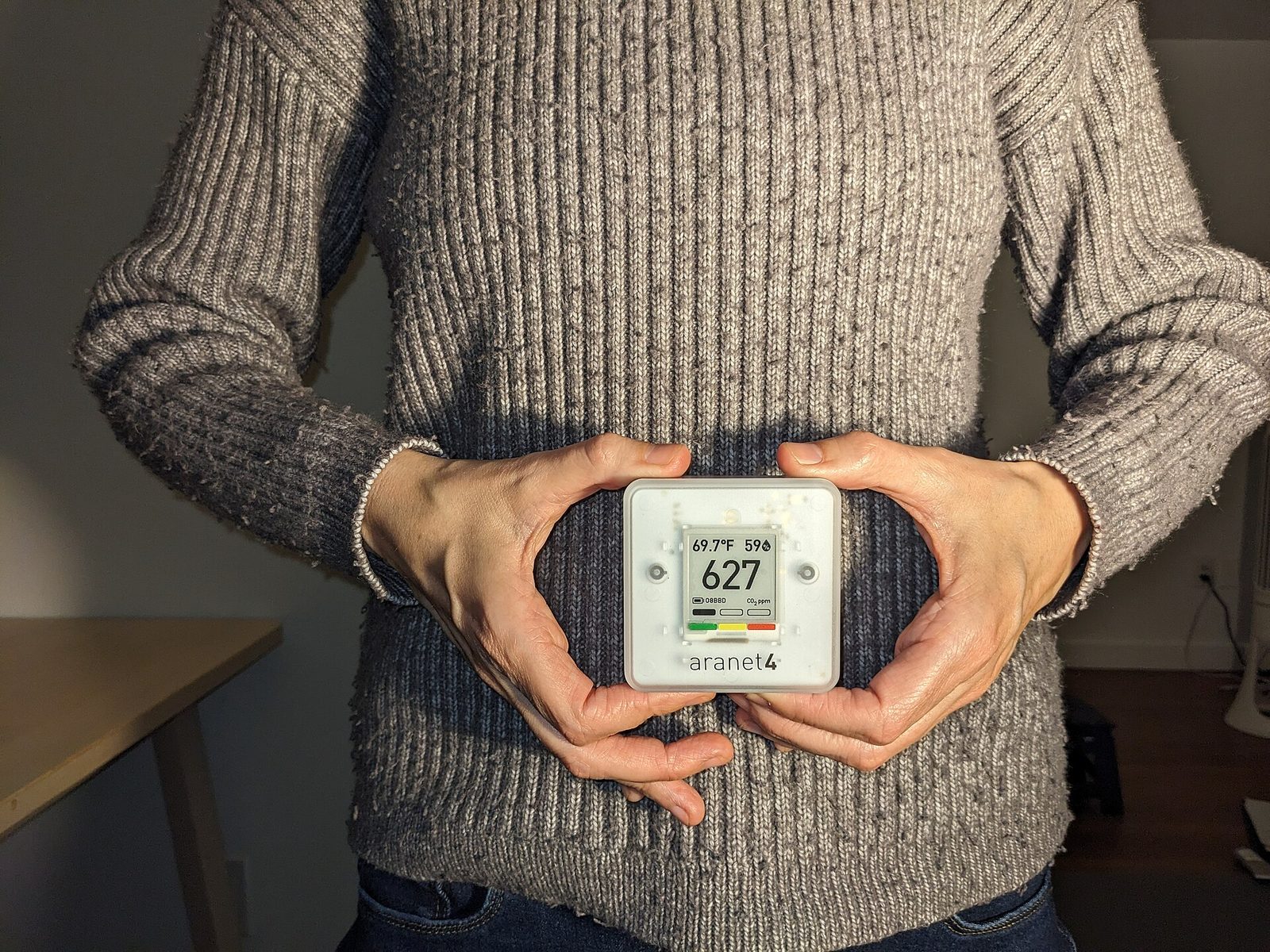
Airveda says its units are made in India and calibrated against Beta Attenuation Monitors, the reference method used at many official stations. The Aranet4, a popular NDIR CO2 benchmark, showed as currently unavailable on Amazon.in when we checked. We found no BIS mark or mandatory Indian certification for home air quality monitors, so treat a vague “certified” claim with caution unless the listing names the standard and the lab.
For most readers, a laser PM2.5 monitor in the ₹3,000 to ₹11,000 range is enough to check a purifier. Spend on NDIR CO2 only if stuffy closed rooms are your real problem.
Where to put it, and a 2-minute test
Place the monitor at about breathing height, roughly where your head is when sitting or sleeping. Keep it at least a metre from windows, AC vents and the purifier’s outlet, and well away from the gas stove. Keep it clear of an ultrasonic humidifier too: its mist, especially from tap water, can read as particles.
To check it responds properly, light an agarbatti a couple of metres away, or watch it during a tadka. PM2.5 should jump within seconds. Then put the purifier on high in the closed room and watch the number fall. A monitor that barely reacts isn’t worth trusting.
Quick buying checklist
- The spec sheet says “laser” for PM and “NDIR” for CO2, by name.
- It shows PM2.5 in µg/m³, not just an AQI number, and says which AQI scale it uses.
- CO2 can be recalibrated outdoors.
- It has an app or logging, so you can see overnight trends.
- It runs on mains power for long use; battery-only units suit spot checks.
- The stated error (±%) is published, and there is local service.
FAQ
Are cheap air quality monitors accurate?
Good enough to show whether air is getting better or worse, not lab-grade. Laser PM2.5 sensors are usually within about 10 to 20% of each other but read high in fog or above roughly 70 to 75% humidity. CO2 is only real if the sensor is NDIR; TVOC and formaldehyde readings are rough trends.
Which reading matters most on a home air quality monitor?
PM2.5 for smog, dust and cooking smoke, and to check whether a purifier is working. CO2 for stuffy closed rooms: outdoor air is about 420 ppm, and a room staying well above 1,000 ppm needs more fresh air.
Why does my monitor show a different AQI from the SAMEER app?
Many monitors use the US EPA AQI, while SAMEER shows India’s CPCB National AQI, which has different cut-offs. Official AQI also uses 24-hour averages from outdoor stations. Compare raw PM2.5 in µg/m³ instead.
What does eCO2 mean on an air quality monitor?
Equivalent CO2: an estimate calculated from a VOC sensor, not a measurement. It jumps with cooking or cleaning sprays. For real CO2 readings, buy a monitor whose spec sheet names an NDIR sensor.
How much should I spend on an air quality monitor in India?
About ₹3,000 to ₹11,000 gets a laser PM2.5 monitor that is enough to check a purifier. A monitor with laser PM2.5 plus true NDIR CO2 costs about ₹20,000 to ₹30,000, for example Airveda Pulse at ₹23,999 on its brand site in November 2026.
Bottom line
For smog and checking a purifier, a laser PM2.5 monitor is enough. For stuffy bedrooms, pay for NDIR CO2. Ignore exact TVOC numbers, compare raw µg/m³, and remember that fog makes cheap PM readings run high.
Photo: Foonarres, Wikimedia Commons, CC0 1.0. Prices checked on brand sites and Amazon.in on 14 November 2026 and will change. Accuracy figures are makers’ published specs and published field studies, not our own lab tests. AQI conversions are approximate.