Check the ISI mark, a thermal cut-out and a working safety valve, give it its own earthed 16A point, and read the warranty as three numbers.
Most geyser listings say the same things: 5 stars, glass-lined, 7-year warranty. It is still easy to end up with an instant geyser that goes lukewarm mid-bath, or a 25 litre tank heating water nobody uses. Three choices matter: storage or instant, how many litres, and which safety features do the real work.
This guide draws on BIS and BEE notifications, gas distributor guidelines, brand spec sheets and current listings, not hands-on testing.
Storage vs instant: what each one really is
In India an “instant” geyser isn’t tankless: it is a 1 to 6 litre tank with a powerful element, usually 3,000 W or more. A storage geyser is a larger insulated tank, typically 6 to 35 litres, with a 2,000 W element that heats slowly and keeps water hot for hours.
| Instant (1 to 6 L) | Storage (10 to 35 L) | |
|---|---|---|
| Typical power | 3,000 to 4,500 W | About 2,000 W |
| Best for | Kitchen sink, washbasin, one quick wash | Bathroom baths and showers |
| Hot water per heating | A few litres, then it slows to a trickle | The full tank, mixed with cold water |
| BEE star label | Not covered | Compulsory (6 to 200 L) |
| Wiring | Needs a 16A point | Needs a 16A point |
Once an instant geyser’s small tank is used up, it heats only as fast as its element allows: a 3,000 W element warms roughly 1.7 litres a minute from 15°C to 40°C. That is far less than a shower uses, and worst in a north Indian winter, when tap water is coldest.
What size geyser you need
Stored hot water is mixed with cold. With the tank at about 60°C and the tap at 20°C, a 40°C bucket is roughly half hot water, so a 15 to 20 litre bucket bath uses about 8 to 10 litres from the geyser. Buying guides broadly agree on these ranges:
| Use | Size to look at |
|---|---|
| Kitchen sink or washbasin | 1 to 3 L instant |
| 1 to 2 people, bucket baths | 6 to 10 L storage |
| 3 to 4 people, bucket baths | 15 L storage |
| Showers, or 5+ people bathing back to back | 25 L or more |
| Two bathrooms | One geyser per bathroom, not one big tank |
Size up for cold winters or a shared morning rush; size down for one person or a guest bathroom. Reheating a full tank takes roughly 15 to 30 minutes depending on the model (Racold lists about 18 minutes for its 25 L Omnis DG).
BEE stars: what they measure, and when they matter
A BEE star label is compulsory on storage geysers from 6 to 200 litres. It measures standing loss: the electricity a full tank uses over 24 hours just to stay hot, with no water drawn. It says nothing about heating speed, tank quality or safety.
The table changed on 1 July 2026. Under the new BEE plan (valid until 31 December 2027), a 5-star 15 L geyser can lose at most 0.346 kWh a day. A 1-star model can lose up to 0.507 kWh. That gap is worth about ₹1 to ₹1.50 a day at ₹6 to ₹9 per unit, and only if the geyser stays on all day. Pay for 5 stars on the daily-use bathroom geyser; don’t stretch for a guest bathroom.
Heating is the real cost: 2,000 W for 20 minutes is about 0.67 kWh, or ₹4 to ₹6 at ₹6 to ₹9 per unit. A timer on a 16A smart plug can automate switching it on before the bath; our smart plugs guide covers that.
The safety features that matter
ISI mark: compulsory, so check it properly
Under the Electrical Appliances for Domestic Water Heating (Quality Control) Order, 2025, storage geysers (IS 2082 and IS 302-2-21), instant geysers (IS 302-2-35) and immersion rods (IS 368) must carry the ISI mark under a BIS licence. This has applied since 1 March 2025 (September 2025 for micro units). Look for the ISI mark with a licence number (CM/L-…) on the unit or box; “ISI certified” with no number is a warning sign.
Thermostat plus a separate thermal cut-out
The thermostat holds the temperature you set; the thermal cut-out switches the element off if the thermostat fails. You want both, listed separately (sometimes as a “multiple safety system”).
Pressure-relief valve and pressure rating
The safety valve releases excess pressure, so never block, cap or remove it. In a high-rise or with a pressure pump, pick an 8 bar rating, as the AO Smith, Bajaj and Racold models named here list.
Tank lining, element and anode for hard water
Hard water, common in Jaipur, Bengaluru, Delhi NCR and Hyderabad, scales the element and corrodes the tank. Look for a glass-lined tank, an Incoloy or glass-coated element and a magnesium anode, which corrodes so the tank doesn’t. Have it checked at each service and replaced when worn, one more reason to pick a brand with service in your city. If you don’t know how hard your water is, the TDS test in our RO vs UV vs UF water purifier guide gives a rough first read.
Read the warranty as three numbers
A big “7-year warranty” on a box almost always covers the inner tank only. The real terms come in three parts:
- Tank: often 5 to 7 years. AO Smith lists 7 years on its SDS-GREEN and VAS Plus tanks, and Bajaj 7 years on the Shield Series New Shakti.
- Heating element: usually 2 to 6 years. AO Smith lists 3 years on the VAS Plus, or 2+2 years on the SDS-GREEN if you register it. Bajaj lists 6 years on the Shield Series.
- Whole product (thermostat, valve, electricals): usually 1 to 2 years.
Instant geysers follow the same pattern. Havells lists 5 years on the Instanio’s inner tank and 2 years on the rest. Free installation usually excludes hoses and removing an old geyser.
Installation: not a DIY job
- A dedicated, earthed 15/16A point. A 2,000 W geyser draws about 9 A, and a 3,000 W instant unit about 13 A. Never plug one into a 5A socket, an extension board or a multi-plug adapter.
- RCCB (ELCB) protection on the circuit, so a leakage fault trips the supply.
- Strong wall mounting. A 25 L geyser weighs about 10 to 12 kg empty (Crompton lists 9.5 kg for the Arno Neo 25 L, Racold 12.4 kg for the Omnis DG 25 L) and well over 30 kg full, so it needs proper anchors in a solid wall.
- Placed out of direct splash, with the switch outside the shower area where possible.
- Fitted by the brand’s technician or a licensed electrician. Don’t wire or rewire a geyser point yourself.
A geyser also can’t run on a normal home inverter during a power cut. It draws far more than a typical 700 to 1,100 VA unit can supply, as our inverter sizing guide explains.
Gas geysers: cheap to run, strict about placement
LPG and PNG geysers are cheap to run, but burning gas produces carbon monoxide, which you can’t see or smell.
IGL’s gas geyser guidelines say flueless geysers must not go in bathrooms or bedrooms. They belong in kitchens, utility areas or a weather-protected balcony with permanent ventilation of at least 45 × 45 cm to open air. Balanced-flue or external-flue models can go in a bathroom that meets its size and ventilation rules. Look for IS 15558, a flame-failure device, overheat protection and an oxygen-depletion sensor, and use your gas company’s approved installer.
Renting? Check the landlord’s geyser first
Before relying on an old geyser in a rented flat, check or ask the owner:
- Is there an ISI mark and a legible rating label?
- Is the safety valve intact, not rusted solid, capped or leaking constantly?
- Is it on its own earthed 16A point, and does the RCCB trip when you press its test button?
- Any warm switch or tingle from the tap? Stop using it and tell the owner in writing.
For gadgets you can take with you, see our renter-friendly smart home guide. The electric kettle and induction guide covers the same 16A socket problem for kitchen appliances. Setting up a new rented flat? Our first kitchen checklist for an Indian apartment covers the rest of the move-in basics.
What geysers cost in India
Winter demand and sales move these prices often, so compare the sale price, not the MRP. Listed prices we saw in October 2026:
| Model | Type | Price seen |
|---|---|---|
| Havells Instanio 3 L | Instant, 3,000 W | About ₹3,400 on Amazon.in (₹3,790 on Havells’ store) |
| AO Smith VAS Plus 15 L | Storage, 2,000 W, 5-star, 8 bar | About ₹6,600 on Amazon.in |
| Bajaj Shield Series New Shakti 15 L | Storage, 5-star, 8 bar | About ₹6,800 on Amazon.in |
| Crompton Arno Neo 25 L | Storage, 5-star | About ₹6,500 to ₹6,900 on Amazon.in |
| AO Smith SDS-GREEN 25 L | Storage, 5-star, 8 bar | About ₹11,400 on Amazon.in |
So a good 15 L storage geyser costs roughly ₹6,000 to ₹10,000 and a 25 L one ₹6,500 to ₹12,000, plus a few hundred rupees for installation and hoses.
FAQ
Which is better for a bathroom, a storage or an instant geyser?
Storage, usually 10 to 25 litres. An instant geyser holds only 1 to 6 litres, which suits a sink or washbasin but runs out fast for a bath or shower.
What size geyser do I need for a family of four?
A 15 litre storage geyser covers bucket baths for three to four people. If the family uses a shower or everyone bathes in one morning rush, choose 25 litres.
Does a BEE 5-star rating make the geyser heat faster?
No. Stars only measure how much heat a full tank loses over 24 hours, not heating speed or build quality.
Can I plug a geyser into a normal 5A socket?
No. A 2,000 W geyser draws about 9 A and a 3,000 W one about 13 A, so it needs a dedicated, earthed 16A point with RCCB protection, fitted by a licensed electrician.
Is it safe to put a gas geyser in the bathroom?
Not a flueless one. IGL’s guidelines allow only balanced-flue or external-flue models in a ventilated bathroom; flueless units belong in a ventilated kitchen, utility area or covered balcony.
Bottom line
Buy for how your household bathes: usually a 15 or 25 litre storage geyser in the bathroom, plus a small instant one at the kitchen sink if you want it. The ISI mark, a thermal cut-out, a working safety valve and a proper 16A point matter more than the stars or the warranty on the box.
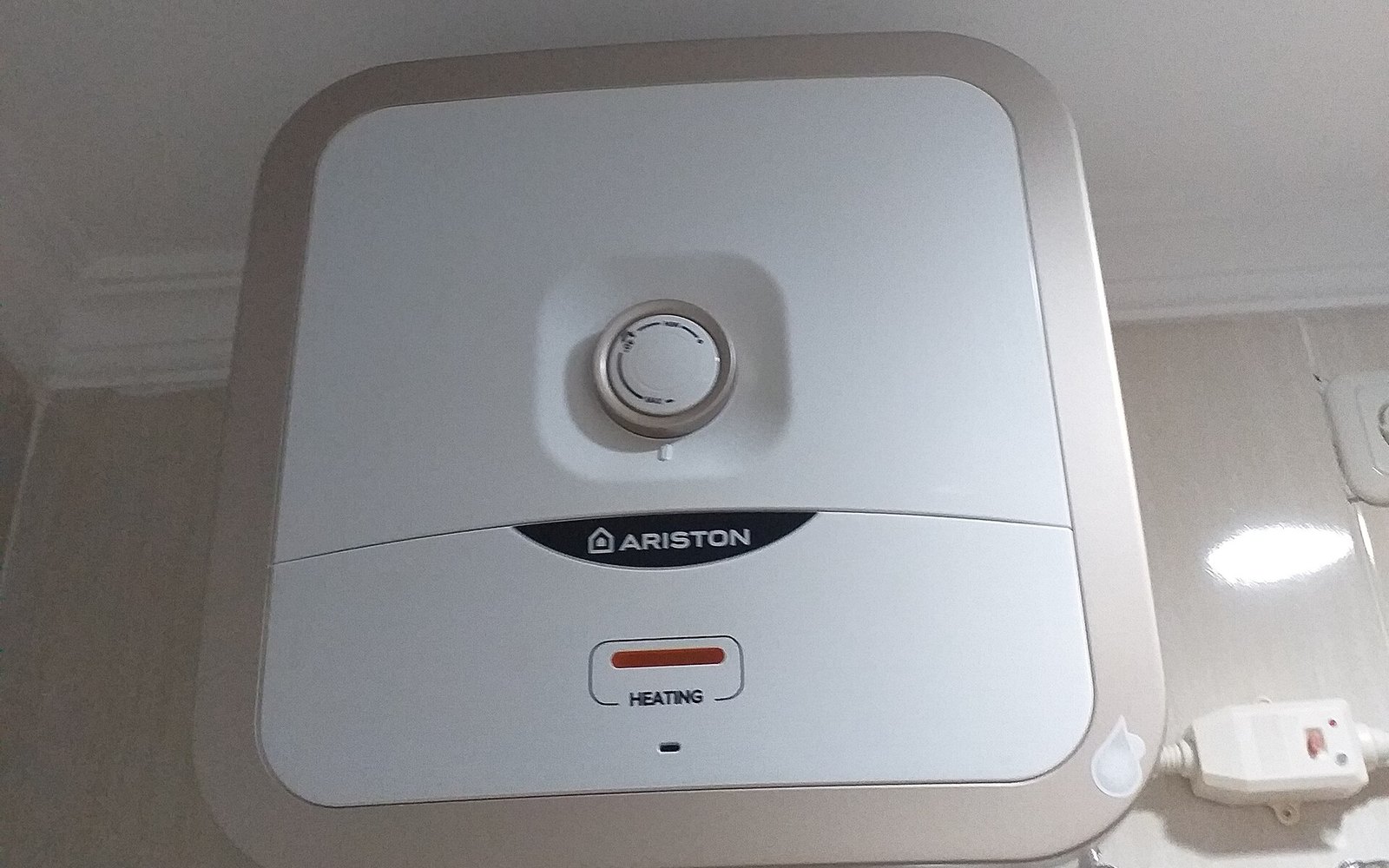
Photo: wall-mounted storage water heater in a tiled bathroom, by BOO109, from Wikimedia Commons, licensed CC BY-SA 4.0, cropped and resized. Star rating limits from the Ministry of Power notification S.O. 5970(E), 23 December 2025. Prices and warranty terms from brand and seller listings in October 2026. They will change.